
Parshvanath Aarti
श्री पार्श्वनाथ आरती
What is the Parshvanath Aarti?
Parshvanath Aarti The Parshvanath Aarti is a Jain devotional song for Bhagwan Parshvanath, the 23rd Tirthankara, recalling his birth in Varanasi, his calm under Kamatha's attack, and his liberation at Sammed Shikhar.
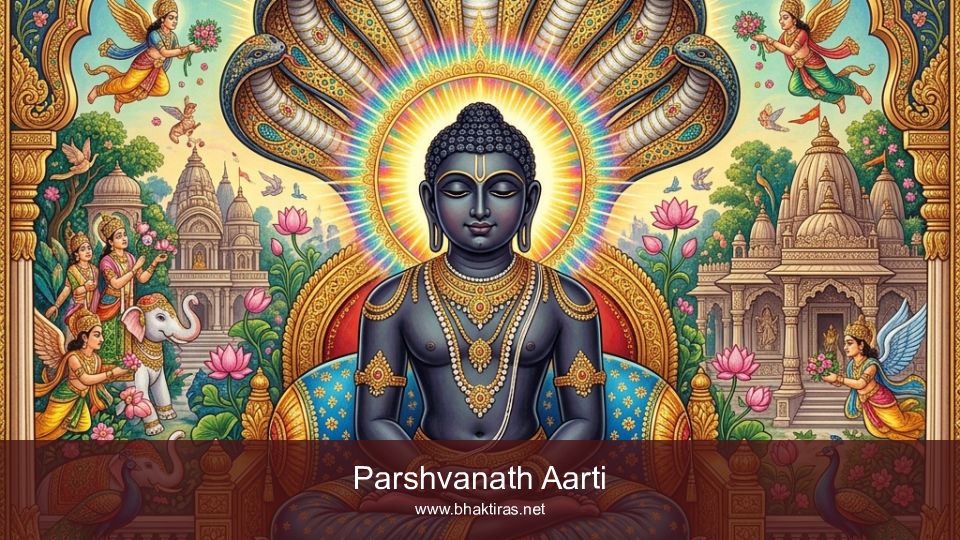
The Parshvanath Aarti honours Bhagwan Parshvanath, the twenty-third Tirthankara of the Jain tradition, whose images are recognised by the seven-hooded serpent held over his head. The verses walk through the five auspicious events of his life, from his birth in Varanasi as the son of King Ashvasena and Queen Vama to his liberation on Sammed Shikhar. It is sung as a Jina-bhakti offering, celebrating a soul that reached omniscience through self-conquest rather than asking a god for favours.
Parshvanath Aarti Lyrics (English)
Roman transliteration for easy chanting. Tap “Meaning” under any verse for the English translation.
Refrain
Om jai Paras Swami, Prabhu jai Paras Swami
Varanasi mein janme, tribhuvan mein naami
Ashvasen ke nandan, Vama ke pyare
Teisven Tirthankar, tum jag se nyare
Meaning
You are the son of King Ashvasena and the beloved child of Queen Vama. As the twenty-third Tirthankara you stand apart from everyone else in the world.
Vadi Vaishakh dutiya, garbh-kalyan hua
Paush krishna ekadashi, janm-kalyan hua
Meaning
Your descent into the womb, the garbha kalyanaka, is marked on Vaishakh Krishna Dwitiya, and your birth, the janma kalyanaka, on Paush Krishna Ekadashi.
Janmadivas hi diksha, dharan ki tumne
Bal-brahmachari ban, tap keena van mein
Meaning
You accepted renunciation on the very tithi of your birth. As a lifelong celibate you practised deep austerity in the forest.
Kamathasur ne tum par, ghor upsarg kiya
Ahichhatra mein tumne, pad kaivalya liya
Meaning
The demon Kamatha hurled a violent storm of torments at you, yet you stayed unshaken. At Ahichhatra you reached kaivalya, the state of complete knowledge.
Shri Sammedshikhar par, moksh-dham paya
Moksh-kalyan manakar, har man harshaya
Meaning
On the peak of Sammed Shikhar you attained the abode of liberation. Celebrating your moksha kalyanaka brings joy to every heart.
Param-sahishnu Prabhu ki, aarti ko aaye
Yahi 'Chandanamati' araj hai, tav gun mil jaayen
Meaning
We come to wave the lamp before the supremely patient Lord. Chandanamati's single request is that your qualities take root in us.
Meaning & Significance
The aarti is built around the five kalyanakas, the auspicious milestones that Jains mark in a Tirthankara’s life: conception, birth, renunciation, the attainment of omniscience, and final liberation. Rather than praising miracles, each line points to a stage of spiritual progress, so the song doubles as a short life-story of Parshvanath and a map of the path he walked.
The fourth verse carries the most familiar episode. As Parshvanath meditated, the vengeful being Kamatha sent a storm to break his concentration, but he remained still, and this scene is why his images show a serpent canopy above his head. The closing verse names its composer, Chandanamati, in the old bhanita style, and turns the whole offering into a prayer that the Lord’s patience and detachment pass into the singer.
How Do You Perform the Aarti?
- Prepare the lamp — Light a ghee or camphor lamp on a clean aarti thali before an image of Parshvanath. Many families first bow, fold their hands, and recite the Namokar Mantra.
- Stand with attention — Face the murti, steady your mind, and begin the refrain, moving the lamp in a slow clockwise circle before the Lord.
- Sing verse by verse — Follow the refrain with each numbered verse, keeping a gentle rhythm so others can join. The mid-line 'Swami' echo is sung together.
- Close with respect — End on the final verse, set the lamp down, and pass your palms over the flame's warmth. A quiet moment of reflection completes the offering.
What Are the Benefits of Singing This Aarti?
Singing the Parshvanath Aarti is above all an act of Jina-bhakti, keeping the Tirthankara’s example close to daily life.
- Steadies the mind: The verse on Kamatha's storm is a reminder to stay calm under provocation, which many find settling during difficulty.
- Teaches the life-path: Each stanza names a kalyanaka, so the singer quietly rehearses the stages of renunciation and self-knowledge that Jainism holds up.
- Builds a devotional routine: Sung at dawn or dusk, it gives a simple daily anchor for family worship and for temple gatherings.
- Encourages virtue: The closing plea to receive the Lord's qualities keeps the focus on cultivating patience, restraint, and detachment in oneself.
Who Wrote This Aarti?
This version of the aarti is composed in the Digambar Jain tradition and carries the signature name Chandanamati in its final verse, a common way for a poet to sign a devotional song. It is set to the same familiar tune used across North Indian aartis, which makes it easy for a congregation to sing together. Older and shorter Parshvanath aartis also circulate in Jain homes and temples, so you may hear other wordings alongside this one.
Frequently Asked Questions
What is the Parshvanath Aarti?
It is a Jain devotional song for Bhagwan Parshvanath, the 23rd Tirthankara, recalling his birth in Varanasi, his calm under Kamatha's attack, and his liberation at Sammed Shikhar.
Who is Bhagwan Parshvanath?
Parshvanath is the twenty-third Tirthankara of Jainism, born a prince in Varanasi to King Ashvasena and Queen Vama. His images are identified by a seven-hooded serpent held above his head.
Why is Parshvanath shown with a serpent?
The canopy of serpent hoods recalls the moment he stayed in meditation while the being Kamatha sent a violent storm against him, a scene of unshaken forbearance central to his story.
When is the Parshvanath Aarti sung?
It is sung during morning and evening worship at Jain temples and homes, and especially on Paush Krishna Ekadashi, remembered as the tithi of his birth and renunciation.
What does the aarti ask for?
Its closing line does not ask for wealth or favours but prays that the Lord's own qualities, his patience and detachment, take root in the devotee.
॥ ॐ जय पारस स्वामी ॥