
Chhinnamasta Aarti
श्री छिन्नमस्ता आरती
What is the Chhinnamasta Aarti?
Chhinnamasta Aarti The Chhinnamasta Aarti is a Hindi devotional song to the self-decapitated Mahavidya goddess Chhinnamasta of Rajrappa, praising the fierce mother who holds her own severed head and still protects her devotees.
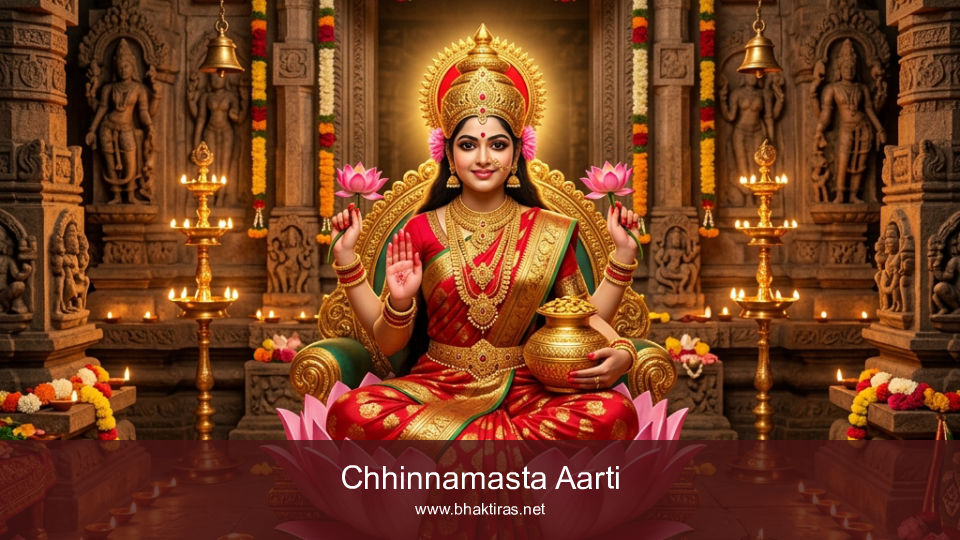
The Chhinnamasta Aarti honours one of the ten Mahavidyas, the goddess who cut off her own head so her blood could feed her two attendants and the world. Its refrain, Aaiye ham Chhinnamasta ki utaare aarti, invites the singer to wave the lamp before her. The lines link her to the famous Rajrappa shrine in Jharkhand and to her many other Shakti forms.
Chhinnamasta Aarti Lyrics (English)
Roman transliteration for easy chanting. Tap “Meaning” under any verse for the English translation.
Aaiye ham Chhinnamasta ki utaare aarti
Bhairavi bhi bhakti se din-raat charan pakhaarti
Meaning
Come, let us wave the lamp of aarti before Chhinnamasta. Even Bhairavi, in devotion, bathes the goddess's feet day and night.
Sang hai Vijaya Jaya ka rakt-dhaara beh rahi
Lok-mangal ke liye maa kasht bhaari seh rahi
Sir hatheli par rakh sada rakh bhakt-gan ko taarti
Meaning
Her companions Jaya and Vijaya stand beside her as a stream of blood flows. The Mother bears heavy suffering for the good of the world, and holding her severed head on her palm she keeps carrying her devotees across.
Refrain
Aaiye ham Chhinnamasta ki utaare aarti
Rakt-vasana sir vikhandit hast do tan shyaam hai
Chhinnamasta naam jiska Rajrappa dhaam hai
Jo Bhavani dusht daityon ka sada sanhaarti
Meaning
Clothed in red, her head severed, two-armed and dark of body, she is called Chhinnamasta and her abode is Rajrappa. As Bhavani she forever destroys cruel demons.
Jo Sati Durga Prachanda Chandika Bhuvaneshwari
Satva-raj-tam rupini jai Ambika Akhileshwari
Jo Karali Kalika hain aur Kamala Bhaarti
Meaning
She who is Sati, Durga, the fierce Chandika and Bhuvaneshwari, who takes form through the three gunas, hail Ambika, mistress of all. She is also Karali, Kalika and Kamala.
Aaiye maa ki sharan mein aur maatha tekiye
Dinata daaridra dukh ko door van mein phenkiye
Bhakt ke kalyaan mein janani kahaan kab haarti
Meaning
Come, take refuge with the Mother and bow your head. Throw your helplessness, poverty and grief far away into the forest. When has the Mother ever fallen short in the welfare of her devotees?
Meaning & Significance
Chhinnamasta is the sixth of the ten Mahavidyas, shown standing on the couple Kama and Rati, holding her own cut head in one hand and a sword in the other. Three jets of blood rise from her neck: two feed her attendants, Dakini and Varnini, and one feeds her own severed head. The aarti reads this startling image as a lesson in self-giving, the Mother who spends herself so that others may live.
The song also gathers her many names, from Durga and Chandika to Kali and Kamala, to say that a single Shakti stands behind all these forms. By closing with a plea to leave sorrow and want behind, the aarti turns a fierce tantric goddess into an approachable mother who never abandons those who bow to her.
How Do You Perform the Aarti?
- Set up the lamp — Light a ghee or oil diya, usually with an odd number of wicks, and keep some red flowers and incense ready before the image of Chhinnamasta.
- Begin with the refrain — Start by singing 'Aaiye ham Chhinnamasta ki utaare aarti' while slowly circling the lit lamp in a clockwise motion before the deity.
- Sing each verse in order — Move through the verses steadily, keeping the beat with a bell or a clap so the recurring refrain frames every stanza.
- Close and share the flame — End with the closing line, then pass your palms over the flame and touch them to your eyes and head, and offer the aarti flame to those present.
What Are the Benefits of Singing This Aarti?
Devotees sing the Chhinnamasta Aarti to seek courage, self-control and the Mother’s protection.
- Builds inner courage: Focusing on a goddess who conquers even herself is meant to steady the mind against fear and hesitation.
- Encourages self-mastery: The image of controlling one's own life-force is read as a call to rein in restless desires and impulses.
- Invites protection: As a fierce Mahavidya, Chhinnamasta is invoked to guard devotees from harm and hostile forces.
- Relieves want and sorrow: The closing verse asks the Mother to cast away poverty and grief, so the aarti is sung in times of hardship.
- Deepens Shakta devotion: Regular singing keeps the goddess and her Rajrappa shrine present in daily worship and steadies the mood before meditation.
Who Wrote This Aarti?
Like most Hindi aartis in common use, this text is traditional and its composer is not recorded. It circulates through temple handbooks and aarti collections tied to the Rajrappa Chhinnamasta shrine in Jharkhand, and small wording differences appear between printings. The version here follows the widely shared reading that opens with ‘Aaiye ham Chhinnamasta ki utaare aarti’.
Frequently Asked Questions
What is the Chhinnamasta Aarti?
The Chhinnamasta Aarti is a Hindi devotional song to the self-decapitated Mahavidya goddess Chhinnamasta of Rajrappa, praising the fierce mother who holds her own severed head and still protects her devotees.
Who is the goddess Chhinnamasta?
Chhinnamasta is the sixth of the ten Mahavidyas, shown holding her own severed head while three streams of blood feed her head and her two attendants. She stands for self-sacrifice and control of the life-force.
Where is the main Chhinnamasta temple?
Her most famous shrine is at Rajrappa in Jharkhand, where the Bhairavi and Damodar rivers meet. The aarti names Rajrappa directly as her dham, or abode.
When should the Chhinnamasta Aarti be sung?
It is sung on Chhinnamasta Jayanti, on Amavasya and Chaturdashi nights, and during Navratri or any personal worship of the Mahavidyas. Many devotees also recite it on Tuesdays.
Why does Chhinnamasta hold her own head?
In the well-known story she cut off her head so her blood could feed her hungry companions. The aarti treats this as an image of a mother who gives herself completely for the welfare of others.
॥ इति श्री छिन्नमस्ता आरती संपूर्णम् ॥