
Vithoba
विठोबा
Vithoba, also called Vitthal, is the presiding deity of Pandharpur in Maharashtra and a form of Krishna and Vishnu. He is the beloved God of the Varkari tradition, shown standing simply on a brick with both hands resting on his hips, waiting patiently for every devotee who comes to him with love.
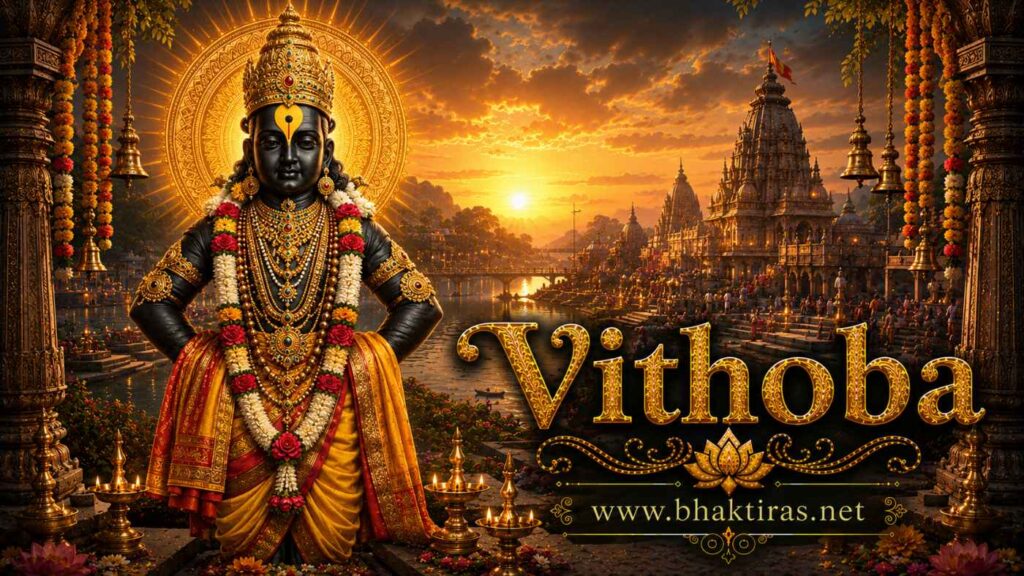
Who Is Vithoba?
Vithoba is the God of Pandharpur, a small town on the banks of the Chandrabhaga river in Maharashtra. For countless Marathi families he is not a distant lord seated on a high throne but a warm presence who waits for them, upright and patient, both hands resting on his hips. The people call him Vitthal, Panduranga, Pandharinath, and most tenderly of all, simply Vithai – as one would call a mother or a close friend.
He is understood as a form of Krishna, and therefore of Vishnu, though the way he is loved in Maharashtra has a flavour all its own. There is no elaborate weaponry in his hands, no display of majesty. He stands quietly on a brick, dark of complexion, ready to receive whoever comes. This simplicity is the whole point: Vithoba is the God who has set aside grandeur so that the humblest farmer, weaver, potter, or servant can approach him without fear.
Around this image grew one of the most tender devotional currents in all of India – the Varkari movement. For roughly eight hundred years, poet-saints and ordinary villagers alike have walked to Pandharpur singing his name, and their love shaped a faith that measures a person not by caste or learning but by the sincerity of the heart.
To understand Vithoba is to understand a God who chose to wait. And to know why he waits, one has to hear the story of a young man named Pundalik.
The God Who Stands on a Brick
Pundalik and his parents
There once lived in a village a young man named Pundalik. In his early years he was careless with his aged mother and father, but a change of heart came over him, and he devoted himself entirely to their care. He fed them, bathed their tired feet, and served them with such attention that serving them became his whole practice of faith. For Pundalik, tending to his parents was tending to the divine.
The Lord arrives, and is asked to wait
So complete was this devotion that Vithoba himself, moved by it, came to Pundalik’s door to give him a blessing. But Pundalik was in the middle of serving his parents and would not leave them, not even for the Lord standing before him. Without turning fully away, he tossed a brick behind him for the Lord to stand upon, and asked him to wait a little while until his duty was done.
And he waits there still
Another God might have taken offence. Vithoba did not. He was so touched by a devotion that placed loving service above even his own presence that he stood upon the brick and waited – hands upon his hips, in no hurry at all. And there, at Pandharpur, he stands to this day. The pose that millions cherish is the pose of a Lord who is content to wait for love. This is why the brick is holy, and why Vithoba is remembered as the God who honours quiet, faithful duty above grand ceremony.
Vithoba as Krishna and Vishnu
Though Pandharpur has its own distinct devotion, Vithoba has long been recognised as a form of Krishna, and through Krishna, of Vishnu. Devotees see in him the same dark-hued, flute-loving cowherd who danced with the gopis and lifted Govardhan – only here he has come to rest in Maharashtra, standing still and waiting rather than playing.
The link to Krishna is deepened by the presence of Rukmini at his side, for she is the queen of Krishna in Dwarka. Many devotees also address him as Hari, a name of Vishnu, and the great Varkari poets moved easily between the language of Vishnu, Krishna, and Vitthal, treating them as one and the same beloved reality.
What Pandharpur added to this inheritance is accessibility. The Krishna of scripture performs cosmic feats; the Vitthal of Pandharpur simply stands on a brick, arms akimbo, meeting each pilgrim eye to eye. It is the same divinity, brought close enough to touch. This is why a farmer from a distant village can call him maza Vitthal – my Vitthal – with complete confidence that the God belongs to him personally.
The Varkari Tradition and the Wari Pilgrimage
The word Varkari means one who makes the wari, the regular pilgrimage to Pandharpur. For centuries the Varkaris have lived a gentle discipline: they keep the name of Vitthal on their lips, wear a small necklace of tulsi beads, avoid meat and intoxicants, and above all treat every other Varkari as a brother or sister, without regard for caste or standing. Their faith is quiet, sung more than argued, and carried in the feet as much as the heart.
Twice a year, but most gloriously in the month of Ashadha, hundreds of thousands of Varkaris set out on foot for Pandharpur in great walking processions called dindis. At the centre of each march moves a palkhi, a palanquin carrying the silver padukas – the sacred sandals – of the saint-poets. The palkhi of Dnyaneshwar sets out from Alandi and that of Tukaram from Dehu, and along the roads of Maharashtra these processions swell with pilgrims until the fields seem to be walking.
For days they travel, singing abhangas and calling out “Vitthal, Vitthal” until the two syllables become their breath. Dust, heat, and rain mean little; the road itself becomes a form of worship. Their goal is to reach Pandharpur by Ashadhi Ekadashi, and again at Kartiki Ekadashi, to stand at last before the God who has been waiting for them all this while. When the Chandrabhaga comes into view, weary walkers weep, for the waiting is over on both sides.
The Saint-Poets of Vitthal
Much of what the world knows of Vithoba comes through the voices of Maharashtra’s saint-poets, who poured their love for him into songs called abhangas. These were not written in scholarly Sanskrit but in plain, tender Marathi, so that a shepherd could understand them and a child could sing them. Through this poetry the God of Pandharpur entered the daily life of ordinary people.
Dnyaneshwar, in the thirteenth century, opened the door with his luminous commentary on the Gita and his devotion to Vitthal. Namdev, a tailor by trade, sang of the Lord with such intimacy that Vitthal became his companion at meals and in sorrow. Eknath gathered and cared for this tradition, cleaning and preserving the earlier saints’ words. Tukaram, a struggling grain-seller, gave the movement some of its most piercing and honest verses, arguing, pleading, and rejoicing with his Vitthal as with a familiar friend.
Among them shines Janabai, a servant woman in Namdev’s household, who sang that Vitthal himself came to help her grind grain and sweep the floor. Her poetry insists that the God of Pandharpur does not stand above the lowly but works beside them. Together these saints made one truth unmistakable: at Pandharpur, love outranks learning, and the door is open to all.
Rukmini – Rakhumai of Pandharpur
Beside Vithoba, in her own shrine within the temple complex, stands his consort Rukmini, known lovingly in Maharashtra as Rakhumai. As Vithoba is the form of Krishna, Rukmini is his queen from Dwarka, and the two are worshipped together as the divine pair who preside over Pandharpur.
Rakhumai is not a mere attendant to the main image; she has her own devotees, her own offerings, and her own place in the songs of the saints. Pilgrims who come to see Vitthal make sure also to stand before Rakhumai, for a visit to Pandharpur is understood as darshan of both. In the warm, family-centred devotion of the Varkaris, she is the mother of the household – approachable, affectionate, and near.
Their standing together completes the picture of Pandharpur as a home rather than a mere temple. Vithoba waits, Rakhumai waits beside him, and the devotee who arrives is received not as a stranger seeking favour but as a child returning to parents who have kept the door open.
Iconography and Symbols
Hands on the hips
Vithoba’s most recognisable feature is his posture: both hands rest calmly on his hips, arms akimbo. There is no raised weapon, no dramatic gesture. The pose speaks of ease, patience, and welcome – a God at rest, in no hurry, glad simply to be met.
The brick underfoot
He stands upon a single brick, the very brick that Pundalik once tossed for him. That humble object is treasured as the root of the whole tradition, a reminder that the Lord came running for the sake of a devotee’s love and was content to wait upon a scrap of clay.
The simple standing form
Dark of complexion and upright in stance, Vithoba is deliberately plain. His simplicity is his message: the divine has made itself small and near so that anyone, of any station, may approach. Nothing about his image is designed to intimidate.
Rakhumai and the Chandrabhaga
Around the central image are the shrine of Rukmini and, just beyond the town, the crescent bend of the Chandrabhaga river. Pilgrims bathe in its waters before their darshan, so that river, consort, and Lord together form the sacred landscape of Pandharpur.
How Vithoba Is Worshipped
Devotion to Vithoba is remarkably simple, in keeping with the God himself. It leans less on elaborate ritual and more on love, song, and the company of fellow devotees. The following are the ways in which his worship most naturally unfolds.
- Chanting his name – repeating “Vitthal Vitthal” or “Jai Hari Vitthal” quietly through the day, so that the name becomes as constant as the breath.
- Singing abhangas – the Marathi devotional songs of the saint-poets, sung alone at home or together in a hall, often with cymbals and the one-stringed ektara.
- Undertaking the Wari – joining the great walking pilgrimage to Pandharpur, especially for Ashadhi and Kartiki Ekadashi, as the highest expression of a Varkari’s love.
- Taking darshan at Pandharpur – standing before Vithoba and Rakhumai, and where custom allows, touching the Lord’s feet, an intimacy few temples permit.
- Bathing in the Chandrabhaga – a dip in the sacred river before darshan, washing away the dust of the road and of the heart.
- Wearing tulsi beads – the small necklace that marks a Varkari, along with a life of simplicity, honesty, and kindness to all.
Prayers and Mantras
The devotion of Vithoba is above all a devotion of the name. The Varkaris teach that the simplest calling of “Vitthal” is itself the highest prayer, needing no elaborate procedure. Still, a few sacred forms are cherished, chanted softly while walking, working, or sitting in worship.
Devanagari: ॐ श्री विठ्ठलाय नमः
Transliteration: Om Shri Vitthalaya Namah
Meaning: I bow to Shri Vitthal, the Lord of Pandharpur who stands upon the brick, waiting with love for all who seek him. To utter his name is itself to draw near to him.
Frequently Asked Questions about Vithoba
Who is Vithoba?
Vithoba, also called Vitthal, is the presiding deity of Pandharpur in Maharashtra and a form of Krishna and Vishnu. He is the beloved God of the Varkari devotional tradition, known for his simple standing image with both hands on his hips, and for meeting every devotee with warmth, as family.
Why does Vithoba stand on a brick?
The brick belongs to the story of Pundalik, a devotee so absorbed in serving his aged parents that when the Lord came to bless him, he tossed a brick for him to wait upon while he finished his duty. Touched by such devotion, the Lord stood on that brick and has been waiting there ever since.
What is the Pandharpur Wari?
The Wari is the great walking pilgrimage to Pandharpur. Hundreds of thousands of Varkaris march for days in processions called dindis, following palkhis that carry the sandals of saints like Dnyaneshwar and Tukaram, singing abhangas and chanting "Vitthal, Vitthal" until they reach the temple on Ashadhi or Kartiki Ekadashi.
Is Vithoba the same as Krishna?
Yes, Vithoba is understood as a form of Krishna, and therefore of Vishnu. Devotees see in him the same dark-hued Lord, now standing quietly at Pandharpur with his consort Rukmini beside him. He is also called Hari, a name of Vishnu, and the saint-poets treated all these forms as one.
Who is Vithoba's consort?
Vithoba's consort is Rukmini, lovingly called Rakhumai in Maharashtra. She is the queen of Krishna from Dwarka and stands in her own shrine beside Vithoba at Pandharpur. Pilgrims take darshan of both, for a visit to Pandharpur is understood as seeing the divine pair together.
Who are the saint-poets connected with Vithoba?
The great Varkari saints include Dnyaneshwar, Namdev, Tukaram, Eknath, and Janabai. Writing in plain Marathi rather than Sanskrit, they poured their love for Vitthal into songs called abhangas, and made the devotion of Pandharpur open to people of every caste and calling.
When are the main festivals of Vithoba?
The two most sacred days are Ashadhi Ekadashi, in the month of Ashadha, and Kartiki Ekadashi, in Kartik. On these days the Wari reaches Pandharpur and the town fills with pilgrims. Ashadhi Ekadashi in particular is the climax of the Varkari year.
Where is the Vithoba temple located?
The main temple of Vithoba is at Pandharpur, on the banks of the Chandrabhaga river in the Solapur district of Maharashtra. Pilgrims traditionally bathe in the Chandrabhaga before entering to take darshan of Vithoba and Rakhumai.
May Vithoba, who waits upon his brick at Pandharpur with hands upon his hips, receive you as his own and keep his name forever on your lips – Vitthal, Vitthal.