
Manasa Devi
मनसा
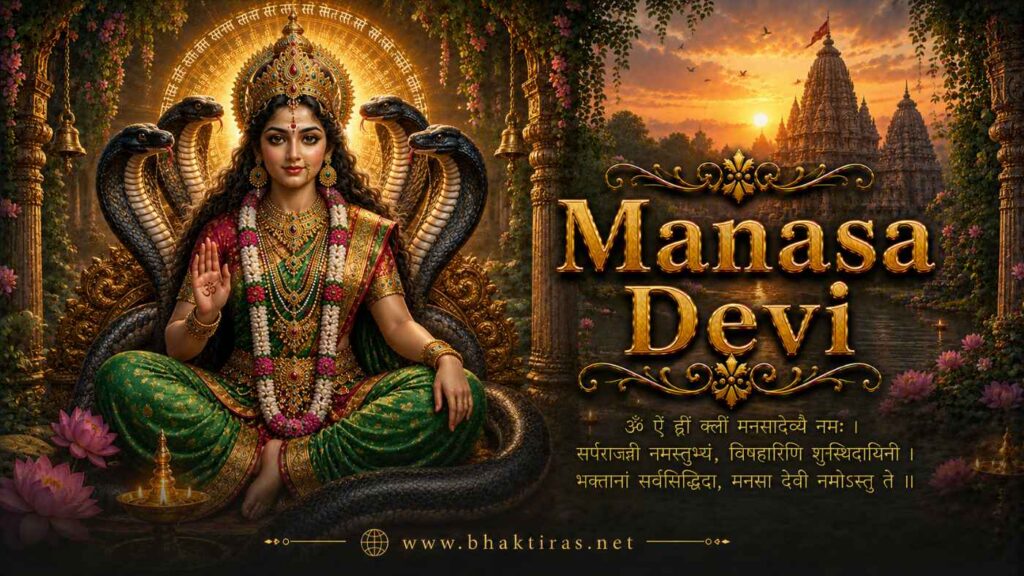
Manasa Devi is the Hindu goddess of snakes, worshipped across Bengal, Assam, Bihar and eastern India for protection from snakebite and for the gift of fertility and prosperity. Said to be born from the mind of Shiva, she is honoured most during the rainy months, when serpents are active and her grace is sought by every household.
Who Is Manasa Devi?
In the villages of Bengal, Assam and Bihar, where paddy fields flood during the monsoon and snakes slip out of their holes with the rising water, one goddess is called upon above all others. Manasa Devi rules over serpents. When she is pleased, no snake will strike; when she is neglected, her displeasure was believed to arrive through a fang in the dark. For farming families who lived close to the earth and its dangers, her worship was not a matter of choice but of survival.
Her name comes from the Sanskrit word manas, meaning the mind or the inner thought. The old stories say she was born not from a womb but from the mind of Shiva himself, and so she carries the name Manasa – the one who arose from thought. She is also called Vishahara, the remover of poison, and Nageshwari, the mistress of snakes.
Manasa belongs to a special class of Hindu deities who live in the space between the great Puranic gods and the earth-close spirits of the village. She is worshipped in temples, but just as often at a simple clay mound under a tree, or before a branch of the sij cactus planted in her honour. Farmers, fishermen, snake-charmers and mothers all turn to her – each asking for the thing they most need protected.
She is a goddess of two faces. One face is stern, quick to anger when slighted, willing to test even the proudest devotee. The other face is deeply maternal, granting children to the childless and standing guard over households through the dangerous months. To know Manasa is to hold both of these together.
Daughter of Shiva, Sister of the Serpent King
The tale of Manasa’s birth is told in many ways, and the folk versions delight in her difficult, half-accepted place among the gods. In the most beloved account, her origin lies in the mind of Shiva. A drop of his thought, or in some tellings his seed fallen upon a lotus leaf, took shape and reached the underworld realm of the serpents, where the great snake-mother Kadru received and raised her. So Manasa is the daughter of Shiva by the father’s line and a child of the serpent world by upbringing – a bridge between the high heaven of the gods and the coiled darkness beneath the earth.
Because of this, her brother is Vasuki, the king of all serpents – the same mighty snake who served as the churning-rope when gods and demons churned the ocean of milk. Manasa is bound to the snake clans not only by devotion but by blood, and it is Vasuki who first taught her the healing arts and the power to draw poison out of a wound.
The stories do not hide the pain in her family life. Shiva’s wife would not fully accept this daughter born outside her own household, and there are tender, sorrowful episodes in which the young goddess is turned away and must make her own place in the world. In one well-loved episode she loses an eye to the anger of a jealous elder, which is why some images show her as one-eyed. This wound is not shameful in the folk memory – it marks her as a goddess who earned her power the hard way, through rejection and endurance rather than easy blessing.
She was later given in marriage to the ascetic sage Jaratkaru. Their union produced a son of great destiny – the boy Astika, whose story would one day save the entire race of serpents from destruction.
The Goddess of Snakes and Their Season
Manasa’s worship follows the calendar of the snakes. In the hot months before the rains, serpents keep to their burrows. But when the monsoon breaks and water fills their holes, cobras and kraits move onto the higher ground where people live and work. Deaths from snakebite rose sharply in these weeks across rural Bengal and Bihar, and it was exactly then that Manasa’s power was felt to be at its height.
Her two great festivals fall in this rainy stretch. Nag Panchami, kept across much of India, honours the serpents directly – milk is offered, and no digging or ploughing is done, so that no snake in the earth is harmed. In Bengal and Assam, the wider Manasa Puja is held through the monsoon month, often reaching its peak in the weeks of Shravan and Bhadra. Households set up her image or her sij branch, and singers perform long recitations of her story through the night.
What devotees ask of her is plain and urgent. They ask that the children playing in the fields come home unbitten. They ask that the harvest be spared, that snakes leave the grain-stores in peace, and that the family multiply. Manasa gives fertility as readily as she withholds poison – the same power that can send a serpent can also grant a longed-for child. Snake-charmers, who handle cobras for a living, count her as their special guardian and will not begin their work without a word to her.
To worship her is to make peace with a real danger rather than pretend it away. That honesty is part of why her devotion has held so firmly for so long.
The Legend of Behula and Chand Sadagar
The Merchant Who Would Not Bow
The heart of Manasa’s worship is a single great legend, sung in the Manasamangal Kavya. Chand Sadagar was a wealthy merchant of the land, and a firm devotee of Shiva. When Manasa demanded that he worship her too, he refused outright. He would bow to the great gods, he said, not to this upstart daughter of the serpents. His refusal was proud and absolute, and it set in motion a long and bitter contest between a mortal man and an angry goddess.
The Goddess Strikes
Manasa answered his defiance with grief. She sank his trading ships and drowned his fortune at sea. One by one, she took the lives of his six sons through snakebite. Still Chand would not yield. When his seventh and youngest son, Lakhindar, was to be married, the merchant built a wedding chamber of iron, sealed against every crack, so that no serpent could reach the boy. But Manasa found the one small gap left by fate, and on the wedding night a snake slipped in and struck Lakhindar dead beside his bride.
Behula's Long Journey
The bride was Behula, and she refused to accept her husband’s death as final. Following the custom, his body was set on a raft and floated down the river. Behula went with it. For many days and nights she journeyed on that raft beside her dead husband’s swelling, decaying body, past mockery and danger, never turning back. Her devotion was not to a god who had rewarded her, but to a love she would not surrender. She floated on until she reached the very court of the gods in heaven.
The Grace That Was Won
In heaven Behula danced before the assembled gods, and her grief and her skill moved them utterly. They pleaded her case with Manasa. The goddess agreed to restore Lakhindar and the other drowned sons to life, and to return the merchant’s lost wealth – but on one condition. Chand Sadagar must at last offer her worship. The proud merchant, his family given back to him, finally set down flowers before her, though the old tale says he did it with his left hand, his face turned away, unwilling even now to fully surrender. It was enough. Through Behula’s unbending love, Manasa’s worship was established in the world, and the story has been sung in Bengali villages ever since.
Iconography and Symbols
The Canopy of Snakes
Manasa is almost always shown with serpents. They rise behind her head in a spreading hood, coil around her arms, or gather at her feet. The snakes are not her enemies but her subjects and her children – a sign that the very danger people fear is under her command.
The Lotus Seat
She is often seated on a full-blown lotus, or holds one in her hand. The lotus, rising clean from muddy water, marks her as a true Devi despite her half-accepted birth, and links her to Padmavati, one of her gentler names, meaning ‘she of the lotus’.
The Single Eye
In some images and in the folk memory Manasa is one-eyed, having lost an eye to the anger of a jealous elder in her youth. Far from a flaw, this marks her as a goddess who suffered and endured, and it sets her apart from the flawless faces of the great goddesses.
The Swan and the Sij Branch
She is sometimes shown with a swan, a bird of grace and discernment. In village worship she often has no carved image at all – instead a branch of the thorny sij cactus is planted and honoured as her living presence, a plant that guards the home much as she does.
How Manasa Devi Is Worshipped
Manasa’s worship is warm, home-centred and tied closely to the rhythm of the rains. It ranges from grand village pujas to the quiet daily care of a household shrine. Common practices include:
- Installing a branch of the sij cactus or a clay image of the goddess in the courtyard during the monsoon, honoured as her living seat.
- Keeping Manasa Puja through the rainy month, often peaking in Shravan and Bhadra, with offerings of milk, bananas, and seasonal flowers.
- Observing Nag Panchami by offering milk to snakes and their images, and by leaving the earth undug so that no serpent is harmed.
- Reciting or hearing the Manasamangal – the epic of Behula and Chand Sadagar – sung through the night by village performers.
- Praying for the safety of children and cattle, for a good harvest, and for the blessing of children in the family.
- Snake-charmers and healers seeking her grace before their work, asking protection over those who handle serpents.
- Simple daily reverence at a home shrine, with a lamp lit and a soft repetition of her mantra during the dangerous weeks of the rains.
Temples and Sacred Sites
Manasa is honoured more at countless small village shrines than at a handful of famous temples, yet several sites carry her name across the east. Notable places of her worship include:
- The Manasa Devi shrines of Bengal, scattered through the villages of West Bengal and Bangladesh, often no more than a mound and a sij branch under an old tree.
- Temples across Assam, where the goddess is deeply woven into local worship and the monsoon festivals draw large village gatherings.
- Shrines through Bihar and Jharkhand, where Manasa Puja is a fixed part of the rainy-season calendar.
- The Manasa Devi temple at Haridwar in the northern hills, set on a hilltop and reached by ropeway, is one of the best known bearing her name, though its character differs from the eastern folk shrines.
- Household and roadside shrines everywhere in the east, kept alive not by priests but by the daily devotion of ordinary families through the season of snakes.
Prayers and Mantras
Manasa is invoked with short, protective mantras, repeated for safety from poison and for the wellbeing of the home. Her seed-mantra gathers several sacred syllables around her name. A widely used form is given below.
Devanagari: ॐ ह्रीं श्रीं क्लीं ऐं मनसा देव्यै स्वाहा
Transliteration: Om Hreem Shreem Kleem Aim Manasa Devyai Svaha
Meaning: This mantra calls upon Manasa Devi through her sacred seed-sounds – hreem for divine power, shreem for abundance, kleem for grace and kleem’s drawing warmth, and aim for wisdom – offering the whole invocation into her keeping with the word svaha. It is a prayer for her protection from all poison and for her blessing of prosperity and safe increase upon the household.
Frequently Asked Questions about Manasa Devi
Who is Manasa Devi?
Manasa Devi is the Hindu goddess of snakes, worshipped mainly in Bengal, Assam, Bihar and eastern India. She protects her devotees from snakebite and poison and grants fertility and prosperity. Born from the mind of Shiva, she is both a fierce and a deeply motherly goddess, honoured above all during the monsoon.
Why is she worshipped in the monsoon?
During the rains, water floods the burrows of snakes and drives cobras and kraits onto the higher ground where people live, so snakebite deaths rose sharply in these weeks. Manasa's power over serpents is felt to be strongest then, so her great festivals and household pujas fall through the rainy months.
Whose daughter is Manasa Devi?
Manasa is regarded as the daughter of Lord Shiva, born from his mind or thought rather than from a womb, which is why she carries the name Manasa. She was raised in the serpent world and is the sister of Vasuki, the king of the snakes, binding her to both the gods and the serpents.
What is the legend of Behula and Chand Sadagar?
It is the central story of the Manasamangal. The merchant Chand Sadagar refused to worship Manasa, so she took his sons and fortune. When his son Lakhindar died of snakebite on his wedding night, his bride Behula floated with the body to heaven, and her devotion won the goddess's grace and her husband's life.
What does Manasa Devi protect against?
Manasa's chief gift is protection from snakes, snakebite and poison of every kind, which is why she is called Vishahara, the remover of poison. Beyond this she guards children and cattle, watches over the harvest, and blesses families with fertility and prosperity through the dangerous season of the rains.
Why is Manasa Devi sometimes shown as one-eyed?
The folk stories say Manasa lost an eye in her youth to the anger of a jealous elder in her difficult, half-accepted family. Rather than a flaw, her single eye marks her in village memory as a goddess who suffered rejection and earned her power through endurance, which is part of why devotees hold her so dear.
What are her other names?
Manasa is known by several loving names. She is Vishahara, the remover of poison; Nageshwari, mistress of snakes; Padmavati, she of the lotus; and Nagini Mata, the serpent mother. Each name carries one of her aspects, from her command over serpents to her gentle, lotus-seated grace.
Through the loud months of the rains, when the fields flood and the snakes come close, Manasa Devi keeps watch over the homes that call her name – stern to the proud, gentle to the faithful, and ever the mother who draws out the poison.