
Lord Chitragupta
चित्रगुप्त
Lord Chitragupta is the divine record-keeper of karma who serves in the court of Yama, the god of death. Born from Lord Brahma, he writes every soul's good and bad deeds in his register, the Agrasandhani, and helps decide each being's reward or punishment after death.
Who Is Lord Chitragupta?
Lord Chitragupta is the celestial accountant of the cosmos – the deity who keeps a careful record of every deed done by every living being. He serves in the court of Yama, the god of death and dharma, and when a soul arrives after death it is Chitragupta’s ledger that is opened. Nothing is missed and nothing is exaggerated; his account is exact, which is the very meaning hidden in his name, often read as the hidden or secret picture of each life.
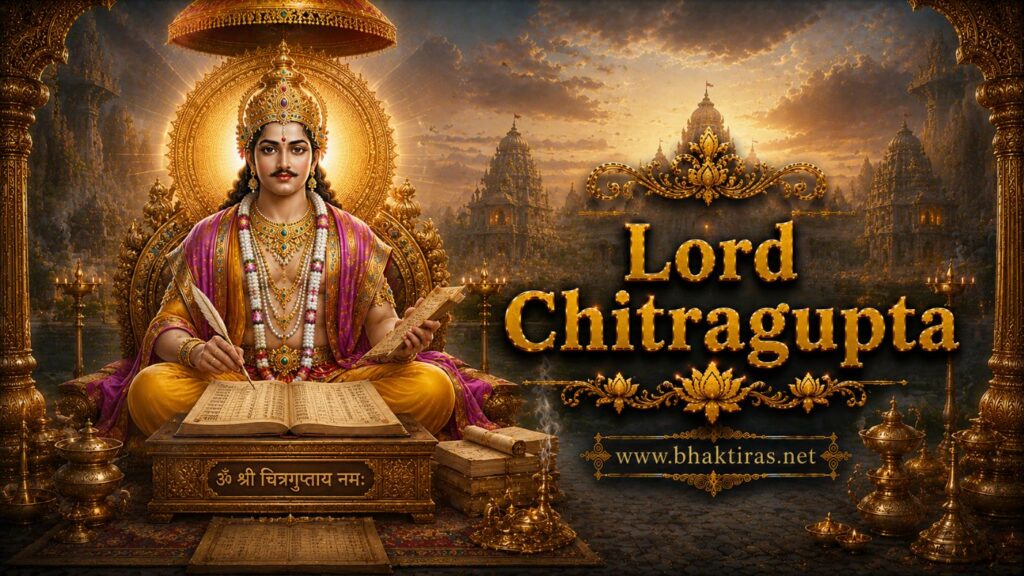
He is pictured as a dignified scribe, calm and unhurried, holding a pen in one hand and a register or palm-leaf book in the other. Where Yama pronounces judgment, Chitragupta supplies the evidence – the complete tally of a person’s virtues and faults, drawn up over an entire lifetime. In this sense he stands for the principle that karma is remembered, that our actions leave a trace, and that justice after death rests on truth rather than favour.
Beyond his role in Yama’s court, Chitragupta is deeply loved as the divine ancestor and patron of the Kayastha community, who honour him as the source of the arts of writing, record-keeping and administration. His worship is warm and personal, especially on his dedicated festival day, when families thank him for the gift of learning and pray for an honest account of their own lives.
Iconography and Symbols
Chitragupta’s images are quiet and scholarly rather than fierce. Every attribute points to his work as the keeper of the cosmic record.
The Lekhani (Pen)
Chitragupta is almost always shown holding a pen, the lekhani, poised as if about to write. It is the tool with which he inscribes every deed, and for his devotees it stands for learning, literacy and the honesty of a well-kept record. The pen is honoured directly during his festival worship.
The Agrasandhani Register
In his other hand he holds a book or scroll – the Agrasandhani, the great register in which the deeds of all beings are recorded. This ledger is the heart of his identity: it is opened before Yama when a soul is judged, and its entries decide reward or punishment.
The Scribe's Bearing
Unlike deities shown mounted or armed, Chitragupta is depicted seated or standing in the calm posture of a scholar and administrator, often finely dressed. Sometimes an inkpot or additional writing tools accompany him, underlining his role as the divine clerk of the court of death.
Origin and Divine Family
The birth of Chitragupta is tied to Lord Brahma, the creator. In the traditional account, after Yama had begun his work of judging the dead, he found the task of remembering every soul’s deeds too vast to hold. Brahma, seated in deep meditation, brought forth Chitragupta from his own body – and because he arose from Brahma’s form, or chitra, and was created to keep the hidden, gupta, account of all, he was named Chitragupta.
Having sprung directly from the creator, he is counted among the divine beings of high dignity. Brahma appointed him to the court of Yama to serve as the recorder of dharma and adharma, the good and the wrong done by every being. In this way his origin and his duty are one: he was made to remember, so that justice after death might rest on a true and complete account. From him, tradition holds, descend the Kayasthas, who carry his legacy of writing and record-keeping into the human world.
Worship, Mantra and Significance
Chitragupta is worshipped by those who value honesty, learning and the fair reckoning of one’s deeds. He is especially dear to the Kayastha community, who revere him as their divine ancestor and the patron of scholarship, writing and administration. His great festival is Chitragupta Puja, observed on Yama Dwitiya – the day also known as Bhai Dooj – in the month of Kartik, shortly after Diwali. On this day devotees place a pen, ink and paper before his image and worship the very tools of writing, praying for wisdom and prosperity in the year ahead.
A gentle custom of the festival is to refrain from writing until the puja is done, in respect for the deity of the pen, after which the writing implements are honoured and blessed. His mantra is chanted to seek clarity of mind and an upright life. At its heart, the worship of Chitragupta is a call to live truthfully – to act well knowing that our deeds are seen, remembered and, in the end, honestly weighed.
Stories and Legends
Born from Brahma to Keep the Cosmic Account
When Yama complained that he could not keep track of the countless deeds of every being that came before him, he approached Brahma for help. Brahma sank into meditation, and after a long spell a radiant being emerged from his body, pen and register already in hand. Brahma named him Chitragupta and gave him his eternal charge: to record the deeds of all living things without error or bias, so that Yama’s judgments would always rest on truth. From that moment the fate of every soul has passed through Chitragupta’s careful accounting.
The Register That Forgets Nothing
It is said that when a soul reaches Yama’s court, Chitragupta reads aloud from the Agrasandhani, the register in which a whole lifetime is written. Neither wealth, rank nor eloquence can alter what is inscribed there, for the record is drawn purely from one’s actions. This tradition carries a quiet moral that devotees hold close: that a good and truthful life is the only way to face a good account, and that kindness and honesty are never truly unseen.
Frequently Asked Questions
Who is Lord Chitragupta?
Lord Chitragupta is the divine record-keeper of karma who serves in the court of Yama, the god of death. He records every being's deeds in his register and helps determine their reward or punishment after death.
How was Chitragupta born?
He was born from Lord Brahma, the creator. Tradition holds that Brahma brought him forth from his own body to help Yama keep an accurate account of the deeds of all souls, and so he was named Chitragupta.
What does Chitragupta do in Yama's court?
He is the celestial scribe and accountant. Using his pen and his register, the Agrasandhani, he keeps a precise record of each soul's good and bad actions, which Yama then uses to deliver a fair judgment.
Why is Chitragupta important to the Kayastha community?
Kayasthas revere Chitragupta as their divine ancestor and the patron of writing, learning and record-keeping. His legacy of scholarship and administration is central to the community's identity and worship.
When is Chitragupta Puja celebrated?
Chitragupta Puja falls on Yama Dwitiya, also called Bhai Dooj, in the month of Kartik, just after Diwali. Devotees worship the pen, ink and paper and pray for wisdom, honesty and prosperity.
May Lord Chitragupta bless you with wisdom, honesty and a life of good deeds.