
Bahuda Yatra 2026 – The Return Chariot Festival of Puri
बाहुडा यात्रा
When is Bahuda Yatra in 2026?
Bahuda Yatra 2026 falls on Friday, 24 July 2026, on Ashadha Shukla Dashami. It is the return chariot festival of Puri, when Lord Jagannath, Balabhadra and Subhadra ride their chariots back from the Gundicha temple to the main Jagannath temple, eight days after the outward Rath Yatra.
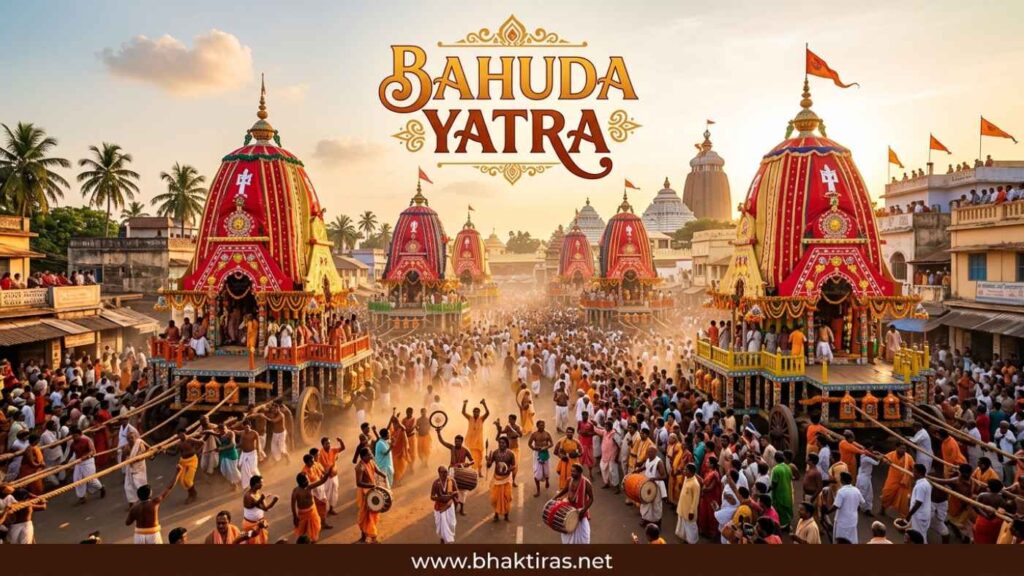
Bahuda Yatra is the return leg of Puri’s famous Rath Yatra – the day the three deities, Lord Jagannath, his elder brother Balabhadra and their sister Subhadra, ride their towering wooden chariots back home to the main Jagannath temple. After a week-long stay at the Gundicha temple, their aunt’s house, the chariots are turned around and pulled back along Bada Danda, Puri’s grand avenue, on Ashadha Shukla Dashami. In 2026 it falls on Friday, 24 July. In Bengal the same day is celebrated as Ulto Rath.
Bahuda Yatra 2026-2028: Dates & Calendar
Bahuda Yatra 2026 is on Friday, 24 July. The date shifts each year because it follows the Hindu lunar calendar, always landing on Ashadha Shukla Dashami – the tenth day of the bright fortnight of Ashadha, eight days after the outward Rath Yatra.
| Year | Date | Day | Notes |
|---|---|---|---|
| 2025 | 5 July | Saturday | Ashadha Shukla Dashami |
| 2026 | 24 July | Friday | Next occurrence |
| 2027 | 13 July | Tuesday | As per Panchanga projection |
| 2028 | 2 July | Sunday | As per Panchanga projection |
The 2027 and 2028 dates are projected from the tithi (Ashadha Shukla Dashami, the eighth day after the Rath Yatra) and are confirmed by the temple nearer the time. Around the main day fall the linked observances – Suna Besha on Ekadashi, Adhara Pana on Dwadashi and Niladri Bije on Trayodashi – which close the Rath Yatra cycle.
Why Bahuda Yatra Is Celebrated
Bahuda Yatra completes the Rath Yatra cycle – it is the homecoming, when the deities leave their aunt’s house at Gundicha and return to their own sanctum in Puri. Many devotees read it as the soul finding its way back to the divine after a journey outward.
The outward Rath Yatra takes Jagannath, Balabhadra and Subhadra from the main temple to the Gundicha temple, roughly three kilometres away, where they rest for seven days. Bahuda is the reverse trip. The same three chariots – Nandighosa for Jagannath, Taladhwaja for Balabhadra and Darpadalana for Subhadra – are hauled back by lakhs of devotees, and pulling the ropes even for a moment is believed to wash away lifetimes of sin.
What makes Bahuda more than a simple return are the rituals wrapped around it. Hera Panchami, the visit of a displeased Goddess Lakshmi, has already played out at Gundicha; the return day itself carries the Mausi Maa stop and the Chhera Pahara sweeping by the Gajapati King. The days that follow bring the golden Suna Besha, the Adhara Pana offering and the emotional Niladri Bije re-entry.
The homecoming
After eight days away, the deities come back to Sri Mandir, their permanent home. The turning of the giant chariots to face the temple and the slow pull down Bada Danda mark the family’s return from the maternal aunt’s house.
Suna Besha darshan
The day after the return, the three deities are dressed in gold ornaments while still on the chariots at the Singhadwara (Lion’s Gate). This golden attire, the Suna Besha, is one of the most photographed and sought-after darshans of the year.
Completing the cycle
Bahuda closes the annual chariot festival that began with the outward journey. The final Niladri Bije ritual, with its playful Lakshmi-Jagannath episode at the temple door, restores the deities to the Ratna Simhasana until the next year.
Deities & Figures Worshipped
Bahuda Yatra honours the Puri triad who ride the three chariots – Lord Jagannath, a form of Vishnu or Krishna, with his elder brother Balabhadra and their sister Subhadra.
Lord Jagannath
Jagannath, the Lord of the Universe, is worshipped at Puri as a form of Vishnu and Krishna. On Bahuda he rides the Nandighosa chariot back to his sanctum and receives the golden Suna Besha the next day.
Balabhadra
Balabhadra, Jagannath’s elder brother, rides the tall Taladhwaja chariot, marked by a palm-tree emblem. His chariot usually leads the return procession down Bada Danda.
Subhadra
Subhadra, the sister of the two brothers, travels on the smaller Darpadalana chariot. Her presence between her brothers is central to the family imagery of the whole Rath Yatra.
Key Rituals, Step by Step
The return day and the observances just after it follow a fixed order, from the pull down Bada Danda to the final re-entry into the temple.
- Pahandi and chariot turning. After the morning rituals at Gundicha, the deities are brought out in the swaying Pahandi procession and the three chariots are turned to face the main temple for the journey back.
- The return pull. Devotees grip the thick ropes and haul Nandighosa, Taladhwaja and Darpadalana down Bada Danda toward the Singhadwara, retracing the outward route in reverse.
- Mausi Maa halt. The chariots pause near the Mausi Maa (Ardhasini) temple, the shrine of Jagannath’s aunt, where the Lord is offered poda pitha, a slow-baked rice-and-jaggery cake he is said to love.
- Chhera Pahara. The Gajapati King of Puri sweeps the chariot platforms with a gold-handled broom and sprinkles sandal water – a reminder that before the Lord, king and commoner stand equal.
- Suna Besha. On the next day, Ashadha Shukla Ekadashi, the deities are decked in gold ornaments while still on the chariots at the Lion’s Gate, giving the crowds the golden Suna Besha darshan.
- Adhara Pana. On Dwadashi, huge earthen pots of a sweet spiced drink, the Adhara Pana, are offered at the lips of the deities on the chariots and then broken, the offering left for unseen spirits and attendants.
- Niladri Bije. On Trayodashi the deities finally re-enter Sri Mandir. Lakshmi, left behind during the festival, playfully bars Jagannath at the Jaya-Vijaya door until he offers her rasagola to make peace, after which he returns to the Ratna Simhasana.
Special Foods of Bahuda Yatra
The return festival has its own signature offerings, from the ritual drink shared with the chariots to the mountain of mahaprasad cooked in Puri’s temple kitchen.
Adhara Pana
A tall, sweet, milky drink flavoured with cheese, sugar, banana, camphor, nutmeg and black pepper, poured into large earthen pots that reach the lips (adhara) of the deities on the chariots, then ritually broken.
Poda Pitha
A dense, slow-baked cake of rice, coconut, jaggery and lentils with a caramelised crust, offered to Jagannath at the Mausi Maa temple during the return halt and a household favourite across Odisha.
Khiri
A creamy rice pudding simmered with milk and jaggery or sugar, part of the sweet mahaprasad served through the Rath Yatra season and shared with family after darshan.
Puri Mahaprasad
The temple’s fifty-six-item bhog, or Chhappan Bhog, cooked in earthen pots over wood fires in the Ananda Bazar kitchen and shared without caste distinction, is at the heart of every Puri festival meal.
Regional Names & Variations
Puri sets the template, but the return chariot day is marked across Odisha, in Bengal as Ulto Rath, and wherever Jagannath temples run their own Rath Yatra.
Puri, Odisha
The original and grandest observance. The Bahuda pull down Bada Danda, the Mausi Maa halt, Suna Besha at the Lion’s Gate and Niladri Bije draw enormous crowds and are broadcast live across the state.
Bengal – Ulto Rath
In West Bengal the return day is called Ulto Rath, literally the reverse chariot. Towns such as Mahesh in Serampore and the ISKCON centres pull their chariots back to the starting point, with fairs and evening lights.
Other rath towns
Ahmedabad, ISKCON temples worldwide and many regional Jagannath shrines run their own return chariot, so devotees far from Puri can take part in the homecoming on or near the same day.
Bahuda Yatra Do's and Don'ts
The return day draws huge crowds along a single avenue, so a little planning keeps the darshan safe and peaceful.
Do
- Reach Bada Danda early to find a safe spot before the chariots move
- Keep children close and agree a meeting point in case you are separated
- Carry water, wear light cotton and protect yourself from the July sun and rain
- Follow police barricades and the marked pulling lanes near the chariots
- Plan ahead for the Suna Besha darshan the next day, which draws its own crowds
Avoid
- Do not push toward the ropes in dense crowds – accidents happen in surges
- Do not carry heavy bags or valuables into the packed avenue
- Do not block emergency lanes or climb barricades for a better view
- Do not rely on vehicles near Bada Danda – roads are closed and diverted
- Do not litter the chariot route or the temple approach
Frequently Asked Questions
When is Bahuda Yatra in 2026?
Bahuda Yatra 2026 is on Friday, 24 July 2026, on Ashadha Shukla Dashami. It is the return chariot day of Puri’s Rath Yatra, eight days after the outward journey on 16 July 2026.
When is Bahuda Yatra in 2027 and 2028?
Bahuda Yatra is expected on Tuesday, 13 July 2027 and on Sunday, 2 July 2028, based on the Ashadha Shukla Dashami tithi. Because it follows the Hindu lunar calendar, the temple confirms the exact date each year closer to the festival.
How is Bahuda Yatra different from the Rath Yatra?
Bahuda Yatra is the return journey, while the Rath Yatra is the outward one. On Rath Yatra the deities travel from the main Jagannath temple to the Gundicha temple; on Bahuda, eight days later, the same three chariots are pulled back home to Puri’s main temple, completing the cycle.
Why is Bahuda Yatra celebrated?
Bahuda Yatra is celebrated as the homecoming of Lord Jagannath, Balabhadra and Subhadra after their week-long stay at the Gundicha temple, their aunt’s house. It closes the annual chariot festival and is seen as the soul’s return to the divine, with pulling the ropes believed to bring great merit.
What is Suna Besha?
Suna Besha is the golden attire darshan given the day after Bahuda Yatra, on Ashadha Shukla Ekadashi. The three deities are dressed in gold ornaments while still on their chariots at the Singhadwara (Lion’s Gate) of the Puri temple, one of the most sought-after sights of the year.
What are Adhara Pana and Niladri Bije?
Adhara Pana is a sweet spiced drink offered in tall earthen pots at the lips of the deities on the chariots, on Dwadashi, and then broken. Niladri Bije, on the next day, is the deities’ re-entry into the main temple, marked by a playful episode where Lakshmi bars Jagannath at the door until he offers her sweets.
What is Ulto Rath?
Ulto Rath is the Bengali name for Bahuda Yatra, meaning the reverse chariot. It is celebrated on the same day across West Bengal, most famously at Mahesh in Serampore, when the chariots are pulled back to their starting point.
Where is Bahuda Yatra celebrated?
Bahuda Yatra is celebrated most grandly at Puri in Odisha, along the Bada Danda avenue. It is also observed across Odisha, as Ulto Rath in West Bengal, and at Jagannath and ISKCON temples in cities across India and abroad.
May the return of Lord Jagannath to his home bring peace and blessings to your family. Jai Jagannath.