
Snana Purnima 2027 – Lord Jagannath's Great Bath at Puri
स्नान पूर्णिमा
When is Snana Purnima in 2027?
Snana Purnima falls on Friday, 18 June 2027. It is the ceremonial bathing festival of Lord Jagannath, Balabhadra, Subhadra and Sudarshana at the Jagannath Temple in Puri, Odisha, held on Jyeshtha Purnima, the full moon of the month of Jyeshtha. This is the deities’ first public appearance of the year, after which they retire into seclusion until the Rath Yatra.
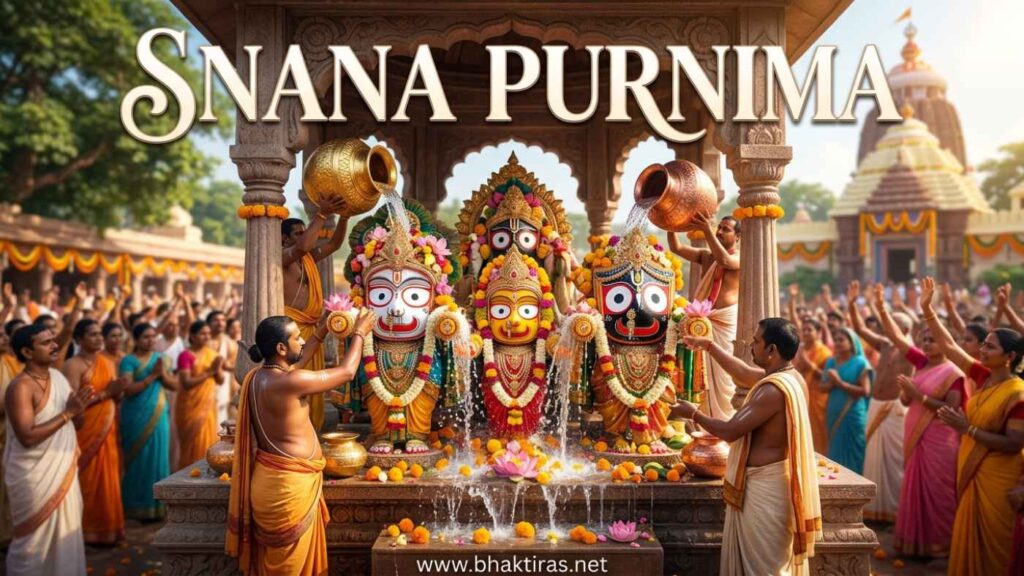
Snana Purnima, also called Deba Snana Purnima or Snana Yatra, is the day Lord Jagannath, Balabhadra, Subhadra and the disc-deity Sudarshana are carried out of the sanctum at Puri and bathed in public on the open Snana Bedi. Observed on Jyeshtha Purnima, the full moon of the Hindu month of Jyeshtha, it marks the deities’ first darshan of the year and is honoured as Jagannath’s birthday. The 108-pot bath, the striking elephant Hati Besha and the seclusion that follows all lead up to the great Rath Yatra.
Snana Purnima 2026-2028: Dates & Calendar
The next Snana Purnima is on Friday, 18 June 2027. The date shifts each year because it is fixed to Jyeshtha Purnima, the full moon of Jyeshtha, on the Hindu lunar calendar rather than a set Gregorian day.
| Year | Date | Day | Notes |
|---|---|---|---|
| 2026 | 29 June | Monday | Already observed |
| 2027 | 18 June | Friday | Next occurrence |
| 2028 | 7 June | Wednesday | Jyeshtha Purnima |
The bathing ritual begins soon after sunrise, once the deities reach the Snana Bedi in the Pahandi procession. Snana Purnima usually falls a little over two weeks before Rath Yatra, since the deities enter a fortnight of seclusion in between.
Why Snana Purnima Is Celebrated
Snana Purnima is celebrated as the grand annual bath and first public appearance of Lord Jagannath. It is regarded as the birthday of the deities and the opening rite of the Rath Yatra season at Puri.
The great annual bath
For most of the year the deities are seen only inside the temple. On Snana Purnima they are brought to the raised Snana Bedi in full view of devotees and bathed with 108 pots of scented water. It is one of the few occasions when Jagannath is worshipped openly outside the sanctum, drawing lakhs of pilgrims.
Jagannath's birthday
Tradition treats Snana Purnima as the appearance day of Lord Jagannath, so the bath doubles as a birthday celebration. Devotees believe that a single darshan on this day carries the merit of a lifetime of worship, which is why the crowds at Puri swell so sharply.
The Hati Besha and the devotee's wish
After the bath the deities are dressed in the Hati Besha, an elephant form linked to a Ganesha devotee named Ganapati Bhatta. The story goes that he longed to see his beloved Ganesha at Puri; moved by his faith, the Lord appeared before him in elephant guise, and the temple has honoured that form on this day ever since.
Illness and the road to Rath Yatra
The long open-air bath is believed to leave the deities feverish, so they withdraw into a fortnight of seclusion called Anasara. During this quiet period they are nursed with herbal remedies and kept away from public darshan, emerging renewed just in time for the Rath Yatra.
Deities & Figures Worshipped
Snana Purnima honours the four deities of the Puri sanctum, bathed together on the Snana Bedi. Lord Jagannath is the presiding form, with his elder brother, his sister and his divine disc.
Lord Jagannath
The dark-faced form of Vishnu-Krishna worshipped at Puri, whose annual bath and birthday this festival marks. His round, wide-eyed image is the centre of the rite and receives the Hati Besha darshan after the bath.
Balabhadra
The elder brother of Jagannath, worshipped in a white-faced form and associated with strength and the serpent Ananta. He is bathed alongside Jagannath and later rides his own chariot at the Rath Yatra.
Subhadra
The sister of Jagannath and Balabhadra, worshipped in a yellow form. She is the smallest of the three main images on the Snana Bedi and is honoured with her own pots of sacred water.
Sudarshana
The personified discus of Vishnu, worshipped as a pillar-like wooden form. Sudarshana is carried out with the three main deities and bathed with them, completing the group on the Snana Bedi.
Key Rituals, Step by Step
The day moves from a grand procession to the public bath, the elephant darshan and finally the deities’ withdrawal into seclusion. Each stage is carried out by the temple’s hereditary servitors.
- Pahandi procession. Soon after sunrise the servitors bring Jagannath, Balabhadra, Subhadra and Sudarshana out of the sanctum in a swaying, rhythmic Pahandi procession to the open Snana Bedi in front of the temple.
- Filling the sacred pots. Water drawn from the temple’s Suna Kua (Golden Well) is carried in 108 pots, purified and scented with sandal, herbs, camphor and flowers, then arranged for the bath.
- The 108-pot abhisheka. The deities are bathed with all 108 pots of consecrated water in a stately sequence, the high point of the festival witnessed by an enormous gathering of devotees.
- Hati Besha darshan. After the bath the deities are dressed in the Hati Besha, or elephant form, honouring the Ganesha devotee Ganapati Bhatta. This rare attire is one of the most cherished sights of the day.
- Onset of Anasara. The long bath is believed to leave the deities unwell, so they are taken back inside to the Anasara Ghara and their public darshan is suspended for about a fortnight.
- Herbal treatment by the daitapatis. During Anasara the daitapati servitors care for the ailing deities in private, applying herbal preparations and following traditional remedies until they recover.
- Reappearance for Rath Yatra. At the close of the seclusion the deities are given fresh youthful darshan (Nabajaubana) and then emerge for the Rath Yatra, when they ride their great chariots to the Gundicha Temple.
Special Foods of Snana Purnima
Because the deities are bathed and then rested, the day’s offerings are simpler than usual, with fruit, light snacks and herbal preparations to the fore. Mahaprasad remains at the centre of the devotee’s experience at Puri.
Phuluri and fried snacks
Light fried offerings such as phuluri (batter fritters) are prepared for the deities on the bathing day, when elaborate cooked meals give way to simpler, easily offered items.
Fresh fruit offerings
Seasonal fruits, tender coconut and other cooling foods are offered to the freshly bathed deities, in keeping with the summer heat of Jyeshtha and the belief that the Lord needs gentle, restorative fare.
Dashamula herbal preparation
During the seclusion that follows, the ailing deities are treated with dashamula, a preparation of ten medicinal roots and herbs, offered as a curative rather than an ordinary bhog.
Mahaprasad
The famed mahaprasad of Puri, cooked in earthen pots and offered to the Lord, is shared among devotees through much of the year. Its sanctity makes it central to any visit to the Jagannath Temple around Snana Purnima.
Where Snana Purnima Is Observed
Snana Purnima belongs above all to Puri, but Jagannath temples across India and abroad mark the same bathing rite on Jyeshtha Purnima.
Puri, Odisha
The Jagannath Temple at Puri is the heart of the festival. Its Snana Bedi, Suna Kua and hereditary servitors give the day its scale, and the sight of the Hati Besha here draws pilgrims from across the country.
Other Jagannath temples in India
Jagannath temples in cities such as Kolkata, Delhi, Ahmedabad and Jamshedpur hold their own Deba Snana Purnima, bathing their deities with 108 pots and observing the Anasara seclusion that follows.
Jagannath temples abroad
ISKCON and other Jagannath communities overseas mark Snana Yatra with the ceremonial bath and Hati Besha, connecting devotees far from Puri to the same annual rite.
Snana Purnima Do's and Don'ts
A few simple points help pilgrims take part respectfully and stay safe amid the very large crowds at Puri.
Do
- Reach the temple early, since the bath begins soon after sunrise and vantage points fill quickly.
- Follow the instructions of temple servitors and the crowd-management staff at all times.
- Keep children and elderly companions close in the dense gathering on the Snana Bedi day.
- Honour the Hati Besha darshan with patience, as it is one of the rarest sights of the year.
- Respect the Anasara period, when the deities rest and normal darshan is suspended.
Avoid
- Do not expect regular darshan of the deities during the fortnight of Anasara that follows the bath.
- Do not push or rush in the crowd; the sheer numbers make patience essential for safety.
- Do not carry prohibited items or leather goods into the temple precincts.
- Do not disturb the servitors as they carry out the bath and the delicate Hati Besha dressing.
- Do not treat the day as an ordinary temple visit; plan for heavy congestion and long waits.
Frequently Asked Questions
When is Snana Purnima in 2027?
Snana Purnima is on Friday, 18 June 2027. It is fixed to Jyeshtha Purnima, the full moon day of the Hindu month of Jyeshtha, so the Gregorian date changes each year. On this day Lord Jagannath and his siblings receive their grand ceremonial bath at Puri.
When is Snana Purnima in 2026 and 2028?
Snana Purnima was on Monday, 29 June 2026, and will fall on Wednesday, 7 June 2028. Both dates follow Jyeshtha Purnima on the Hindu lunar calendar, which is why the festival moves within June from one year to the next.
Why is Snana Purnima celebrated?
Snana Purnima is celebrated as the grand annual bath and first public appearance of Lord Jagannath at Puri, and is honoured as his birthday. The deities are bathed with 108 pots of sacred water and given the elephant Hati Besha darshan, which opens the run-up to the Rath Yatra.
Which deities are bathed on Snana Purnima?
Four deities are bathed on Snana Purnima: Lord Jagannath, his elder brother Balabhadra, his sister Subhadra and the disc-deity Sudarshana. They are carried from the sanctum to the open Snana Bedi and bathed together in public view.
What is the Hati Besha of Lord Jagannath?
Hati Besha, also called Gajanana Besha, is the elephant form in which Jagannath and Balabhadra are dressed after the Snana Purnima bath. It honours a Ganesha devotee named Ganapati Bhatta, before whom the Lord is said to have appeared in elephant guise, and it is one of the rarest darshans of the year.
How is Snana Purnima connected to the Rath Yatra?
Snana Purnima is the opening rite of the Rath Yatra season. The long open-air bath is believed to leave the deities feverish, so they withdraw into a fortnight of seclusion called Anasara, then emerge renewed to ride their chariots in the Rath Yatra a little over two weeks later.
What is the Anasara period after Snana Purnima?
Anasara is the roughly fortnight-long seclusion that follows Snana Purnima, when the deities are believed to be unwell from the great bath. During this time public darshan is suspended and the daitapati servitors care for the deities in private with herbal remedies until they recover for the Rath Yatra.
Where is Snana Purnima mainly celebrated?
Snana Purnima is mainly celebrated at the Jagannath Temple in Puri, Odisha, where lakhs of devotees gather to watch the bath and the Hati Besha. Other Jagannath temples across India and abroad, including ISKCON centres, observe the same bathing rite on Jyeshtha Purnima.
May the sight of Lord Jagannath’s great bath bless your year. Jai Jagannath!