
Mahesh Rath Yatra 2026 – India's Second-Oldest Chariot Festival
মাহেশ রথযাত্রা
When is Mahesh Rath Yatra in 2026?
Mahesh Rath Yatra 2026 falls on Thursday, 16 July 2026, on Ashadha Shukla Dwitiya – the same tithi as the Puri Rath Yatra. Held at Mahesh in Serampore, Hooghly district of West Bengal, it is regarded as India’s second-oldest chariot festival after Puri, running for around 625 years. Lord Jagannath, Balaram and Subhadra are pulled on a towering iron chariot to the Masirbari, returning on Ulto Rath on 24 July 2026.
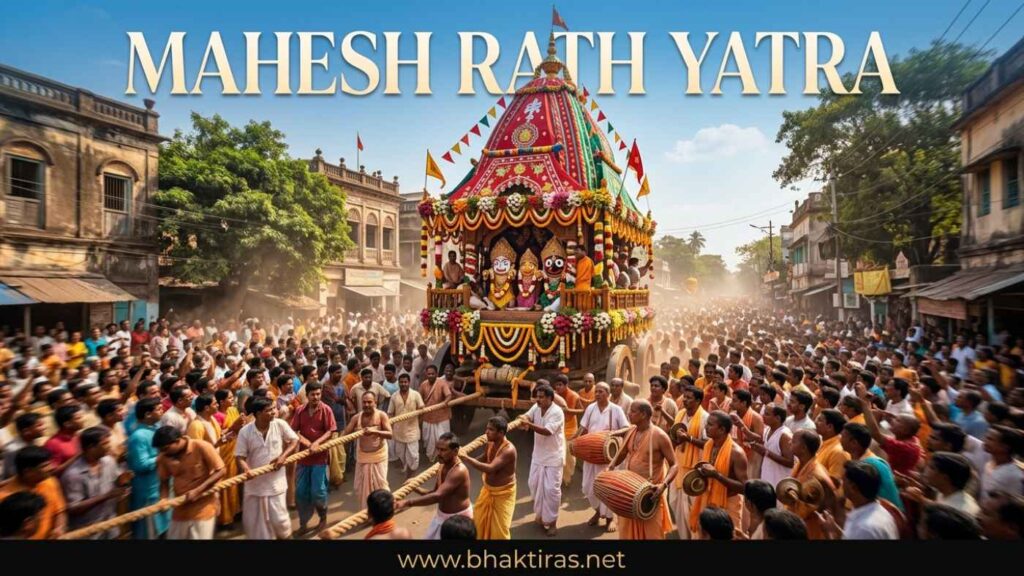
Mahesh Rath Yatra is the chariot festival of the Jagannath temple at Mahesh in Serampore, Hooghly district of West Bengal. Held on Ashadha Shukla Dwitiya, the same day as the Puri Rath Yatra, it is widely counted as the second-oldest such festival in India, traced back to about 1396. On this day the wooden images of Jagannath, Balaram and Subhadra are drawn on a tall iron chariot along a crowded route to a house at Ballavpur, staying there a fortnight before the return, or Ulto Rath. A month-long fair, the famous Mahesh-er Mela, grows up around it.
Mahesh Rath Yatra 2026-2028: Dates & Calendar
The next Mahesh Rath Yatra is on Thursday, 16 July 2026. The date shifts each year because it is fixed by the Hindu lunar calendar, on the second bright day of the month of Ashadha, and not by the Gregorian date.
| Year | Rath Yatra | Day | Ulto Rath (return) |
|---|---|---|---|
| 2026 | 16 July | Thursday | 24 July 2026 |
| 2027 | 5 July | Monday | 13 July 2027 |
| 2028 | 24 June | Saturday | 2 July 2028 |
The main procession is the forward journey (Soja Rath) on Rath Yatra day. The deities then stay at the Masirbari for a fortnight and are pulled back on Ulto Rath (Bahuda Yatra), which falls on the tenth bright day of Ashadha, eight days after the outward journey.
Why Mahesh Rath Yatra Is Celebrated
Mahesh Rath Yatra is celebrated as the annual outing of Lord Jagannath from his temple at Mahesh to a smaller shrine called the Masirbari, mirroring the Puri festival. Its fame rests on its great age – roughly 625 years – which makes it the oldest Rath Yatra in Bengal and second-oldest in India.
The festival grew from the Jagannath temple at Mahesh, a small settlement now absorbed into Serampore on the west bank of the Hooghly. Because the same worship of Jagannath, Balaram and Subhadra was carried into Bengal here, the sage Chaitanya Mahaprabhu is said to have called the place Naba Nilachala, or new Puri, giving it a standing beyond an ordinary local shrine.
The legend of Dhrubananda
Tradition credits the temple to a 14th-century sage, Dhrubananda Brahmachari. Turned away from serving food to the deity at Puri, he is said to have received a vision telling him to return to the Ganga at Mahesh, where a neem log would drift ashore. From that sacred wood he carved the three images and set up worship around 1396, founding the line that continues today.
Second only to Puri
Mahesh Rath Yatra is regarded as the second-oldest chariot festival in India after Puri, and the oldest in Bengal, at roughly 625 years old. Unlike Puri, where the images are renewed periodically, the Mahesh deities are treated as the originals handed down through the founder’s line, adding to the sense of unbroken continuity.
A place in Bengali memory
The novelist Bankim Chandra Chattopadhyay set part of his story Radharani at the Mahesh fair, describing a girl separated from her mother in the crush of the crowd. That single tale fixed Mahesh-er Mela in the Bengali literary imagination, and the festival is still spoken of through it.
The iron chariot
The present chariot is not the usual wooden one rebuilt each year but a standing iron structure, said to be about 50 feet tall and very heavy, built in 1885 by the Martin Burn company under the patronage of a local landowner, Krishnaram Basu. Its nine-turret, Nabaratna design and twelve wheels give the Mahesh rath its distinctive look.
Deities Worshipped at Mahesh
The festival centres on the Jagannath triad – Lord Jagannath with his brother Balaram and sister Subhadra – the same three deities carried in procession at Puri.
Jagannath
Jagannath, a form of Vishnu or Krishna, is the presiding deity of Mahesh. His large round-eyed image, carved from neem wood, is the central figure placed on the chariot and the focus of the temple’s daily worship.
Balaram
Balaram (Balabhadra), the elder brother of Jagannath, rides on the chariot alongside him. He is honoured as the strong, protective sibling of the triad and shares the outward journey and the fortnight at the Masirbari.
Subhadra
Subhadra, the sister of Jagannath and Balaram, completes the trinity. She is placed between her two brothers on the chariot, and the three travel and return together through the days of the festival.
Key Rituals, Step by Step
The festival runs from the deities leaving the temple on Rath Yatra day to their return two weeks later, framed by the great fair.
- Snan Yatra first. A fortnight before the Rath Yatra, on the full-moon day of Jyeshtha, the deities are given a ceremonial bath. They are then kept out of public view for a spell, described as a period of fever, before Rath Yatra day.
- Deities brought out. On Ashadha Shukla Dwitiya the images of Jagannath, Balaram and Subhadra are carried from the temple sanctum and installed on the iron chariot with due ceremony.
- Pulling the rath. Devotees take hold of long ropes and haul the heavy iron chariot along the route towards the Masirbari at Ballavpur. Taking part in the pulling is considered an act of great merit, and huge crowds press in for a hand on the rope.
- The fortnight away. At the Masirbari, treated as the aunt’s house, the deities rest for roughly a fortnight, receiving worship there just as at Puri’s Gundicha temple.
- Ulto Rath return. On the tenth bright day of Ashadha the chariot is pulled back to the main temple in the return journey, called Ulto Rath or Bahuda Yatra, completing the cycle.
- Mahesh-er Mela. Around the whole period a large fair springs up near the temple and along the riverside, with stalls, sweets, toys and rural goods, drawing visitors for weeks rather than a single day.
Special Foods of Mahesh Rath Yatra
The festival is as much a food fair as a religious event, and the sweets and snacks of Mahesh-er Mela are part of its draw.
Jilipi
Crisp, syrup-soaked jilipi (jalebi) is the signature treat of Rath Yatra fairs in Bengal. Freshly coiled and fried at stalls around Mahesh, it is bought hot and eaten on the spot.
Papor
Papor (papad), fried to a light crunch, is sold in stacks through the fair. It is a simple, everyday snack that becomes tied to the memory of the mela for many families.
Khichuri bhog
Khichuri, a soft mix of rice and lentils, is offered to the deities and shared as bhog with devotees. Warm and lightly spiced, it is the comforting prasad most associated with the temple on festival days.
Pantua
Pantua, deep-fried milk-solid balls in sugar syrup close to gulab jamun, is a favourite Bengali sweet at the fair. Along with other chhana-based sweets, it fills the mishti stalls of Mahesh-er Mela.
Serampore, Hooghly & How It Compares
Mahesh sits within Serampore in Hooghly district, and its festival is often set beside the two other great Bengal-region Rath Yatras at Puri and Mahishadal.
Serampore & Hooghly
Mahesh is a locality of Serampore, a former Danish settlement on the west bank of the Hooghly, about 25 km from Kolkata. The temple and its riverside fairground make the town a major draw during Ashadha, with special trains and buses laid on for the crowds.
Compared with Puri
Puri in Odisha is the original and largest Rath Yatra, with three tall wooden chariots rebuilt every year. Mahesh shares its exact date and the same three deities but is far older in Bengal terms and famous for a single standing iron chariot rather than newly built wooden ones.
Compared with Mahishadal
Mahishadal in East Medinipur runs another celebrated Bengal Rath Yatra, tied to its royal family and a tall many-tiered chariot. Together with Mahesh, it forms part of the trio of historic West Bengal chariot festivals that devotees try to visit.
Mahesh Rath Yatra Do's and Don'ts
The day draws very large crowds, so simple care makes the visit safer and more rewarding.
Do
- Reach the route early to find a safe standing spot before the crowds build.
- Keep children close and agree a meeting point in case anyone gets separated.
- Carry water and wear light cotton clothing for the July heat and humidity.
- Follow the directions of police and temple volunteers managing the rope-pulling.
- Try the local jilipi, pantua and khichuri bhog as part of the experience.
Avoid
- Do not push towards the ropes in dense crowds or let children near the moving wheels.
- Do not carry heavy bags or valuables that are hard to manage in a crush.
- Do not block the chariot path or the marked emergency lanes.
- Do not rely on vehicles reaching the temple – roads close, so plan to walk.
- Do not ignore feeling faint in the heat; step aside and rest early.
Frequently Asked Questions
When is Mahesh Rath Yatra in 2026?
Mahesh Rath Yatra 2026 is on Thursday, 16 July 2026. It is held on Ashadha Shukla Dwitiya, the same lunar day as the Puri Rath Yatra, at the Jagannath temple in Mahesh, Serampore, West Bengal. The return journey, or Ulto Rath, follows on 24 July 2026.
When is Mahesh Rath Yatra in 2027 and 2028?
Mahesh Rath Yatra falls on Monday, 5 July 2027 and on Saturday, 24 June 2028. The date changes each year because it is set by the Hindu lunar calendar on Ashadha Shukla Dwitiya, so it moves between late June and mid-July in the Gregorian calendar.
Why is Mahesh Rath Yatra famous?
Mahesh Rath Yatra is famous as India’s second-oldest chariot festival after Puri and the oldest in Bengal, dating to about 1396 – roughly 625 years. It is known for its tall standing iron chariot, its huge month-long Mahesh-er Mela fair, and its place in Bengali literature through Bankim Chandra’s story Radharani.
Which god is worshipped at Mahesh Rath Yatra?
The Mahesh Rath Yatra worships Lord Jagannath, a form of Vishnu, together with his brother Balaram and sister Subhadra. These are the same three deities carried at Puri, and their neem-wood images are pulled on the chariot from the temple to a nearby shrine and back.
How old is Mahesh Rath Yatra?
Mahesh Rath Yatra is around 625 years old, traced to about 1396 when the sage Dhrubananda Brahmachari is said to have founded the Jagannath temple at Mahesh. This makes it the oldest chariot festival in Bengal and the second-oldest in India after Puri.
What is the Mahesh iron chariot?
The Mahesh chariot is a permanent iron structure rather than a wooden one rebuilt each year like Puri’s. It is about 50 feet tall with a nine-turret Nabaratna design and twelve wheels, and was built in 1885 by the Martin Burn company under the patronage of the landowner Krishnaram Basu.
What is Mahesh-er Mela?
Mahesh-er Mela is the large fair that surrounds the Mahesh Rath Yatra, running for about a month near the temple and along the Hooghly riverside. Stalls sell sweets like jilipi and pantua, toys and everyday goods, and the fair was immortalised in Bankim Chandra Chatterjee’s story Radharani.
When is the Ulto Rath at Mahesh?
The Ulto Rath, or return journey, at Mahesh in 2026 is on 24 July 2026, eight days after the outward Rath Yatra. On this day the deities are pulled back from the Masirbari to the main Jagannath temple, ending their fortnight-long stay and completing the festival.
May Lord Jagannath’s blessings reach every home this Rath Yatra – Jai Jagannath.