
Chitra Pournami 2027 – Chitragupta's Day of Reckoning
சித்திரா பௌர்ணமி
When is Chitra Pournami in 2027?
Chitra Pournami falls on Tuesday, 20 April 2027. It is the full moon (Pournami) day of the Tamil month Chithirai, when the Chitra star coincides with the full moon. Devotees worship Chitragupta, the divine record-keeper of every soul’s deeds, and pray for forgiveness of past wrongs and a lighter karmic account.
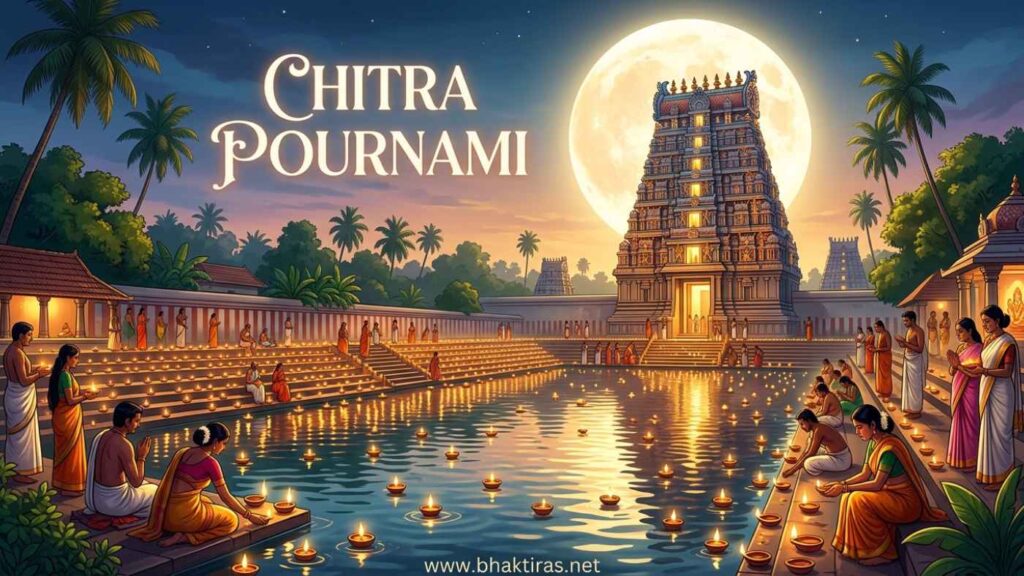
Chitra Pournami is the full moon day of Chithirai, the first month of the Tamil year, honouring Chitragupta, the celestial scribe who keeps a ledger of every good and bad act a person commits. Falling in April or May, it is a day of self-reckoning: families fast, visit Chitragupta shrines, and give in charity to soften the karmic debt that Chitragupta is believed to tally on behalf of Yama, the lord of death and justice.
Chitra Pournami 2026-2028: Dates & Calendar
The next Chitra Pournami is on 20 April 2027. The date shifts each year because it tracks the Tamil lunar month Chithirai rather than a fixed Gregorian day, so it lands anywhere from mid-April to mid-May.
| Year | Date | Day | Notes |
|---|---|---|---|
| 2026 | 1 May | Friday | Chithirai full moon |
| 2027 | 20 April | Tuesday | Next occurrence |
| 2028 | 8 May | Monday | Chithirai full moon |
The festival is a single-day observance. Because Chithirai opens the Tamil year, Chitra Pournami often falls within weeks of Puthandu (Tamil New Year) and the Chithirai festival of Madurai.
Why Chitra Pournami Is Celebrated
Chitra Pournami is celebrated to honour Chitragupta, the divine accountant who records every soul’s deeds, and to seek forgiveness for past faults. The full moon of Chithirai is held to be an especially auspicious time for cleansing karma through prayer, fasting and charity.
Chitragupta, keeper of the record
In Hindu belief Chitragupta sits in Yama’s court and maintains a precise ledger of everyone’s virtues and sins, which decides their fate after death. On his day devotees pray that entries against them are set right, offering repentance for wrongs done knowingly or unknowingly through the year.
A day to lighten the karmic account
The core idea of Chitra Pournami is that good deeds performed now, especially giving to the poor, can offset debts already noted in Chitragupta’s book. Fasting and honest self-examination are meant to reduce the burden a soul carries into its final reckoning.
The full moon's auspiciousness
Pournami, the full moon, is considered a high point of spiritual energy in the Hindu calendar. When it coincides with the Chitra nakshatra in Chithirai, the merit of vratas, prayers and donations is believed to be multiplied, making it a favoured day for penance and worship.
The story of Indra's penance
One well-known legend links the day to Indra, king of the gods, who lost his merit after slighting his guru Brihaspati. Told to atone on earth, Indra worshipped a Shivalinga beneath a Kadamba tree in Madurai on the Chithirai full moon and was freed of his sin, which is why the day is also tied to Indra and to seeking release from guilt.
Deities & Figures Worshipped
The central figure of Chitra Pournami is Chitragupta, the divine scribe. He is worshipped alongside Yama, the god of death and justice whom he serves, and in some regions the day also honours Indra.
Chitragupta
Chitragupta is the celestial record-keeper who notes every action a person takes. He is usually depicted seated, holding a pen (ezhuthani) and a palm-leaf ledger, symbols of his work. The Kayastha community across North India reveres him as their divine forefather and worships him with special devotion on this day.
Yama
Yama, lord of death and cosmic justice, presides over the court where Chitragupta’s records are read out. Praying to Yama on Chitra Pournami is a plea for a fair and merciful judgement, and for a good death when the time comes.
Indra
In the Madurai legend, Indra is freed of his sins on the Chithirai full moon after worshipping Shiva. Because of this the day is, in some places, also observed as an occasion sacred to Indra and to the cleansing of accumulated wrongs.
Key Rituals, Step by Step
Observance centres on a dawn-to-dusk fast, worship of Chitragupta and acts of charity. The steps below follow the usual order in a household or temple observance.
- Rise early and bathe. Devotees wake before sunrise, bathe, and wear clean clothes to begin the day in a state of purity before any food is taken.
- Prepare the puja space. A kolam is drawn at the threshold and before the altar, with the south side left open as a symbolic welcome to Chitragupta, who is associated with Yama’s southern quarter.
- Observe the fast. Many keep a full fast from dawn to dusk. Where a fast is kept, salt is traditionally avoided, and it is broken at dusk with plain curd rice made without salt.
- Worship Chitragupta with the pen and ledger. An image or picture of Chitragupta is honoured with lamps, flowers and incense; the pen and account-book he holds are remembered as the emblem of the deeds he records. Slokas are recited and aarti offered.
- Offer naivedyam. Cooked rice, dhal, pongal and payasam are offered to the deity. In some traditions payasam is made with buffalo milk rather than cow’s milk, as the buffalo is linked to Yama.
- Visit a Chitragupta shrine. Where possible devotees visit a Chitragupta temple, most famously the ancient shrine at Kanchipuram, where special poojas and the deity’s ceremonial wedding are conducted on this day.
- Give charity (daan). Feeding the poor and donating rice, grain, vegetables or money to the needy and to priests is considered the surest way to reduce one’s karmic debt, and is the heart of the day’s observance.
- Reflect and resolve. Devotees close the day by honestly reviewing their conduct and resolving to do better, in keeping with the idea that Chitragupta weighs intentions as well as actions.
Special Foods of Chitra Pournami
The food of the day reflects the fast: simple, often saltless dishes for the observant, and rice-based offerings for the deity. Sweet payasam and mixed rices are the mainstays.
Salt-free curd rice
Those keeping the fast traditionally break it with plain curd rice made without salt, in line with the day’s rule of avoiding salt. It is a light, cooling dish suited to the April-May heat.
Chitrannam (mixed rices)
Tangy variety rices such as lemon rice, tamarind rice and coconut rice are common on festival days in the Tamil kitchen. They are easy to prepare in quantity for family gatherings and for offering.
Payasam
Payasam, a milk-and-jaggery or sugar pudding with rice or moong dhal, is offered to the deity and shared. Some households prepare it with buffalo milk, avoiding cow’s milk on this particular day out of the Yama association.
Pongal and dhal
Ven pongal, a savoury rice-and-moong-dhal dish, and simple dhal preparations are offered as naivedyam and eaten after the puja, forming the staple of the festive meal.
Sweets and fruit
Homemade sweets and seasonal fruit are added to the offering tray and given to guests, rounding out a table that stays largely vegetarian and modest in keeping with a day of penance.
Regional Names & Variations
Chitra Pournami is strongest in Tamil Nadu, but the worship of Chitragupta reaches far beyond the south through the Kayastha community.
Tamil Nadu
Here the day is central, observed as Chithirai Pournami with home poojas, fasting and temple visits. The Chitragupta temple at Kanchipuram, one of very few shrines dedicated solely to him, draws large crowds for its Chitra Pournami wedding ceremony and special poojas.
Kayastha communities across North India
For Kayastha families, who trace their descent to Chitragupta, the day is a community festival of reverence for their divine ancestor. It is marked at Chitragupta shrines in places such as Uttar Pradesh and Bihar, where the pen and inkpot are honoured as symbols of learning and record-keeping.
Kerala and the diaspora
In Kerala and among Tamil and South Indian communities abroad, the full moon is observed with home worship, fasting and charity, keeping the emphasis on cleansing karma even where a dedicated Chitragupta temple is not nearby.
Chitra Pournami Do's and Don'ts
A few simple customs shape how the day is kept.
Do
- Wake early, bathe and start the day with prayer before eating
- Keep the fast sincerely if your health allows, and break it gently at dusk
- Worship Chitragupta with a lamp, flowers and the recitation of slokas
- Give food, grain or money in charity to the poor and needy
- Reflect honestly on your conduct and resolve to make amends
Avoid
- Do not add salt to food if you are observing the traditional fast
- Avoid harsh words, quarrels or dishonest dealings on a day of reckoning
- Do not skip the charity, which is regarded as the day’s most important act
- Avoid non-vegetarian food and alcohol during the observance
- Do not treat the fast as a diet; keep its purpose of repentance in mind
Frequently Asked Questions
When is Chitra Pournami in 2027?
Chitra Pournami is on Tuesday, 20 April 2027. It is the full moon day of the Tamil month Chithirai, when the Chitra star meets the full moon, and is dedicated to Chitragupta, the recorder of deeds.
When is Chitra Pournami in 2026 and 2028?
Chitra Pournami falls on Friday, 1 May 2026 and on Monday, 8 May 2028. The date moves each year because it follows the Tamil month of Chithirai rather than a fixed Gregorian date, ranging from mid-April to mid-May.
Why is Chitra Pournami celebrated?
Chitra Pournami is celebrated to honour Chitragupta, the divine scribe who records every person’s good and bad deeds for Yama’s court of justice. Devotees pray for forgiveness of their faults and give in charity, believing that good acts on this full moon help lighten their karmic debt.
Which god is worshipped on Chitra Pournami?
Chitragupta, the celestial record-keeper, is the main deity worshipped on Chitra Pournami. He is honoured alongside Yama, the god of death and justice whom he serves, and in some traditions the day is also linked to Indra.
Who is Chitragupta and why is he important?
Chitragupta is the divine accountant in Yama’s court who keeps a detailed ledger of every soul’s deeds, deciding their fate after death. He is shown holding a pen and a palm-leaf book, and the Kayastha community reveres him as their divine forefather.
How is Chitra Pournami observed?
Chitra Pournami is observed with an early bath, a dawn-to-dusk fast, worship of Chitragupta with lamps and slokas, and offerings of rice, pongal and payasam. Many visit a Chitragupta temple, and giving food or money in charity is considered the most important act of the day.
What foods are prepared for Chitra Pournami?
Rice-based dishes dominate Chitra Pournami: pongal, mixed rices such as lemon and tamarind rice, and payasam offered to the deity. Those keeping the fast traditionally avoid salt and break it at dusk with plain saltless curd rice.
Where is the famous Chitragupta temple?
The best-known Chitragupta temple is in Kanchipuram, Tamil Nadu, one of the very few shrines dedicated solely to him. On Chitra Pournami it holds special poojas and the deity’s ceremonial wedding, drawing large numbers of devotees seeking to clear their karmic account.
May Chitragupta note only good in your ledger this Chitra Pournami, and may the year’s account be lighter than the last.