
Chaitanya Mahaprabhu
चैतन्य महाप्रभु
Chaitanya Mahaprabhu (1486-1534) was a Bengali saint and mystic whom his followers worship as Krishna and Radha joined in one golden form. Born as Nimai at Nabadwip, he spread the Hare Krishna chant and congregational singing of the holy names, and founded the spirit of Gaudiya Vaishnavism.
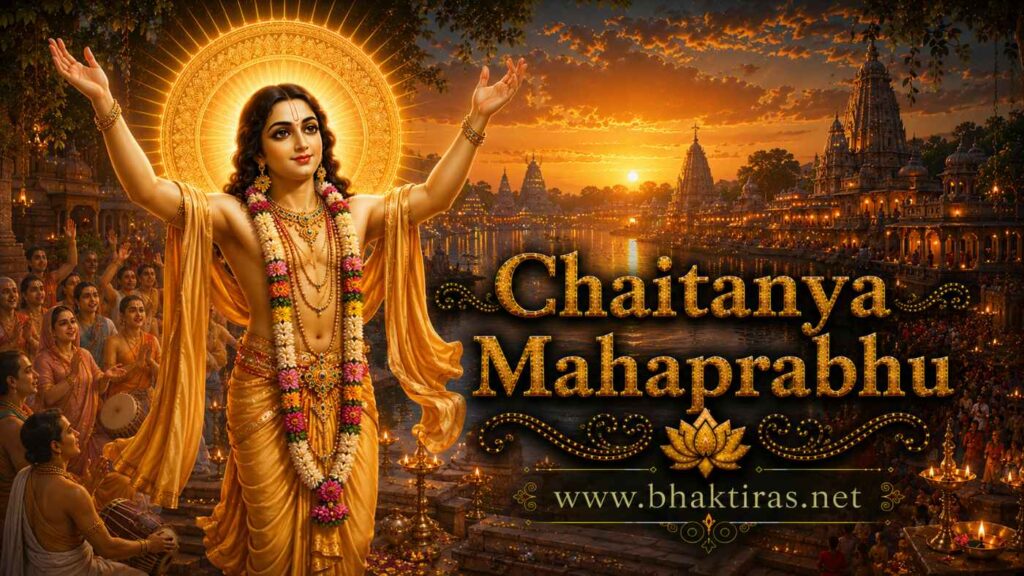
Who Is Chaitanya Mahaprabhu
Chaitanya Mahaprabhu is one of the most beloved saints of Bengal, and for those who follow him he is far more than a saint. In the tradition he inspired, he is understood as Krishna himself, come once more to earth – but this time wearing the golden complexion and the tender heart of Radha, his own dearest devotee. The story his followers tell is quietly astonishing: Krishna, who has been loved by countless souls, grew curious about the love that Radha felt for him. To taste that love from the inside, they say, he took Radha’s mood and Radha’s radiance and appeared as a single golden being. That being was Chaitanya.
He was born in 1486 in the town of Nabadwip on the banks of the Ganga, and named Vishvambhara Mishra. As a small child the neighbours simply called him Nimai, after the neem tree beside which he was born. He grew into a dazzling young scholar of Sanskrit grammar and logic, sharp-tongued and confident, the kind of student who could silence a room of older pandits. Nothing in those early years hinted at the flood of feeling that was waiting for him.
Then that feeling came, and it changed everything. The proud young logician became a man who could barely speak Krishna’s name without weeping, who would fall to the ground trembling, who sang and danced through the streets until dawn. People began to call him Gauranga and Gaursundar, the golden Lord, for the light that seemed to pour off his skin. And through him a whole movement of song and devotion was born.
Nimai of Nabadwip
Nabadwip in the late fifteenth century was a river town famous for its scholars. Along its lanes, students argued over grammar and philosophy late into the night, and a family’s honour could rest on a boy’s cleverness. Into this world Sachi Devi and Jagannath Mishra welcomed a son who arrived, the accounts say, during a lunar eclipse while the whole town was already outside chanting the names of God by the river. It felt to them like an omen, though they could not have guessed how large.
The boy was a handful. Bright, mischievous, quick to laugh and quicker to win an argument, he mastered the difficult texts of grammar while still very young and even, by tradition, wrote a commentary of his own. He opened a small school and taught students not much younger than himself. He married Lakshmipriya, and when she died of a snakebite while he was away, he later married Vishnupriya. To his neighbours he was Nimai the scholar, a young householder with a bright future in learning.
Yet even then something restless moved in him. He would sometimes ask his students questions that had nothing to do with grammar – questions about Krishna, about love, about the point of all this cleverness. The answers he found in books did not satisfy him. The real answer was still ahead of him, waiting on a road to the south.
The Awakening of Divine Love
The turning came when Nimai travelled to Gaya to perform the funeral rites for his late father. There, at the sacred site, he met a holy teacher, Ishvara Puri, and received from him the Krishna mantra and initiation. Something long held shut swung open. The young man who had gone to Gaya as a brilliant scholar came back a different person entirely.
His students noticed it at once. He could no longer teach grammar; every word seemed to lead him back to Krishna. He would stop mid-sentence, his eyes filling, and murmur the holy name. He wept, he fainted, he laughed for no reason his friends could see. This was not madness, his companions came to understand, but prema-bhakti – pure love of God so intense that the body could hardly contain it. The tradition treats these states of ecstasy as the very heart of who he was: not a philosopher describing love from a safe distance, but a man drowned in it.
Around him gathered a circle of devotees who felt the same fire kindling in their own hearts. Nabadwip, the town of dry debate, began to fill at night with singing. The scholar had become a lover, and the lover was about to give the world a new way to reach God.
Sankirtana – the Chanting of the Holy Name
What Chaitanya taught was breathtakingly simple. In an age of complicated rituals and jealously guarded scholarship, he said the surest path to God was to sing his names together, aloud, with love – anyone, anywhere, of any birth. This congregational singing and dancing is called sankirtana, and at its centre is the Hare Krishna maha-mantra, the sixteen-word chant of the names of Krishna and Rama.
He called this chanting the yuga-dharma, the spiritual practice best suited to Kali Yuga, our present quarrelsome age. When minds are scattered and lives are short, he taught, the loving repetition of the holy name carries a soul home more surely than austerities or complex sacrifice. And crucially, he threw the door open to everyone. In sankirtana there was no barrier of caste, no gate of learning, no fee of birth. A washerman and a scholar could dance in the same circle and shed the same tears.
The nightly kirtans of Nabadwip grew into great processions. Chaitanya would lead them through the streets, arms lifted, the town shaking with the names of God. It was joyful and it was defiant – a public, unstoppable tide of devotion that no wall of privilege could hold back. This is the gift for which he is most remembered: he made love of God a song that anyone could sing.
Renunciation and the Years at Puri
At the age of twenty-four, Chaitanya took sannyasa, the vows of a renunciant, and left the settled world of home, mother, and young wife behind. It was a wrenching parting – the accounts of Sachi Devi’s and Vishnupriya’s grief are among the tenderest in his story – but he felt called to give himself wholly to Krishna and to carry the chant beyond Bengal.
After a long southern pilgrimage, he made his home at Jagannath Puri in Odisha, by the great temple of Lord Jagannath, a form of Krishna. There he spent the last eighteen years of his life. Devotees streamed to Puri from every direction to be near him. During the annual Rath Yatra, when Jagannath is drawn through the streets on his towering chariot, Chaitanya would dance before the deity in such rapture that onlookers could scarcely bear to watch.
In these final years his inner life deepened into something almost unbearable. Absorbed in the mood of Radha separated from Krishna, he passed through long nights of longing, love, and ecstatic absorption. He would gaze at the sea and see the Yamuna, mistake a garden for Vrindavan, and cry out for his beloved. His closest companions kept watch over him with awe and tenderness. In 1534 he passed from the world at Puri, and the manner of his passing is remembered as a mystery – a merging back into the very divinity he had come from.
The Six Goswamis and the Recovery of Vrindavan
Chaitanya himself wrote almost nothing down; his teaching lived in his person, his singing, and a handful of verses. But he understood that a movement of the heart also needs firm foundations, and so he sent his most gifted followers to build them. Chief among these were the Six Goswamis – Rupa, Sanatana, Jiva, Gopala Bhatta, Raghunatha Bhatta, and Raghunatha Dasa – learned and renounced souls who settled in Vrindavan on his instruction.
Their double task was to recover and to record. Over the centuries the holy places of Vrindavan, where Krishna is said to have played as a cowherd boy, had been forgotten and overgrown. The Goswamis located the sacred groves and bathing places, uncovered lost sites, and helped establish the temples that draw pilgrims there to this day. At the same time they poured out a library of theology, poetry, and devotional guidebooks that gave Gaudiya Vaishnavism its philosophical backbone.
It was largely through their writings, and later through the great biography Chaitanya Charitamrita by Krishnadasa Kaviraja, that Chaitanya’s inner experience and teaching were preserved for those who never saw him dance. The song began in Bengal; the scriptures that explained it were written in Vrindavan.
His Teaching and Legacy
At the philosophical core of Chaitanya’s path lies a subtle and beautiful idea: achintya-bheda-abheda, ‘inconceivable oneness and difference’. The soul and God, this teaching holds, are at once one and distinct – as inseparable and yet as distinguishable as the sun and its rays. We are not swallowed up into the divine, nor are we ever truly separate from it. This delicate balance is what makes loving relationship possible: there must be two for there to be love, and yet the two are never really apart. It is a philosophy built to hold the sweetness of devotion rather than to explain it away.
From this vision grew Gaudiya Vaishnavism, the tradition of Bengal that worships Krishna as the supreme and adores Radha as the summit of loving devotion. For four centuries it flowered quietly across eastern India, carried in song and in the writings of the Goswamis.
Then, in the twentieth century, it went around the world. A. C. Bhaktivedanta Swami Prabhupada, a teacher standing squarely in Chaitanya’s line, sailed to America in 1965 and founded the International Society for Krishna Consciousness – the Hare Krishna movement, or ISKCON. The chant that first rose over the lanes of Nabadwip is now sung in temples on every continent. Five hundred years on, Chaitanya’s simple instruction – sing the holy names together, with love – still gathers people into a circle and sets them dancing.
How Chaitanya Mahaprabhu Is Remembered
Across Bengal, Odisha, Vrindavan, and Hare Krishna temples worldwide, Chaitanya is remembered less with grand ritual than with the very thing he loved: song. To honour him is to chant.
- Gaura Purnima – his appearance day, celebrated on the full moon of Phalguna (February-March), with all-night kirtan, processions, and the reading of his life story.
- Nightly and festival sankirtana – the congregational chanting of the Hare Krishna maha-mantra that he made the heart of the tradition, from village courtyards to ISKCON temples.
- Rath Yatra at Puri – the chariot festival of Lord Jagannath, where devotees dance before the deity as Chaitanya himself once did in ecstasy.
- Pilgrimage to Nabadwip and Mayapur – visits to his birthplace on the Ganga, a major centre of pilgrimage and kirtan.
- The Chaitanya Charitamrita – his authoritative biography, recited and studied by devotees as a devotional practice in itself.
- Kirtan and bhajan – the whole living culture of Bengali and Vaishnava devotional singing, which flows directly from the tide he set in motion.
Prayers & Mantras
The chant Chaitanya gave the world is the Hare Krishna maha-mantra, the ‘great mantra’ of sixteen holy names. It is meant not for silent study but for singing – alone on beads, or together in a circle of clapping hands and moving feet.
Devanagari: हरे कृष्ण हरे कृष्ण कृष्ण कृष्ण हरे हरे
हरे राम हरे राम राम राम हरे हरे
Transliteration: Hare Krishna Hare Krishna Krishna Krishna Hare Hare / Hare Rama Hare Rama Rama Rama Hare Hare
Meaning: A loving call to the divine – ‘Hare’ addresses the Lord’s own tender energy of devotion (Radha), while ‘Krishna’ and ‘Rama’ are names of God as the all-attractive and the source of all joy. To chant it is to plead, softly and again and again, ‘O Lord, O sweet energy of the Lord, please let me serve you in love.’
Frequently Asked Questions about Chaitanya Mahaprabhu
Who is Chaitanya Mahaprabhu?
Chaitanya Mahaprabhu (1486-1534) was a Bengali saint born as Nimai at Nabadwip. A brilliant scholar transformed by ecstatic love for Krishna, he spread the Hare Krishna chant and congregational singing of the holy names. His followers revere him as Krishna and Radha combined in one golden form, and he is the founding inspiration of Gaudiya Vaishnavism.
Why is Chaitanya considered an avatar of Radha and Krishna?
The tradition teaches that Krishna wished to taste the intense love that his devotee Radha felt for him. To experience that love from the inside, he appeared as a single golden being wearing Radha's mood and radiance. That being is Chaitanya – Krishna and Radha in one form – which is why he is worshipped as their combined avatar.
What is sankirtana?
Sankirtana is the congregational singing and dancing of the holy names of God, especially the Hare Krishna maha-mantra. Chaitanya made it the heart of his teaching and called it the yuga-dharma, the ideal spiritual practice for the present age. Open to everyone regardless of caste or learning, it is a simple, joyful path to divine love.
What does 'Gauranga' mean?
Gauranga means 'the golden-limbed one', and Gaursundar means 'the beautiful golden Lord'. These names, along with Gaurhari, describe Chaitanya's radiant, fair complexion, which devotees connected to the golden glow of Radha. They are among the most affectionate names by which his followers call him.
What is the Chaitanya Charitamrita?
The Chaitanya Charitamrita is the great biography of Chaitanya Mahaprabhu, written in Bengali by Krishnadasa Kaviraja. It records his life, travels, ecstatic states, and teachings, and preserves the philosophy of the tradition. Devotees study and recite it as a sacred text and the fullest account of his inner spiritual life.
What is achintya-bheda-abheda?
Achintya-bheda-abheda means 'inconceivable oneness and difference'. It is the philosophy of Chaitanya's school, holding that the soul and God are simultaneously one and distinct, like the sun and its rays. This subtle balance allows a loving relationship between devotee and God, since love requires both closeness and distinctness at once.
How is Chaitanya connected to the Hare Krishna movement and ISKCON?
Chaitanya's tradition, Gaudiya Vaishnavism, was carried worldwide in the twentieth century by A. C. Bhaktivedanta Swami Prabhupada, who founded ISKCON in 1965. The Hare Krishna movement stands directly in Chaitanya's spiritual line, and the chant heard in its temples today is the same maha-mantra he popularised five centuries ago in Bengal.
May the golden Lord who danced through the streets of Nabadwip fill your heart with the sweetness of the holy name.