
Lord Hanuman
हनुमान
Lord Hanuman is the mighty vanara (divine monkey) god of Hinduism, the son of the wind god Vayu and the perfect devotee of Lord Rama. Worshipped as Bajrangbali, he is the embodiment of strength, courage, humility and selfless service, invoked for protection, fearlessness and relief from every trouble.
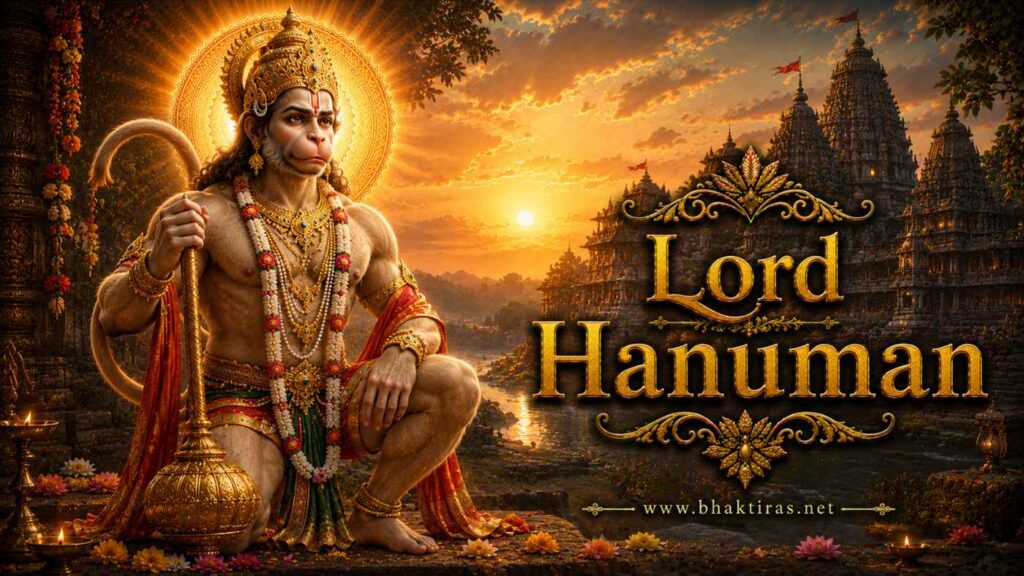
Who Is Lord Hanuman?
Of all the figures in Hindu devotion, few are loved as fiercely and as tenderly as Lord Hanuman. He is the mighty vanara – the divine monkey – whose strength could carry mountains and cross oceans, yet whose heart bowed low before a single name: Rama. In him, power and humility meet without contradiction. He can level an army, and in the next breath sit quietly at his master’s feet, asking nothing for himself.
Devotees know him by many names, and each carries a story. He is Bajrangbali, the one whose limbs are hard as the vajra, the thunderbolt. He is Pavanputra and Vayuputra, son of the wind. He is Anjaneya, the child of Anjana. He is Maruti, Sankat Mochan (the remover of troubles), and Mahavira, the great hero. To call on any of these names is to feel a little braver.
Hanuman is worshipped as an amsha – a portion, an incarnation – of Lord Shiva himself, born to serve Rama on earth. He is a Chiranjivi, one of the immortals, still present in the world today. Tradition holds that wherever the Ramayana is recited with love, Hanuman is there, listening, tears in his eyes, palms pressed together.
Yet for ordinary people, Hanuman is closer than any grand theology. He is the god you turn to when you are afraid in the night, when trouble surrounds you, when you feel small and the road ahead feels impossible. He answers not because you are worthy, but because devotion is his nature, and he cannot refuse a sincere heart.
Son of the Wind, Portion of Shiva
Hanuman’s mother was Anjana, an apsara who had taken birth in the world of the vanaras as the wife of Kesari, a noble vanara king of great courage. Anjana longed for a child and undertook long, austere penance to be granted one. Her prayers reached the heavens.
Vayu, the wind god who moves through all things unseen, carried a divine blessing to her – in many tellings, a share of a sacred offering meant to bring forth an extraordinary son. And so Anjana conceived a child of the wind, a boy who would inherit his father’s speed, his boundless reach, and his freedom to go anywhere. This is why Hanuman is called Pavanputra and Vayuputra, and why the wind is said to be his very kin.
But the deeper mystery runs to Shiva. It is widely held that Hanuman was born as an amsha, a portion, of Lord Shiva – a Rudravatar – descending into the world to place his immense power at the service of Rama, who was Vishnu come to earth. In Hanuman, then, the great gods conspire in love: Shiva takes birth as a servant so that he may worship Vishnu in human form. There is no rivalry in the divine, only devotion answering devotion.
From his very first days, Anjana’s son was no ordinary child. He was strong beyond measure, restless, glowing with an energy that could not be contained. And soon that energy would carry him toward the sky itself.
The Child Who Reached for the Sun
Leaping for a fruit of fire
When Hanuman was still a small child, hunger woke him one morning, and he looked up at the sky. There, rising red and round over the mountains, was the sun. To his innocent eyes it was a ripe fruit, glowing and ready to be plucked. So he did what any hungry child of the wind would do – he leapt.
Up he shot, faster and higher, mile after mile, until the whole earth fell away beneath him and the burning sun grew large before his face. He was reaching out to grasp it as one might reach for a mango on a branch, utterly unafraid of its fire.
The blow of Indra and the name Hanuman
That very day happened to be the day the demon Rahu had come to seize the sun, as he does at every eclipse. Seeing this small flying figure racing toward Surya, Rahu fled in alarm to Indra, king of the gods, crying that another had come to swallow the sun. Indra, to protect the order of the heavens, hurled his thunderbolt, the vajra, at the child.
The bolt struck the boy on the jaw, and he fell, senseless, to the earth. His jaw was marked and swollen by the blow – and from this comes the name Hanuman, for hanu means jaw. When Vayu saw his son struck down, grief turned to fury, and the wind withdrew itself from the world. All breath stopped; every creature began to suffocate.
Terrified, the gods rushed to make amends. They revived the child and, one by one, blessed him with gifts and powers – that no weapon could truly harm him, that he could change his size and fly where he wished, that he would live free and immortal. So the injury became a crowning. The marred jaw became a name spoken with love by millions.
The Supreme Devotee of Rama
For all his strength, Hanuman’s true greatness lies not in what he could lift, but in whom he chose to love. When he met Lord Rama in the forest, searching for the abducted Sita, something in him recognised his lord at once. From that moment, Hanuman belonged wholly to Rama, and asked for nothing in return but the chance to serve.
This is the heart of Hanuman’s example. He is called the dasa, the perfect servant, and he wears that title with pride, not shame. When once asked how he saw himself in relation to Rama, he is said to have answered with beautiful humility: in body, he is Rama’s servant; in spirit, a part of him; and in truth, they are one. Service, devotion, and union – all at once.
There is a tender image devotees hold close. When Hanuman was gifted a pearl necklace, he began biting each pearl and casting it aside, and the court laughed at his ignorance. He explained that he searched each pearl for the name of Rama, and finding it absent, the pearl was worthless to him. Then, to silence every doubt, he tore open his own chest – and there, seated in his heart, were Rama and Sita themselves. Wherever Hanuman is, Rama is enthroned within.
This is why devotion to Hanuman is never a detour from Rama, but the surest road to him. To love the servant is to be led straight to the master. Hanuman’s whole being points away from himself and toward the one he adores.
The Great Deeds of the Ramayana
The Ramayana is, in many ways, Hanuman’s stage. Time and again, when the cause of Rama seemed lost, it was Hanuman who turned the tide – not with cleverness alone, but with a strength born of pure devotion. These are the deeds that generations recount:
- The leap across the ocean. To find the captive Sita, Hanuman grew vast and sprang from the coast of India clear across the sea to the island of Lanka – a hundred yojanas in a single bound, over waves no one else could cross.
- Finding Sita in the Ashoka grove. In the garden where Ravana held her, Hanuman found the grieving Sita, comforted her with news of Rama, and gave her Rama’s signet ring as a token so she would know he was truly sent by her lord.
- Burning Lanka. When Ravana’s men set fire to Hanuman’s tail to mock him, he turned the insult into a weapon – leaping from rooftop to rooftop, he set the golden city of Lanka ablaze, then dipped his burning tail in the sea and returned unharmed.
- Carrying the Sanjeevani mountain. When Lakshmana lay dying on the battlefield, Hanuman flew to the Himalayas for the life-saving Sanjeevani herb. Unable to tell one healing plant from another in the dark, he lifted the entire mountain and carried it back through the sky, reaching the field in time to save Rama’s brother.
- Valour throughout the war. In the great battle for Lanka, Hanuman fought without pause – shattering armies, bearing Rama and Lakshmana on his shoulders, and standing as the tireless heart of their forces until Ravana fell.
In every one of these deeds, Hanuman acts not for glory but for his master. His strength is only ever a tool of his love, and that is what makes it holy.
Bajrangbali – Strength, Courage and Protection
The name Bajrangbali comes from bajrang (a form of vajra-anga, “one whose body is like the thunderbolt”) and bali (the strong one). It captures what draws so many people to Hanuman: here is a god of raw, protective power, whose strength is placed entirely at the service of those who call on him.
Devotees turn to Hanuman above all for courage. When fear presses in – fear of failure, of enemies, of the dark, of the unknown – his name is a shield. There is an old and deep-rooted belief that evil spirits and malign forces flee from wherever Hanuman is worshipped, and that reciting his praises drives away every terror of the night. He is Sankat Mochan, the breaker of troubles, and people bring him their worst difficulties trusting that he will carry them through.
He is also the patron of the strong and the striving – of wrestlers, athletes, soldiers, students, and anyone who must summon willpower and discipline. As a lifelong brahmachari, he embodies focused energy, self-control, and a body and mind bent to a single purpose. To worship Hanuman is to ask for the strength to endure, and the fearlessness to keep going.
The Hanuman Chalisa and How He Is Worshipped
No prayer to Hanuman is more beloved than the Hanuman Chalisa, forty verses composed in the Awadhi language by the poet-saint Tulsidas, the same devotee who gave the world the Ramcharitmanas. In simple, singing lines, the Chalisa recounts Hanuman’s virtues, his deeds, and his devotion, and asks for his protection. It is among the most recited prayers on earth, murmured by millions each morning and evening, in temples, homes, buses and trains.
Tuesday and Saturday are Hanuman’s special days. On these days, devotees visit his temples, offer worship, and often keep a simple fast or eat only once. Two offerings are almost inseparable from him: sindoor, the red-orange vermilion, and oil. The sindoor recalls a tender story – Hanuman once smeared his whole body with vermilion because he had seen Sita apply a little to her forehead for the long life of her husband, and he reasoned that if a pinch pleased Rama, then covering himself entirely would please him all the more. This is why Hanuman idols are so often coated in glistening orange sindoor mixed with oil.
Alongside these, devotees offer boondi laddus, betel leaves, and garlands, light lamps, and chant his mantras or the Chalisa. The worship of Hanuman is famously uncomplicated – he asks for no elaborate ritual, only sincerity. A single heartfelt “Jai Hanuman” is said to reach him.
Hanuman and Shani
Among the reasons people worship Hanuman with such trust is his power to protect them from the harsh influence of Shani – the planet and deity Saturn, whose periods are feared for bringing hardship, delay and suffering. Where Shani’s shadow falls heavy, Hanuman is believed to lighten it.
A well-loved story explains their bond. When Hanuman was setting fire to Lanka, he is said to have freed Shani, who had been imprisoned and made to lie beneath Ravana’s bed. In gratitude for his release, Shani promised Hanuman that he would never trouble those who are devoted to him – and would even show mercy to Hanuman’s worshippers during their most difficult planetary periods. In other tellings, Hanuman defeats Shani outright and wins the same promise of protection.
This is why Saturday – the day of Shani – is one of Hanuman’s two great days of worship. People undergoing sade sati or a hard Shani phase come to Hanuman’s temples, offer him oil and sindoor, and recite the Chalisa, asking him to stand between them and the weight of Saturn. In Hanuman they find a protector strong enough to soften even the sternest of the planetary powers.
Iconography & Symbols
Hanuman is shown in a handful of unmistakable forms, and each posture carries meaning:
The Mace (Gada)
His signature weapon, resting on his shoulder or raised in his hand, marks him as a warrior of immense strength and a guardian who stands ready to defend the devout. The mace is the sign of the Mahavira, the great hero.
The Mountain
Hanuman is often shown flying with a whole mountain balanced in one palm – the Sanjeevani peak he carried to heal Lakshmana. It recalls his willingness to move heaven and earth for those he loves, and his readiness to do the impossible when Rama’s cause demands it.
The Flying Form
Leaping through the air, one arm outstretched, tail curling behind, Hanuman the son of the wind is caught mid-flight. This form celebrates his speed, his freedom, and his boundless reach – no distance and no ocean can stop a servant carrying his master’s errand.
The Torn Chest
In one of the most moving images in all of Hindu art, Hanuman kneels and pulls open his own chest, revealing Rama and Sita seated within his heart. It is the purest emblem of bhakti – the devotee in whom the beloved lord literally lives.
Prayers & Mantras
Hanuman is called with some of the simplest and most powerful mantras in all of devotion. Chanted on Tuesday or Saturday, before dawn or at dusk, they are said to steady the heart, drive out fear, and draw his protection close. Below is his root mantra, followed by two of the most-loved invocations.
- ॐ हनुमते नमः – Om Hanumate Namah – “I bow to Hanuman.” The simplest of all his mantras, a whole prayer in a single breath, repeated on a mala for strength and courage.
- ॐ हं हनुमते रुद्रात्मकाय हुं फट् – Om Ham Hanumate Rudratmakaya Hum Phat – a protective invocation calling on Hanuman in his fierce, Shiva-natured (Rudra) form to shield the devotee from all fear and harm.
- श्रीगुरु चरन सरोज रज, निज मनु मुकुरु सुधारि – Shri guru charan saroj raj, nij manu mukuru sudhari – the opening doha of the Hanuman Chalisa, in which Tulsidas dusts the mirror of his mind with the pollen of his guru’s lotus feet before he begins to sing Hanuman’s glory.
Whether you chant the whole Chalisa or simply repeat “Jai Hanuman” through a hard day, the promise is the same: he hears, and he comes.
Frequently Asked Questions about Lord Hanuman
Who is Lord Hanuman?
Lord Hanuman is the vanara (divine monkey) god of Hinduism, the son of the wind god Vayu and Anjana, and the supreme devotee of Lord Rama. Regarded as an incarnation of Lord Shiva, he embodies strength, courage, humility and selfless service, and is worshipped for protection and fearlessness.
Why is Hanuman called Bajrangbali?
Bajrangbali means "the strong one whose limbs are like the vajra," the thunderbolt. The name honours Hanuman's extraordinary, near-invincible strength – a power he received through the blessings of the gods and uses entirely in the service of Rama and the protection of his devotees.
Why is Hanuman worshipped on Tuesday and Saturday?
Tuesday is traditionally linked to strength and courage, the very qualities Hanuman gives. Saturday is the day of Shani (Saturn), whose harsh influence Hanuman is believed to soften. Devotees visit his temples on both days, offering sindoor and oil and reciting the Hanuman Chalisa.
What is the Hanuman Chalisa?
The Hanuman Chalisa is a devotional hymn of forty verses composed by the saint Tulsidas in the Awadhi language. It praises Hanuman's virtues and deeds and seeks his protection. It is one of the most recited prayers in the world, chanted daily by millions for courage and relief from trouble.
Why is Hanuman shown covered in orange sindoor?
It comes from a story of his devotion. Seeing Sita apply a little vermilion for Rama's long life, Hanuman reasoned that covering himself entirely in sindoor would please Rama even more. Devotees honour this love by anointing his idols with orange sindoor mixed with oil.
Is Hanuman still alive today?
Yes, in the tradition. Hanuman is a Chiranjivi, one of the immortals blessed to live on through the ages. It is widely believed that he is present wherever the Ramayana is recited with devotion, listening quietly with Rama and Sita enshrined in his heart.
What does worshipping Hanuman give the devotee?
Devotees seek strength, courage, and freedom from fear. Hanuman is invoked to remove obstacles and troubles (as Sankat Mochan), to protect against negativity and evil forces, and to grant relief from the difficult periods of Shani (Saturn). Above all, he leads the devotee closer to Rama.
Why is Hanuman considered an incarnation of Shiva?
Tradition holds that Hanuman was born as an amsha, or portion, of Lord Shiva – a Rudravatar – so that Shiva himself could descend to serve Rama, an incarnation of Vishnu. It expresses a beautiful truth of Hindu devotion: the great gods delight in worshipping one another.
May Bajrangbali bless you with strength when you are weak, courage when you are afraid, and the quiet faith that carries every trouble to its end. Jai Hanuman.