
Goddess Savitri
सावित्री
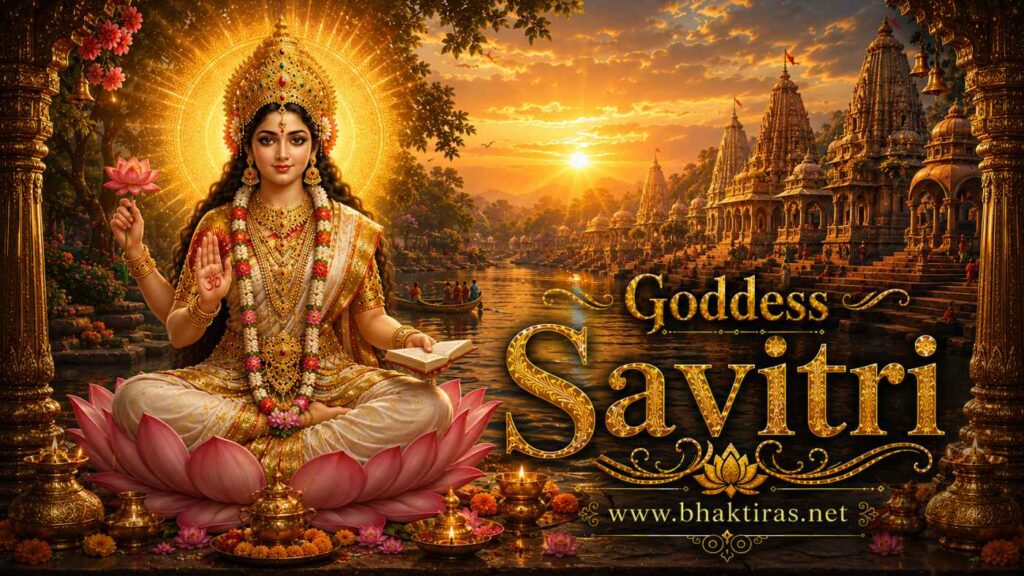
Savitri is the Vedic solar goddess who personifies the life-giving power of Savitr, the vivifying aspect of the Sun, and she is honoured as a consort of Lord Brahma. She is closely tied to the Gayatri Mantra, and her name is also carried by the beloved Mahabharata heroine who won back her husband from the god of death.
Who Is Goddess Savitri?
Goddess Savitri is one of the oldest and most luminous figures in the Hindu tradition, and her name gathers together two threads that Hindus have loved for thousands of years. The first is the Savitri of the Vedas – the solar goddess who carries the vivifying power of the Sun, worshipped as a consort of Lord Brahma and bound up with the most cherished prayer in Sanatana Dharma, the Gayatri Mantra. The second is the Savitri of the Mahabharata – a princess whose love for her husband Satyavan was so pure and so brave that she followed the god of death himself and would not turn back until she had won her husband’s life again.
These two Savitris are distinct. One is a shining deity of the heavens; the other is a mortal woman whose story became a mirror of ideal devotion. Yet they share more than a name. Both carry the theme of light against darkness – solar grace that gives and sustains life, and human love strong enough to call a soul back from death. In the warmth of Hindu devotion, the two have grown close, so that when a married woman keeps the Vat Savitri fast, she is remembering both the goddess of light and the woman whose faith outshone the shadow of Yama.
To meet Savitri, then, is to meet two faces of the same grace. This page honours both: the Vedic solar Devi and Brahma’s consort, and the Savitri-Satyavan ideal that lives on in the banyan-tree vow kept every year across India.
The Solar Goddess and Consort of Brahma
Savitri and the Gayatri Mantra
The Story of Savitri and Satyavan
A Princess Named for the Sun
In the Mahabharata we meet another Savitri – a princess born to King Ashwapati after long prayer, and named for the solar goddess whose grace had granted her. She grew into a woman of rare intelligence and calm strength. When the time came to marry, she chose for herself, and her choice was Satyavan, a noble young man living in a forest hermitage with his blind, exiled father. The sage Narada warned her: Satyavan was destined to die exactly one year from that day. Savitri did not waver. Having given her heart once, she would give it fully. ‘I have chosen him,’ she said, ‘and I will not choose again.’
The Day Yama Came
Savitri married Satyavan and lived quietly with him in the forest, serving his parents and keeping the year’s count in her heart. As the fatal day drew near she took a hard fast of three nights, standing in prayer. On the appointed morning she asked to walk with her husband into the woods as he went to gather firewood. There, as he had been foretold, Satyavan grew faint, laid his head in her lap, and his breath left him. And then Savitri saw a figure she had never seen – Yama, the god of death himself, come in person to draw out so pure a soul.
Following the Lord of Death
Yama bound Satyavan’s soul and turned to leave, and Savitri rose and followed. Mile after mile she walked behind the god of death, speaking to him with such wisdom, courtesy and truth that Yama, moved, offered her boons – any gift, he said, except her husband’s life. Savitri asked first for her father-in-law’s sight and kingdom restored, then for children for her own father, then for a hundred sons of her own. Yama granted each. But then she gently reminded him: how could she, a devoted wife, bear a hundred sons without her husband? Caught by his own word and won over by her virtue, Yama smiled and released Satyavan’s soul. Savitri returned to the forest, her husband woke as if from sleep, and by her steadfast love a life was called back from death.
The tale of Savitri and Satyavan has been retold across India for centuries, not as a story of magic but of character – of a love so faithful and a mind so clear that even death could be answered with reason and grace. She became the enduring image of the devoted wife, and her courage the measure of what love can accomplish.
Vat Savitri Vrat
Iconography & Symbols
The Radiance of the Sun
In her Vedic form, Savitri is imagined as a goddess of light, glowing with the warmth of the Sun. Golden hues, a soft halo of rays, and an air of serene grace mark her as the feminine face of Savitr, the life-giving solar power.
Beside Lord Brahma
As Brahma’s consort she is often shown near the four-faced creator, sharing in the work of creation. Her presence signals the vitality and sustaining warmth without which the created world could not flourish.
The Sacred Banyan
In her festival form, Savitri is inseparable from the banyan tree. Depictions of Vat Savitri show her fasting and worshipping beside the vat, a tree whose long life and spreading roots mirror the endurance of a faithful marriage.
The Devoted Wife
The Mahabharata Savitri is pictured as a calm, resolute woman – sometimes shown following Yama, sometimes cradling Satyavan’s head in her lap. Her image carries dignity, courage and unshakeable love rather than adornment.
How Goddess Savitri Is Worshipped
Savitri is worshipped both as the solar Devi of the sacred mantra and through the devotional vow that carries her name. Her worship is gentle, daily and heartfelt, centred on light, faithfulness and the household.
- Chanting the Gayatri Mantra at dawn, dusk and midday – the Savitri mantra addressed to the life-giving Sun – is the most widespread way of honouring her.
- Offering water to the rising Sun (Surya Arghya) at sunrise, remembering Savitr as the source of light and life.
- Keeping the Vat Savitri Vrat in Jyeshtha, when married women fast and worship the banyan tree for the long life of their husbands.
- Tying a sacred thread around the banyan trunk and circling it in prayer, echoing Savitri’s vigil beside the tree where Satyavan was revived.
- Reciting or listening to the story of Savitri and Satyavan on the festival day, so that her devotion is remembered and honoured.
- Lighting a lamp and offering vermilion, turmeric and flowers to the goddess, praying for marital harmony, wisdom and inner illumination.
Prayers & Mantras
The prayers to Savitri call upon light – both the outer light of the Sun and the inner light of understanding. The simple salutation below can be chanted daily, and the Gayatri Mantra, her own sacred verse, remains the fullest way of drawing near to her grace.
Salutation to Savitri
ॐ सावित्र्यै नमः
Om Savitryai Namah
Salutations to Savitri, goddess of the life-giving Sun. A short, gentle mantra to invoke her radiance and her steadfast, protecting grace at the start of the day.
The Gayatri (Savitri) Mantra
ॐ भूर्भुवः स्वः तत्सवितुर्वरेण्यं भर्गो देवस्य धीमहि धियो यो नः प्रचोदयात्॥
Om Bhur Bhuvah Svah, Tat Savitur Varenyam, Bhargo Devasya Dhimahi, Dhiyo Yo Nah Prachodayat
We meditate on the adorable light of the divine Sun (Savitr); may that light awaken and guide our understanding.
Frequently Asked Questions about Goddess Savitri
Who is Goddess Savitri?
Savitri is the Vedic solar goddess who personifies the life-giving power of Savitr, the vivifying aspect of the Sun, and is honoured as a consort of Lord Brahma. Her name is also carried by the Mahabharata princess who won back her husband Satyavan from the god of death, so she embodies both solar grace and ideal devotion.
Is Savitri the same as Gayatri?
They are very closely related and often identified as one. The famous Gayatri Mantra is technically the Savitri mantra, addressed to Savitr, the Sun. Because Savitri personifies that solar light, devotees frequently use the names Savitri and Gayatri interchangeably for the goddess of the sacred verse, though each name carries its own shade of meaning.
What is the story of Savitri and Satyavan?
Princess Savitri married Satyavan knowing he was fated to die within a year. When Yama, the god of death, came for his soul, Savitri followed him and answered him with such wisdom and virtue that he granted her boons. By her cleverness and unshakeable love, she won back Satyavan's life, becoming the enduring ideal of the devoted wife.
What is Vat Savitri Vrat?
Vat Savitri Vrat is a fast kept by married women in the month of Jyeshtha, honouring the day Savitri saved Satyavan. Women worship the banyan (vat) tree, offer water and flowers, tie a sacred thread around its trunk, and pray for the long life of their husbands, remembering Savitri's faithful devotion.
Who is Savitri's consort?
As the Vedic solar goddess, Savitri is honoured as a consort of Lord Brahma, the creator. She embodies the warm, life-giving radiance of the Sun that lets the created world flourish, and is sometimes named alongside Sarasvati and Gayatri among the goddesses who attend Brahma's work of creation.
Why is the banyan tree worshipped in Savitri's festival?
Tradition holds that Satyavan was revived beneath a banyan tree, so the vat became sacred to Savitri's vow. The banyan's long life and spreading aerial roots, which grow into new trunks, make it a living emblem of endurance and continuity – a fitting symbol of the lasting marital bond the fast seeks to protect.
What blessings do devotees ask of Goddess Savitri?
Devotees pray to Savitri for the long life and wellbeing of their husbands, for marital harmony and a happy home, and for wisdom and inner light. In her solar and Gayatri form she is invoked for clarity of mind and spiritual illumination, that the divine light of the Sun may awaken and guide the understanding.
May the light of Goddess Savitri fill your days with warmth and clarity, and may her devotion inspire love that endures.