
Yama Dev
यम
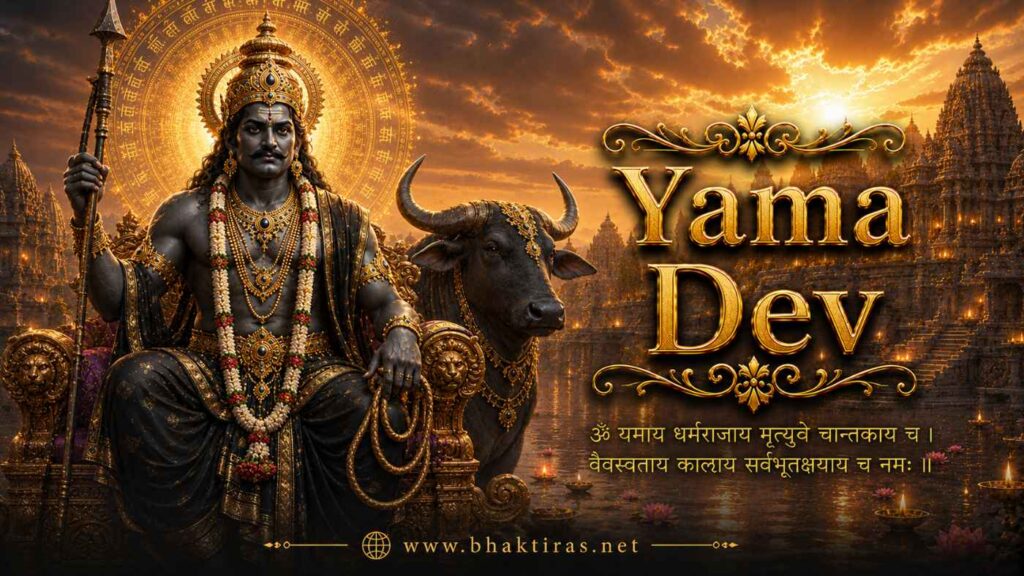
Yama Dev is the Hindu god of death and dharma, the fair judge who weighs every soul's deeds at the end of life. Called Dharmaraja, he guards the southern direction, rides a buffalo, and carries the danda staff and pasha noose. He is just and righteous, never cruel – the keeper of cosmic law.
Who Is Yama Dev
Yama Dev is the Hindu god of death and the guardian of dharma, the moral order that holds the universe together. When a life reaches its appointed end, it is Yama who oversees the passage of the soul from one world to the next. Far from a figure of terror, he is honoured as Dharmaraja, the king of righteousness, whose task is to see that every being receives exactly what its actions have earned – no more and no less.
A common mistake is to picture Yama as a devil or a cruel executioner. He is neither. In Hindu thought, death is not evil but a natural turning of the wheel, and Yama is its impartial administrator. He does not decide who lives or dies out of malice; he simply upholds the law of karma that governs all souls, including the gods themselves. His fairness is so complete that even his own relatives receive no favour before his ledger.
He is counted among the ancient Devas of the Vedas, where he already appears as a wise and kingly presence. Over the centuries his portrait deepened – part magistrate, part elder, part teacher – yet the core never changed. Yama is the one who ensures that the cosmos remains just, that consequence follows conduct, and that no deed is ever truly forgotten.
To remember Yama is to remember our own mortality, and Hindu tradition treats this not as morbid but as clarifying. Keeping death in view sharpens the mind toward what truly matters: honesty, compassion, duty faithfully done. In this sense Yama is a quiet moral guide for the living as much as a judge of the departed.
The First to Die – Pathfinder & King of Ancestors
One of the oldest ideas about Yama, carried in the hymns of the Rigveda, is that he was the first mortal to die. Being the first to cross over, he discovered the path that leads from this world to the world beyond – and having found that road, he became its keeper and guide for all who would follow.
Because of this, Yama is called the king of the ancestors, the ruler of the realm where the pitrs (the departed forefathers) dwell. The old verses describe him gathering the good in a place of light and rest, welcoming them as a host receives honoured guests. This gentle, almost paternal image sits at the very heart of his character: he is not a stranger to death but the elder who walked ahead and now waits to receive us.
His twin sister Yami stood at his side in these earliest accounts, and together the pair are among the first named beings in the human story. This origin – the pioneer who charts the unknown road so others need not fear it – gives Yama a tenderness that later, sterner images sometimes obscure. He was, before he was ever a judge, simply the first traveller who learned the way home.
Iconography & Symbols
Yama is depicted with a striking, memorable set of attributes, each one carrying meaning about his office and his nature.
The Buffalo Mount
Yama rides a mighty black buffalo (mahisha), a steady and powerful animal that reflects his grave, unhurried authority. The buffalo carries him across the worlds as he goes about his duty, and its dark strength mirrors the inevitability of the law he serves.
The Danda (Staff)
In one hand Yama holds the danda, the staff of rule and punishment. It is the emblem of his authority to judge and to enforce the sentence that karma demands. The very word ‘Dandadhara’, staff-bearer, is one of his titles, marking him as the enforcer of cosmic justice.
The Pasha (Noose)
Yama and his messengers carry the pasha, a noose used to draw the soul gently out of the body at the moment of death. It binds the departing spirit and leads it to Yamaloka for reckoning. The noose is not a weapon of violence but an instrument of an appointed, orderly passage.
The Dark Form
His body is often shown deep blue-black or dark green, the colour of the unknown and of the night into which all life eventually passes. This darkness is not sinister; it signifies the profound mystery of death that lies beyond ordinary sight.
The Crown
As Dharmaraja, the king of righteousness, Yama wears a royal crown. He rules a genuine kingdom with its own order, court and record-keepers, and the crown affirms that death is not chaos but a well-governed dominion.
The Red Robes
Yama is frequently draped in red garments, a colour tied to power, gravity and the solemn seriousness of his work. The rich robes present him as a dignified sovereign presiding over the most important of judgements.
Chitragupta & the Ledger of Karma
Yama does not judge from memory or whim. At his side works Chitragupta, the meticulous divine scribe whose name means ‘hidden picture’ – the one who keeps the secret record of every soul. From the moment a person is born, Chitragupta notes down each deed, good and bad, spoken and unspoken, in a great ledger called the Agrasandhani.
When a soul arrives in Yamaloka, this account is opened and read aloud. Nothing is missed and nothing can be argued away, for the record is exact. On the strength of this ledger, Yama weighs the balance of a person’s life – the merit of their virtues against the weight of their faults – and pronounces what is owed. This is the true meaning of the ‘weighing of karma’: a precise accounting, not an arbitrary verdict.
Souls whose wrongs outweigh their good may pass through the corrective regions of Naraka, described in texts like the Garuda Purana as places of purification where the consequences of harmful deeds are worked through. Importantly, Naraka in most Hindu understanding is not eternal – it is a temporary settling of accounts. Once the debt is paid, the soul moves on to rebirth, carrying the lessons forward. Yama’s realm is therefore a station on the endless journey of the soul, not a final destination, and his justice serves the soul’s long path toward release.
Guardian of the South
Yama holds a place among the Dikpalas, the eight guardians who watch over the directions of space and keep the cosmos in order. To Yama belongs the South (Dakshina), and he is honoured as its lord and protector.
This is why, in traditional practice, the south is associated with the ancestors and with rites for the departed – offerings to the pitrs are made facing that quarter, toward Yama’s domain. When temples and homes are laid out according to Vastu principles, the southern direction is treated with the gravity befitting the direction of dharma and reckoning.
As a Dikpala, Yama is not only the judge of individual souls but a pillar of the wider order of the universe. Each guardian anchors a direction and, with it, an aspect of cosmic balance; Yama’s charge is the balance of justice itself. In protecting the south, he protects the principle that actions carry consequences and that the world remains morally sound.
Yama & His Sister Yamuna – Bhai Dooj
Yama shares a deeply loved story with his twin sister Yamuna (also called Yami), the goddess of the sacred river that bears her name. The bond between them gives rise to one of the warmest festivals of the Hindu year – Bhai Dooj, also known as Yama Dwitiya.
The tradition tells that Yama, busy with his solemn duties, had long been apart from his sister. Yamuna longed to see him and invited him warmly to her home. When he finally came, she received him with great affection – a tilak on his forehead, a garland, and a lovingly prepared meal. Touched by her care, Yama offered her a boon, and she asked that any brother who receives his sister’s welcome and blessing on this day be granted long life and freedom from fear of untimely death.
Yama granted her wish, and so the festival was born. To this day, on the second day after Diwali, sisters apply a tilak to their brothers’ foreheads and pray for their wellbeing, and brothers offer gifts and their protection in return. It is a beautiful reminder that even the god of death honours the ties of love and family, and that his blessings flow toward those who cherish one another.
The Teaching to Nachiketa
The Katha Upanishad preserves one of the most profound conversations in all of Hindu scripture – and its teacher is Yama himself. A young boy named Nachiketa, sent by his father in a moment of anger to the house of Death, arrives at Yama’s abode and waits three days without food while Yama is away.
On returning, Yama, ashamed to have left a guest unwelcomed, offers the boy three boons. For the first, Nachiketa asks that his father’s anger be calmed; for the second, he asks to learn the fire sacrifice that leads to the heavens. Both are granted. For the third, he asks the deepest question of all: what happens after death – does the Self continue, or is there nothing?
Yama tries to turn him aside, offering wealth, long life, sons and pleasures in its place. But Nachiketa refuses every temptation, insisting on the truth. Impressed by the boy’s clear resolve, Yama at last teaches him the great secret: the Atman, the true Self, is unborn and undying. It is not slain when the body is slain; it neither kills nor is killed. What passes away is only the outer form, while the innermost Self is eternal. Through this dialogue, the very lord of death becomes the guru of immortality, showing that to understand death rightly is to be freed from the fear of it.
A Story Every Devotee Knows
Savitri Wins Back Satyavan
Savitri, a princess of great wisdom, chose Satyavan as her husband though she knew he was fated to die within a year. When the appointed day came and Yama arrived to take his soul, Savitri followed the god of death step by step, refusing to turn back. Moved by her devotion, Yama offered her boons – anything but her husband’s life. Cleverly and with unshakeable love, she asked for boons that could only be fulfilled if Satyavan lived: children, the restoration of her father-in-law’s kingdom and sight. Cornered by his own word and disarmed by her virtue, Yama at last returned Satyavan’s life. The tale, told in the Mahabharata, honours both a wife’s devotion and Yama’s essential fairness – even Death yields to truth and righteousness.
Markandeya and the Grace of Shiva
Markandeya was a boy destined to die at sixteen, yet he was so devoted to Shiva that he spent his short life in worship. When the fateful day arrived and Yama came with his noose to claim him, the boy clung fast to the Shiva lingam in prayer. As the noose was cast, it fell upon the lingam itself, and Shiva burst forth in fierce compassion to protect his devotee. Yama, recognising the will of the great god, withdrew, and Markandeya was blessed to remain forever sixteen. The story is remembered not as Yama’s defeat but as a lesson: even the law of death bends before sincere devotion and the grace of the divine, and Yama, being dharmic, honours that higher order.
Prayers & Mantras
Devotees turn to Yama Dev not out of dread but out of respect, seeking his blessing for a life lived with honesty, for a peaceful passing when the time comes, and for protection from untimely death. Remembering him also keeps the heart mindful of dharma. His simple root mantra is chanted with a steady, reverent mind:
- Mool Mantra: ॐ यमाय नमः – Om Yamaya Namah – ‘I bow to Yama, the lord of dharma and just judge of all.’
The most beloved observance in his honour is the Yama Deepam, kept on the evening of Dhanteras. A single lamp of oil is lit and placed facing south – the direction of Yama – usually at the doorway or outside the home. As the flame burns, the family prays for protection from untimely death and for the wellbeing of every member of the household. This quiet ritual of a lone light in the gathering dark is a graceful way of acknowledging death while asking for the gift of a full and peaceful life.
Frequently Asked Questions about Yama Dev
Who is Yama Dev?
Yama is the Hindu god of death and dharma, the fair judge who weighs every soul's deeds after life. Also called Dharmaraja and Yamaraja, he rides a buffalo, carries the danda staff and pasha noose, and guards the southern direction. He is not evil – he is the impartial keeper of justice and cosmic law.
Is Yama Dev good or evil?
Yama is neither cruel nor evil. He is the dispassionate judge of karma who gives each soul exactly what its actions have earned, guided by dharma rather than anger. Hindu texts honour him as Dharmaraja, the lord of righteousness, and even portray him teaching the deepest truths about the soul to the boy Nachiketa.
Who records our deeds for Yama?
Chitragupta, Yama's divine scribe, is said to keep the Agrasandhani – a complete ledger of every being's good and bad actions. When a soul reaches Yamaloka, Chitragupta reads out this record, and Yama pronounces the just result: rebirth, reward or a period of learning, always in keeping with the soul's own karma.
Which direction does Yama Dev guard?
Yama is the Dikpala, or guardian, of the South. In temple design, rituals and vastu the southern quarter is placed under his charge, which is why the head is traditionally kept away from the south while sleeping and why the south is linked to the ancestors and the path of the departed.
What is the story of Yama and Nachiketa?
In the Katha Upanishad, the boy Nachiketa is sent to Yama and waits three days. Pleased, Yama grants three boons, and for the last Nachiketa asks what happens after death. Yama first tempts him with riches, then, seeing his sincerity, teaches the immortal nature of the Self – one of Hinduism's deepest dialogues on death.
Why is Yama linked to Bhai Dooj?
Yama's twin sister is Yamuna. Tradition says she lovingly invited him to her home, applied a tilak and fed him, and Yama blessed that any brother honoured by his sister on that day would be freed from fear of untimely death. This is remembered as Bhai Dooj, also called Yama Dwitiya.
How is Yama Dev worshipped?
Yama is honoured for a long, righteous life and a peaceful passing. On Dhanteras, a lamp called Yama Deepam is lit facing south to seek protection from untimely death. Sisters honour brothers on Bhai Dooj in his name, and the mantra 'Om Yamaya Namah' is chanted with prayers for courage to live by dharma.
May Yama Dev bless you with a life of honesty and dharma, and may his justice remind us always that every kind and truthful deed carries its own quiet reward.