
Vayu Dev
वायु
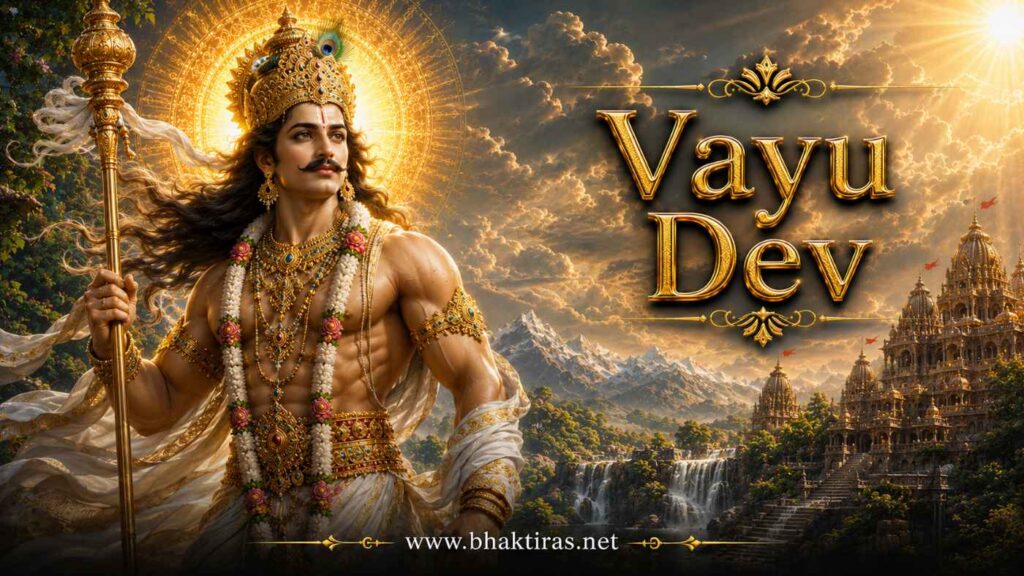
Vayu is the Vedic god of wind, air, and the vital breath (prana) that animates every living being. Invisible yet present everywhere, he governs life-force and movement, guards the North-West direction, and is honoured as the divine father of Hanuman and of the Pandava hero Bhima.
Who Is Vayu Dev
Vayu is the Vedic god who moves through the world as wind, air, and the breath that keeps every creature alive. His name comes from the Sanskrit root va, meaning to blow, and he is called by many names across the scriptures – Pavana (the purifier), Marut, Anila, Vata, and Prana, the vital force itself. He is one of the oldest deities in Hindu thought, praised in the earliest hymns of the Rigveda alongside Indra and Agni.
What sets Vayu apart is that he cannot be seen, only felt. He has no fixed shape, yet nothing lives without him. A gust bending the trees, the cool relief of a morning breeze, the rise and fall of one’s own chest – all of this is Vayu at work. Because breath is the closest and most constant sign of being alive, Vayu is understood not as a distant sky-god but as a presence carried inside every body.
In the classical picture of the cosmos, Vayu is a Dikpala, a guardian of the directions, holding watch over the North-West quarter known as Vayavya. He commands the Maruts, a band of youthful storm gods who ride the thunderclouds. And in the epics he becomes a father: Hanuman and Bhima are both called his sons, which earned him a lasting place in stories of devotion and strength.
Vayu is worshipped across the whole of India rather than at a single famous shrine, because his presence is universal. Wherever there is wind and wherever there is breath, he is already there.
Wind as Prana – the Breath of Life
The deepest meaning of Vayu is not weather but life. In Hindu philosophy, prana is the vital energy that flows through the body, and Vayu is its divine source. The same air that stirs the outer world enters the lungs and becomes the current that sustains thought, movement, and consciousness. To breathe, in this view, is to receive Vayu directly.
Yogic teaching maps this force with great care. The single word prana opens into five pranas or vital airs – prana (intake and the heart region), apana (elimination, the lower body), samana (digestion), udana (the upward breath and speech), and vyana (circulation through the whole frame). Each is a face of Vayu operating inside a person. Health, in this understanding, is these airs flowing freely; illness is their blockage.
This is why pranayama, the discipline of controlled breathing, sits at the centre of yoga. By lengthening, steadying, and directing the breath, a practitioner is working with Vayu himself, calming the mind through the very air that carries it. The breath becomes both the tool and the teacher. When Hindus speak of Vayu as the god of life-force, they mean something intimate: he is nearer than any temple, present in every inhalation.
The Divine Father – Hanuman & Bhima
Vayu’s most beloved role in the epics is that of a father. Hanuman, the devoted servant of Rama, is known as Pavanputra and Vayuputra – the son of the wind. It is Vayu’s nature that gives Hanuman his signature powers: the ability to leap across the ocean, to fly, to expand or shrink his form, and to move with a speed no obstacle can hold back. When Hanuman soars toward Lanka or carries an entire mountain through the sky, the wind-god’s blood is showing itself.
In the Mahabharata, Vayu is the divine father of Bhima, second of the five Pandava brothers. Bhima’s tremendous strength, his appetite, and his fierce loyalty all echo his father’s untamed force. Like Hanuman, Bhima is swift and mighty, and the two are treated as spiritual brothers – both born of the same wind.
For devotees, this fatherhood makes Vayu approachable and warm. To honour Hanuman is, in a quiet way, to honour Vayu as well. The wind-god is remembered not only as an abstract cosmic power but as the parent behind two of the most loved heroes in the tradition, a giver of courage, endurance, and unstoppable movement.
Iconography & Symbols
The Deer Mount
Vayu is most often shown riding a deer or gazelle, a creature famous for its speed and lightness. The swift, darting animal mirrors the wind’s own quick and restless nature. In some depictions he rides a horse instead, another symbol of galloping motion.
The Banner
A flag or banner streaming in his hand is Vayu’s clearest emblem. Cloth needs wind to unfurl, so a fluttering banner is the visible proof of an invisible god – the one image that makes the unseen wind suddenly plain to the eye.
Blue-White Form
When given a body, Vayu appears fair and luminous, often in shades of blue and white that suggest clear sky and open air. He is pictured as strong and youthful, sometimes holding an ankusha (goad), a sign of his power to drive and direct the winds.
The Unseen Wind
The truest image of Vayu is no image at all. Artists give him a form so worshippers have something to focus on, but his real presence is the moving air itself – felt on the skin, heard in the trees, and breathed into the body, everywhere at once and never held.
Guardian of the North-West & the Maruts
In the ordered map of the cosmos, each direction has a guardian deity called a Dikpala, and Vayu rules the North-West, the quarter named Vayavya after him. Temples, city plans, and the traditional science of vastu place the wind-god’s influence in that corner, associating it with air, movement, and circulation. Offerings and orientations that honour the North-West are, in effect, an acknowledgement of Vayu’s watch.
Vayu does not act alone. He leads the Maruts, a spirited troop of storm gods described in the Rigveda as youthful, golden, and armed with lightning. They ride the racing clouds, driving rain and thunder before them, and their arrival is the sky in motion. As their commander, Vayu directs the wild energy of the monsoon and the tempest – the same force that clears the air, waters the fields, and reminds the world of nature’s raw power.
Through this role, Vayu holds together two sides of the wind. He is the gentle, life-giving breath within the body, and he is also the vast, sweeping gale that shakes the mountains. Guardian of a direction and captain of the storm, he keeps the great currents of the world moving.
Vayu in the Dvaita Tradition
Vayu holds a place of extraordinary honour in the Dvaita (dualist) school of Vaishnavism founded by the thirteenth-century saint Madhvacharya. In this tradition Vayu is revered as Mukhyaprana, the chief of all vital forces and the foremost among the jivas – the highest of all living souls, ranked just below God (Vishnu) himself. He is seen as the loyal servant and mediator between the Lord and the world, the one who carries devotion upward.
Madhva’s followers teach that Vayu takes three great forms across the ages to guide humanity toward truth. In the Treta Yuga he came as Hanuman, the perfect devotee of Rama; in the Dvapara Yuga as Bhima, the righteous Pandava; and in the Kali Yuga as Madhvacharya himself, the teacher who restored true devotion. This lineage of Hanuman, Bhima, and Madhva is central to Dvaita faith.
Because of this, Vayu is worshipped with deep reverence in Dvaita communities, especially across Karnataka and coastal regions. He is not merely a nature-god here but the ideal devotee, the model of surrender and service, showing that the path to the divine is walked through humble, unwavering love.
How Vayu Dev Is Honoured
Vayu is honoured less through grand temples and more through daily and inward practice, fitting for a god who lives in the breath. Devotees turn to him for health, energy, and freedom from obstacles, and remember him in these ways:
- Practising pranayama and yogic breathing, treating each conscious breath as communion with the wind-god.
- Worshipping Hanuman, since honouring the son as Pavanputra naturally honours the father, Vayu.
- Chanting his name Om Vayave Namah for vitality, mental calm, and the clearing away of stagnation.
- Observing the North-West (Vayavya) direction in vastu and in the placement of ventilation and open space in the home.
- Reciting Vedic hymns and Maruta prayers for rain, good air, and the health of crops and cattle.
- Honouring him within Dvaita worship as Mukhyaprana, the model of pure devotion and service.
A Story from the Scriptures
The Contest with the Cosmic Serpent
A well-known Puranic tale tells of a proud rivalry between Vayu and Adishesha, the great thousand-hooded serpent who coils around Mount Meru and holds the world steady. When the two argued over who was stronger, they set a test: Adishesha wrapped his enormous body tightly around the mountain, and Vayu was challenged to move it. The wind-god summoned a storm of such force that the earth shook and the seas rose, but the serpent held firm. Then the sage Narada quietly advised Adishesha to lift just one hood for a moment. In that instant Vayu’s gale tore the peak of the mountain away and flung it into the sea, where it became the island of Lanka. The story teaches that even the most immovable strength must eventually yield to the wind, and that pride invites a humbling.
The Birth of Hanuman
The scriptures tell how Vayu came to father Hanuman. When a sacred offering meant to grant sons was carried on the wind, a portion of it reached Anjana, a devoted celestial woman living in penance. By Vayu’s grace she conceived, and Hanuman was born carrying the wind-god’s power – his speed, his boundless leaping, and his ability to change his size at will. From his first days Hanuman showed his father’s nature, once bounding toward the sun itself, mistaking it for a fruit. Through this birth, Vayu gave the world its greatest example of devotion clothed in strength.
Prayers & Mantras
Prayers to Vayu ask for vitality, clarity, and the smooth flow of life-energy. The simplest and most widely used mantra is a direct salutation to the wind-god, often chanted while steadying the breath. Repeated with attention, it is believed to calm the mind, strengthen the body, and clear away what feels stuck or heavy.
Frequently Asked Questions about Vayu Dev
Who is Vayu Dev?
Vayu is the Vedic god of wind, air, and the vital breath called prana. He is an ancient deity praised in the Rigveda, one of the guardians of the directions, and the divine father of Hanuman and Bhima. Though invisible, he is present everywhere as the moving air and the life-force within all beings.
Why is Vayu called the father of Hanuman?
Hanuman is known as Pavanputra and Vayuputra, meaning son of the wind. The scriptures say Vayu granted his power to Anjana, and Hanuman was born carrying the wind-god's nature – his great speed, his ability to fly and leap vast distances, and his power to change his size at will. Honouring Hanuman is therefore a way of honouring Vayu.
What is the connection between Vayu and prana?
Prana is the vital energy that sustains life, and Vayu is its divine source. The same air that moves the world enters the body as breath and becomes prana. Yoga describes five vital airs – prana, apana, samana, udana, and vyana – each a form of Vayu working within a person. This is why breathing itself is seen as receiving the wind-god.
How is Vayu Dev worshipped?
Vayu is honoured mostly through inward practice rather than large temples. Devotees chant Om Vayave Namah, practise pranayama and yogic breathing, and worship Hanuman as his son. In vastu the North-West direction is kept for him. In the Dvaita tradition he is revered as Mukhyaprana, the ideal devotee and model of service.
What is Vayu's mantra?
The most common mantra is Om Vayave Namah (ॐ वायवे नमः), a simple salutation meaning "I bow to Vayu." It is often chanted while steadying the breath, and devotees believe it brings vitality, mental calm, and the clearing away of stagnant energy. Vedic hymns to Vayu and the Maruts are also recited for health and good air.
Who are the Maruts?
The Maruts are a troop of youthful storm gods who serve under Vayu's command. Described in the Rigveda as golden, swift, and armed with lightning, they ride the racing clouds and bring rain and thunder. As their leader, Vayu directs the wild energy of the monsoon and the tempest, the powerful side of the wind that clears the air and waters the earth.
Why is Vayu important in the Dvaita tradition?
In Madhvacharya's Dvaita school, Vayu is revered as Mukhyaprana, the chief of vital forces and the highest of living souls, ranked just below Vishnu. He is seen as the perfect devotee and mediator. The tradition holds that he took three forms – Hanuman, Bhima, and Madhvacharya himself – to guide people toward true devotion in different ages.
Which direction does Vayu Dev guard?
Vayu is the Dikpala, or guardian deity, of the North-West direction, known as Vayavya after him. In vastu and traditional cosmology this quarter is linked to air, movement, and circulation. Homes and temples are often designed with the North-West in mind, keeping it for ventilation and open flow, which acknowledges the wind-god's influence.
May Vayu Dev fill your days with clear breath, steady strength, and the quiet grace of the wind that moves through all things.