
Shani Dev
शनि
Shani Dev is the Navagraha lord of the planet Saturn and the fair judge of karma. He is not evil or unlucky – he simply returns to each person the exact result of their own actions. Honest, patient, hardworking people find him kind, while shortcuts and cruelty meet his discipline. He is worshipped on Saturdays.
Who Is Shani Dev?
Before anything else, it helps to clear up the most common worry. Shani Dev is not a bringer of bad luck or misfortune. He is the fair judge of karma among the Navagraha, the nine celestial governors. Shani presides over the planet Saturn, and his task is simple and impartial: he weighs what each person has done and returns to them exactly what they have earned – no more and no less.
His name comes from shanaih, meaning slowly, because Saturn is the slowest-moving of the classical planets. That slowness is part of his character. Shani never rushes a judgement. He observes patiently over long stretches of time, which is why his lessons often unfold across years rather than days. This patience is also why he governs discipline, hard work, perseverance, longevity and old age.
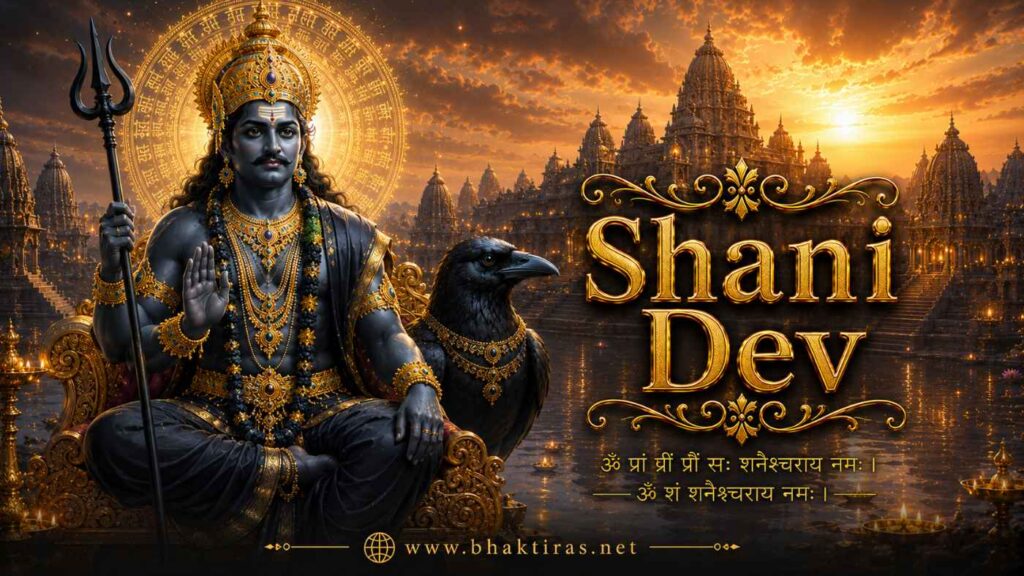
Shani is the son of Surya, the Sun, and Chhaya, the shadow. He is the brother of Yama, the lord of dharma, and the two share a deep concern with justice – Yama over death, Shani over the living. In images he appears dark of complexion, calm and unhurried, riding a crow and carrying the staff of justice.
The devotees who fear Shani are usually those who dread being held accountable. Those who live honestly come to see him as a steady, protective guide. He rewards effort, patience and truthfulness, and he humbles arrogance and cruelty. Understood this way, Shani is one of the most reassuring figures in the tradition: with him, life is fair.
The Fair Judge of Karma
The heart of Shani worship is the law of karma – action and its fruit. Shani is the deity who makes that law visible in daily life. If a person plants effort, honesty and kindness, Shani sees to it that they eventually reap security, respect and quiet strength. If someone sows deceit, cruelty or laziness, the same lord ensures those seeds ripen into difficulty. Nothing is arbitrary. Everything is earned.
This is why Shani is called strict but never unjust. A judge who lets the guilty go free and punishes the innocent would be cruel; Shani does neither. He is exacting precisely because he is fair. The delays and obstacles people associate with him are rarely punishments for their own sake. More often they are corrections – a slowing down that forces a person to face what they have avoided, mend what they have neglected, and grow.
There is real comfort in this for honest, hardworking people. Shani has a special regard for the labourer, the servant, the disciplined student, the person who keeps their word when no one is watching. To such devotees he is generous, granting endurance, steady progress and rewards that last because they were truly deserved. Far from something to dread, his gaze is the assurance that sincere effort is never wasted.
Birth and Iconography
Shani’s form carries meaning in every detail. Born of the Sun and a shadow, he is depicted as dark and grave, embodying the seriousness of judgement. Each symbol below expresses a part of his role.
Dark, calm complexion
Shani is shown deep black or blue-black, the colour of Saturn and of impartial night. His calm expression reflects a mind that judges without anger or favour.
The crow mount
His vahana is usually a crow, a bird linked to ancestors and karmic memory. He is also pictured with a vulture, a buffalo or an iron chariot, all creatures of patience and endurance.
Sword and danda
He carries a sword and the danda, the staff of justice held by rightful authority. They stand for the firm, lawful correction that follows wrongdoing.
Bow and arrow
The bow marks his precision. Like an archer, Shani delivers exactly the result a person’s actions have aimed at – never a stray or unearned outcome.
The lame gait
Shani is often described as limping. In one account an injury made his walk slow and uneven, a fitting image for the deity who moves and judges deliberately, taking his time with every soul.
Iron and dark cloth
Iron is his metal and black his colour. Offerings of iron, black sesame and dark cloth honour this austere, grounding energy that strips away excess and vanity.
Understanding Sade Sati and Dhaiya
Two terms cause more anxiety than any others: Sade Sati and Dhaiya. It is worth explaining both plainly and calmly, because fear usually comes from misunderstanding.
Sade Sati means seven and a half. It refers to the roughly seven-and-a-half-year period when Saturn transits the sign before your Moon sign, your Moon sign itself, and the sign after it – three phases of about two and a half years each. Dhaiya, meaning two and a half, is a shorter Saturn influence lasting about two and a half years over other positions. Because Saturn moves so slowly, these periods return only a few times in a lifetime.
These are best understood as seasons of lessons and maturing, not sentences of doom. Sade Sati often coincides with a stretch where life asks you to work harder, take responsibility, let go of what is not real, and build patience. Many people look back on these years as the making of them – the time they finally grew up, steadied their finances, or deepened their character. Handled with honesty and effort, Saturn’s pressure produces resilience and lasting reward.
Traditional remedies are gentle and constructive: Shanivar observance, reciting the Hanuman Chalisa, serving those in need, giving black sesame, mustard oil or iron in charity, and simply behaving with integrity. None of this is deterministic. Astrology in this tradition is a lens for reflection and faith, not a fixed fate. A calm, sincere heart is the surest way through any Shani period.
How Shani Dev Is Worshipped
Worship of Shani is simple, austere and centred on Saturday (Shanivar), his sacred day. The spirit of it is humility and service rather than lavish display. Common practices include:
- Keeping a Saturday vrat (fast), often taking a single simple meal after evening prayers.
- Offering black sesame (til), black urad dal, black cloth and blue or black flowers.
- Pouring mustard or sesame oil (til ka tel) over the Shani idol or lighting a lamp with it.
- Reciting the Hanuman Chalisa, since Hanuman ji is the beloved remedy for Shani’s troubles.
- Chanting the Shani mantra, the Shani beej mantra or the Dashrath-krit Shani Stotra.
- Giving iron, oil, black sesame or food to the poor and to workers – charity Shani especially favours.
The thread running through all of it is sincerity. Shani values honest devotion and kindness to the humble far above expensive offerings.
Shani Shingnapur and Sacred Temples
Shani is honoured across India, and a handful of shrines draw devotees from every region:
- Shani Shingnapur (Maharashtra) – the famous village where homes and shops traditionally have no doors, the people trusting Shani himself to guard against theft. Its swayambhu (self-manifested) black stone is one of the most visited Shani sites.
- Tirunallar Saniswaran Temple (Tamil Nadu) – a revered Navagraha shrine where devotees pray during Sade Sati and on Saturdays, especially at the sacred Nala Tirtha tank tied to the story of Raja Nala.
- Shani temples and Navagraha shrines nationwide – most Navagraha groupings place Shani in a place of honour, and many towns keep a dedicated Shani mandir busiest on Saturdays.
The doorless houses of Shingnapur say something quietly profound: where people live honestly, they have nothing to fear from the lord of karma.
A Story Every Devotee Knows
Several beloved tales explain why Shani’s gaze is respected – and why even he bows in humility.
The power of Shani's gaze
It is said that whatever Shani looks upon with his full drishti (gaze) is changed. Because his glance carries the weight of karmic accounting, even the mightiest were cautious of it – stories tell of Ganesha and the demon-king Ravana feeling its effect. Yet the tradition is careful to add that Shani himself keeps his eyes lowered out of respect and reluctance to cause harm. He does not enjoy delivering hard lessons; he does it only because justice requires it. His lowered gaze is a picture of a judge who takes no pleasure in the sentence.
Raja Nala and the friendship with Hanuman
The righteous King Nala, though virtuous, passed through a long ordeal during his Saturn period – separated from his kingdom and his queen Damayanti, humbled and tested for years. He did not curse his fate; he endured with patience and faith, and in time everything was restored to him greater than before, at the sacred waters now linked to Tirunallar. Alongside this runs the cherished bond between Hanuman and Shani: in a well-loved account, Hanuman freed Shani from Ravana’s captivity, and in gratitude Shani promised that anyone who devotedly worships Hanuman would be spared his harshest effects. This is why the Hanuman Chalisa remains the most trusted remedy for Shani.
Prayers and Mantras
Chanting Shani’s names with a calm, honest heart is the simplest way to invite his goodwill. The central mantra is short and easy to remember, and is traditionally recited on Saturdays, ideally 108 times. Alongside it, devotees use the Shani beej mantra and the Dashrath-krit Shani Stotra, the hymn King Dasharatha is said to have composed to pacify Saturn. The mool mantra is given below, followed by its transliteration and meaning.
What matters most is not perfect Sanskrit but a sincere mind. Recited with humility, gratitude and a resolve to act justly, these prayers align you with the very qualities Shani rewards.
Frequently Asked Questions about Shani Dev
Is Shani Dev bad or unlucky?
No. Shani is not evil or a source of bad luck. He is the impartial judge of karma who returns to each person the results of their own actions. Honest, patient and hardworking people find him kind and rewarding. He only feels harsh to those facing the consequences of wrongdoing or of lessons they have avoided.
What is Sade Sati?
Sade Sati is the roughly seven-and-a-half-year period when Saturn transits the sign before your Moon sign, your Moon sign, and the sign after it, in three phases. It is a season of lessons, responsibility and maturing rather than punishment. Met with honesty, effort and faith, it often becomes a time of real, lasting growth.
Why is Saturday special for Shani?
Saturday, or Shanivar, is the weekday ruled by Saturn and therefore sacred to Shani Dev. Devotees observe fasts, offer sesame or mustard oil, black sesame and dark cloth, and recite Shani and Hanuman prayers on this day, believing sincere Saturday worship earns his goodwill and eases difficult periods.
Why is Hanuman the remedy for Shani?
A beloved story tells how Hanuman rescued Shani from Ravana's captivity. In gratitude, Shani vowed that true devotees of Hanuman would be spared his harshest effects. This is why reciting the Hanuman Chalisa, especially on Saturdays, is the most widely trusted remedy during Sade Sati and Saturn periods.
Should I wear a Blue Sapphire (Neelam) for Shani?
Blue Sapphire is Shani's gemstone, but it is considered powerful and fast-acting, so it must be worn with real care. Never wear one casually. Consult an experienced, trustworthy astrologer who can examine your chart, and if advised, observe any trial period they suggest before committing to it.
How do I please Shani Dev?
Live honestly, work hard and treat humble people with kindness – these are what Shani values most. Alongside this, observe Saturday, offer sesame oil and black sesame, recite the Shani mantra and Hanuman Chalisa, and give iron, oil or food in charity. Sincere character matters far more than elaborate ritual.
What is Shani's mantra?
The simplest and most popular is the mool mantra: Om Sham Shanaishcharaya Namah (ॐ शं शनैश्चराय नमः). It is usually chanted 108 times on Saturdays. Devotees also recite the Shani beej mantra and the Dashrath-krit Shani Stotra with a calm, honest and grateful heart.
Are Sade Sati and Dhaiya the same thing?
No. Sade Sati is the longer seven-and-a-half-year Saturn influence around your Moon sign, in three phases. Dhaiya (meaning two and a half) is a shorter Saturn transit of about two and a half years over certain other positions. Both are periods of lessons and discipline, not fixed misfortune.
Is astrology about Shani deterministic?
In this tradition astrology is a lens for reflection and faith, not a fixed sentence. Shani periods highlight where growth is needed; they do not remove your free will. Honest effort, good conduct, prayer and charity genuinely shape the outcome. A calm, sincere response is always the wisest approach.
May Shani Dev bless you with patience, honest strength and the quiet confidence of one who has nothing to fear from a fair judge.