
Lord Brahma
ब्रह्मा
Lord Brahma is the creator god of the Hindu Trimurti, alongside Vishnu the preserver and Shiva the destroyer. Shown with four faces and four arms, he brings the universe into being at the start of each cosmic cycle. His consort is Saraswati, goddess of knowledge, and his mount is the swan, Hamsa.
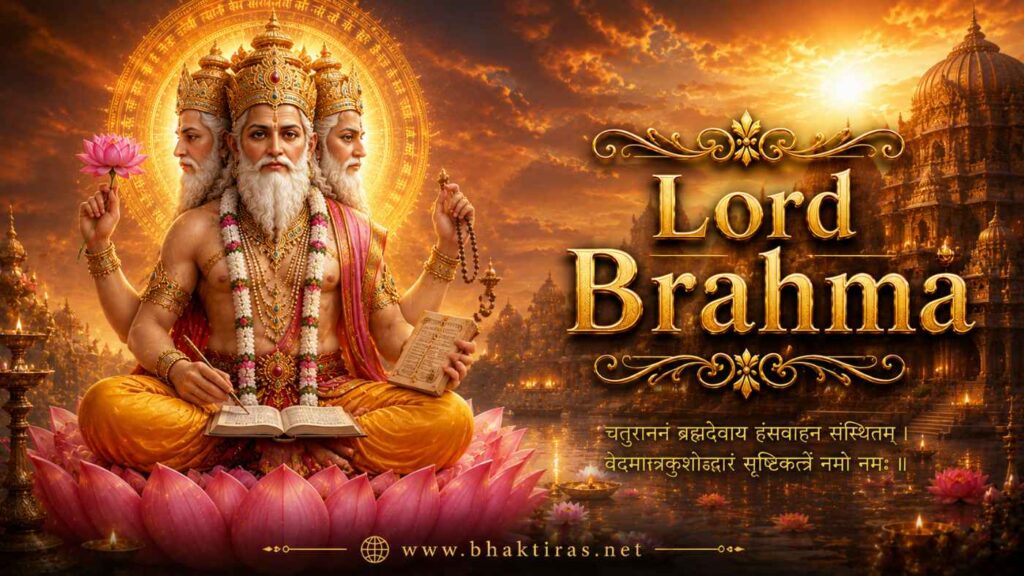
Who Is Lord Brahma?
Lord Brahma is the creator within the Hindu Trimurti, the trinity of great functions that keep the cosmos turning. Vishnu preserves what exists and Shiva dissolves it when its time is done, while Brahma is the one who fashions the worlds, the beings and the very laws by which they live. Each new cycle of creation begins with him.
His name comes from a Sanskrit root that carries the sense of growing and expanding, which fits a god whose work is to unfold the whole of manifest reality. Devotees also call him Prajapati, the lord of creatures, and Svayambhu, the self-born, because he arises without a mother or father at the dawn of time.
Brahma is often described as emerging from a golden lotus that grows out of the navel of the reclining Vishnu, seated in meditation as the first act of the new age. From that lotus seat he looks in every direction with his four faces and speaks the four Vedas, giving order and sound to the silence.
Although he holds one of the three highest offices in Hindu cosmology, Brahma is rarely worshipped in the way Vishnu and Shiva are. This is one of the most curious features of his story, and it is bound up with a set of well-known legends that we will come to below.
Iconography and Symbols of Lord Brahma
Every part of Brahma’s form points back to his role as creator and to the wisdom that creation demands. Here is what the images and temple murtis are telling us.
Four Faces (Chaturmukha)
Brahma’s four faces look toward the four directions and, by tradition, recite the four Vedas – the Rig, Yajur, Sama and Atharva. They also suggest that the creator sees the whole of space at once, missing nothing in the world he has made.
Four Arms
His four hands hold the tools of creation and worship rather than weapons of war. Together they mark him as a god of knowledge, ritual and generative power instead of battle.
Kamandalu (Water Pot)
The water pot holds the primal waters from which creation springs. It is a quiet reminder that all life begins in water, and that the creator carries the source of life in his own hand.
The Vedas
In one hand Brahma holds the sacred texts, showing that creation and knowledge are inseparable. To make the world is also to reveal the wisdom by which it should be understood and lived.
Akshamala (Rosary)
The prayer beads represent time itself, counted bead by bead, and the endless cycles of creation. They also mark Brahma as a god who is himself devoted to contemplation and the measured rhythm of the ages.
Hamsa (Swan)
His mount is the swan, said to be able to separate milk from water. It stands for pure discernment – the ability to sift truth from illusion, which is the mark of a wise mind.
Lotus Seat and White Beard
Brahma is usually shown seated on a full-blown lotus, itself a symbol of creation rising from the waters. His white beard signals his great age and the eternal, unhurried wisdom of the first-born.
Saraswati and the Work of Creation
Brahma’s consort is Saraswati, the goddess of knowledge, speech, music and the arts. Their pairing is deeply fitting: the god who shapes the universe is joined to the goddess who gives it language, learning and harmony. Creation without wisdom would be blind, and so the creator and the goddess of knowledge belong together.
The beings born of Brahma are known as his Manasaputras, the mind-born sons, because they sprang directly from his thought rather than from ordinary birth. From these first sages descended the great lineages of rishis who carried forward the Vedas and the sacred order.
Among the most revered of his mind-born children are the four Kumaras – Sanaka, Sanandana, Sanatana and Sanatkumara – who chose lifelong renunciation and are depicted as eternal youths. Other Manasaputras include the sages Marichi, Atri, Angiras, Pulastya, Pulaha, Kratu, Vasishtha and Bhrigu, along with Narada, the divine wanderer, and Daksha, the great progenitor. Through them the human and celestial worlds were peopled.
Why Lord Brahma Has So Few Temples
Of the three great gods of the Trimurti, Brahma is by far the least worshipped, and India holds only a small number of temples dedicated to him. Several old legends try to explain this, and while they differ in detail they share a common thread.
One well-known account tells that Brahma, in his pride, once claimed to be the supreme creator and was humbled. In another cycle of stories, a fiery pillar of light appeared before Brahma and Vishnu, and Brahma falsely claimed to have found its top, telling a lie backed by a witness. For this untruth he was cursed so that he would receive little formal worship on earth, even though he keeps his place among the gods.
A further tradition connects the loss of worship to Saraswati’s displeasure at Pushkar, where a ritual could not wait for her arrival. Whatever the version, the message is a moral one: even the creator is not above truth, patience and humility. The rarity of his temples turns Brahma’s story into a lasting lesson rather than a simple loss of honor.
The great exception is Pushkar in Rajasthan, home to the most famous Brahma temple in the world and the heart of his living worship.
How Lord Brahma Is Worshipped
Though dedicated temples are rare, Brahma is honored across Hindu practice in ways woven into daily and ceremonial life. His worship tends to be tied to knowledge, ritual fire and the beginning of things.
- Offering prayers at the start of a new venture, since Brahma governs beginnings and creation.
- Reciting the Gayatri mantra, which is closely linked to Brahma and to Vedic learning.
- Performing yajna (fire sacrifice), the Vedic ritual over which Brahma presides as the lord of the sacrifice.
- Honoring him during Vedic study and rites of passage, especially the sacred-thread ceremony.
- Taking a holy dip in the Pushkar lake and offering worship at the Brahma temple there, regarded as especially meritorious.
- Chanting simple invocations such as Om Brahmane Namah with a lit lamp and white flowers.
Temples of Lord Brahma
Brahma temples are scattered and few, which makes each one special. These are among the best known places where the creator is worshipped as the presiding deity.
- Jagatpita Brahma Mandir, Pushkar (Rajasthan) – the most celebrated Brahma temple, set beside the sacred Pushkar lake and central to his worship.
- Brahma Temple, Khedbrahma (Gujarat) – an old shrine whose very name recalls the creator.
- Brahmapureeswarar and Brahma shrines around Kumbakonam (Tamil Nadu) – where Brahma is honored within the temple traditions of the region.
- Uttamar Kovil near Srirangam (Tamil Nadu) – a rare temple where Brahma has a shrine alongside Vishnu and Shiva.
- Brahma Karmali Temple, Goa – a notable western Indian shrine to the creator.
- Asotra Brahma Temple (Rajasthan) – a more recent temple continuing the tradition of Brahma worship in the desert state.
Festivals of Lord Brahma
The main festival tied to Brahma unfolds at Pushkar and draws pilgrims from across India.
- Kartik Purnima – the full-moon day of the month of Kartik (October – November) is considered the most sacred time to bathe in the Pushkar lake and worship Brahma, marking the day his temple worship reaches its peak.
- The Pushkar Fair – held around Kartik Purnima, this great gathering combines devotion, a famous livestock fair and days of pilgrimage centered on the Brahma temple.
- Sacred bathing days – devotees also honor Brahma during Vedic new-year and ritual occasions linked to fresh beginnings and Vedic study.
A Story Every Devotee Knows
The Pillar of Light and the Lost Truth
In one of the most retold tales, an argument arose between Brahma and Vishnu over who was the greater. As they disputed, a shaft of blazing light with neither beginning nor end appeared before them – the form of Shiva. The two agreed to test their power: Vishnu would seek the base and Brahma the summit. Vishnu descended for ages and returned honestly, admitting he could not find the bottom. Brahma flew upward but, unable to reach the top, chose to lie, presenting a fallen flower as a false witness that he had touched the crown. Shiva, revealing himself, honored Vishnu’s truthfulness and decreed that Brahma, for his untruth, would not be widely worshipped in temples on earth. The story is remembered as a warning that even the creator must hold to truth.
The Lotus from Vishnu's Navel
At the dawn of a new age, Vishnu rested upon the cosmic ocean on the serpent Ananta, and from his navel a golden lotus unfolded. Seated within it was Brahma, the first-born, ready to begin the work of creation. Looking about the endless waters and seeing no other, Brahma set out to meditate and to bring forth the worlds. This image of the creator rising from a lotus rooted in Vishnu quietly binds the two gods together, showing creation itself as resting upon the preserving power that sustains all things.
Prayers and Mantras to Lord Brahma
Prayers to Brahma call upon the creator for wisdom, clear thought and the blessing of good beginnings. The simplest invocation is ॐ ब्रह्मणे नमः (Om Brahmane Namah), meaning ‘salutations to Brahma’. Devotees also chant the Brahma Gayatri, and Brahma is honored above all through the great Gayatri mantra itself, the heart of Vedic prayer, which he is said to have first revealed.
The Brahma Gayatri runs: ॐ वेदात्मनाय विद्महे हिरण्यगर्भाय धीमहि तन्नो ब्रह्मा प्रचोदयात् – ‘We meditate on the soul of the Vedas, we contemplate the golden-wombed one; may that Brahma inspire and awaken our minds.’ Recited at dawn with a lamp and white flowers, these prayers invite the creator’s grace upon study, memory and every fresh undertaking.
Whether whispered before an exam, an important task or the reading of the Vedas, a heartfelt prayer to Brahma seeks the same gift: a mind clear enough to create well and truthful enough to hold what it creates.
Frequently Asked Questions about Lord Brahma
Who is Lord Brahma?
Lord Brahma is the creator god of the Hindu Trimurti, the trinity that also includes Vishnu the preserver and Shiva the destroyer. He brings the universe and all beings into existence at the start of each cosmic cycle. He is shown with four faces and four arms, seated on a lotus, with the goddess Saraswati as his consort.
Why does Brahma have four faces?
Brahma's four faces look toward the four directions and are traditionally said to recite the four Vedas – the Rig, Yajur, Sama and Atharva. They express his role as the creator who perceives the entire universe at once and who first gave voice to sacred knowledge. Because of this he is often called Chaturmukha, meaning 'four-faced'.
Why are there so few Brahma temples?
Several legends explain this rarity. In the most famous, Brahma told a lie during a contest with Vishnu over a pillar of light and was cursed by Shiva so that he would receive little temple worship on earth. Other stories link it to Saraswati's displeasure at Pushkar. The lesson is that even the creator must uphold truth and humility.
Where is the most famous Brahma temple?
The most celebrated Brahma temple stands at Pushkar in Rajasthan, beside the sacred Pushkar lake. Known as the Jagatpita Brahma Mandir, it is one of the very few temples in the world dedicated to the creator and is the heart of his living worship. Pilgrims gather there especially during Kartik Purnima.
Who is Brahma's consort?
Brahma's consort is Saraswati, the goddess of knowledge, speech, music and the arts. Their union pairs the god who shapes the universe with the goddess who gives it wisdom and language. Saraswati is worshipped by students, scholars and artists, and her presence beside Brahma shows that creation and knowledge belong together.
What is Brahma's connection to the Gayatri mantra?
Brahma is closely tied to the Gayatri mantra, the most revered prayer of the Vedas. Tradition holds that he first revealed it, and it is chanted to awaken clear thought and spiritual insight. The Gayatri is often personified as a goddess associated with Brahma, and reciting it is regarded as honoring the creator and the source of Vedic wisdom.
Who are Brahma's mind-born sons?
Brahma's children are called the Manasaputras, the mind-born sons, because they arose from his thought rather than ordinary birth. They include the four eternal youths known as the Kumaras and great sages such as Marichi, Atri, Angiras, Vasishtha, Bhrigu, Narada and Daksha. From these first rishis descended the sacred lineages that carried the Vedas forward.
What is Brahma's vahana and what does it mean?
Brahma's mount, or vahana, is the Hamsa, a swan or goose. The swan is famed in tradition for being able to separate milk from water, which makes it a symbol of pure discernment – the power to distinguish truth from illusion and the real from the false. It reflects the wisdom expected of a creator who orders the cosmos.
How long is Brahma's day?
In Hindu cosmology a single day of Brahma is called a kalpa and lasts about 4.32 billion earthly years, followed by a night of equal length when creation rests. Through the day countless ages, or yugas, rise and pass. This vast measure of cosmic time shows the immense scale on which the creator's work unfolds and repeats.
May Lord Brahma, the first-born creator, bless your mind with clarity, wisdom and truthful beginnings.