
Goddess Saraswati
सरस्वती
Saraswati is the Hindu goddess of knowledge, wisdom, music, arts, learning, and speech, and one of the Tridevi alongside Lakshmi and Parvati. Dressed in white, seated on a swan, she plays the veena and holds the sacred books. Devotees honour her on Vasant Panchami, and students seek her blessing before study, exams, and every new beginning of learning.
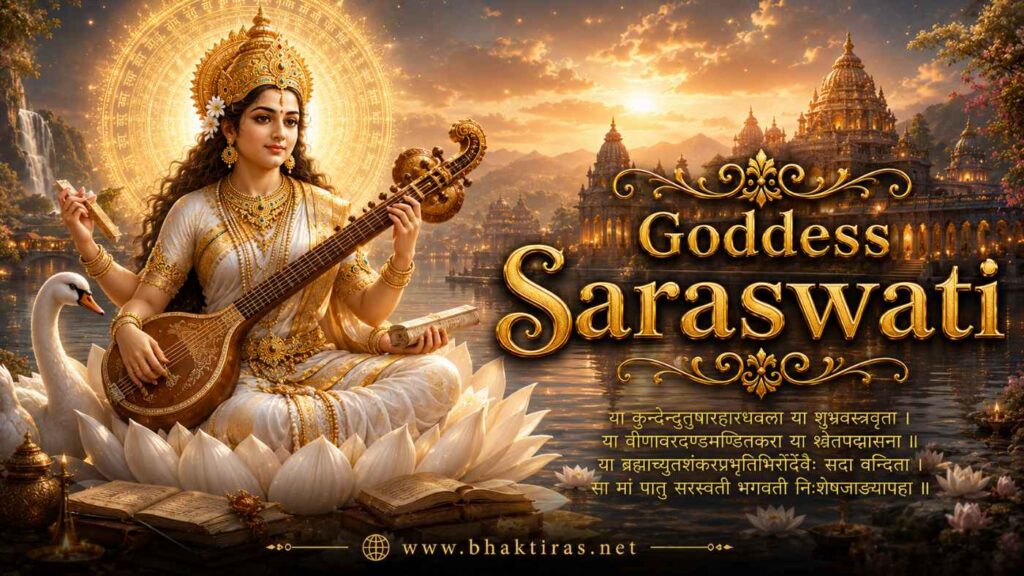
Who Is Goddess Saraswati
Saraswati is the goddess who presides over everything that flows: water, speech, music, and thought. As one of the Tridevi – the three great goddesses alongside Lakshmi and Parvati – she carries the power of vidya, the knowledge that lets a person understand the world and express it well. Where Lakshmi gives wealth and Parvati gives strength, Saraswati gives the wisdom to use both.
She is worshipped as the source of language and learning. Her name appears in the oldest layer of Hindu scripture, the Rigveda, first as a mighty river and then as the goddess of that river’s life-giving power. Over time she became Vagdevi, the deity of speech, and Sharada, the giver of learning, honoured by poets, singers, scholars, and schoolchildren alike.
Unlike goddesses associated with abundance or protection, Saraswati is quiet and inward. She wears plain white, carries no weapons, and rides a calm swan. Her gifts are not gold or victory but clarity of mind, a steady voice, and the patience to keep learning. This is why a student praying before an exam and a musician tuning an instrument turn to the same goddess.
She is also called the consort of Brahma, the creator. In the logic of the tradition this pairing makes sense: creation needs a plan, and wisdom is what shapes formless potential into ordered thought. Brahma imagines the world; Saraswati gives it meaning, measure, and sound.
Iconography & Symbols
Every part of Saraswati’s image teaches something about knowledge. Nothing she holds is decorative; each object is a lesson about how wisdom is gained and used.
The White Sari
Her plain white robe stands for purity, honesty, and a mind free of clutter. White reflects all colours and hides nothing, just as true knowledge conceals no falsehood. It also signals that she is untouched by greed or vanity.
The Veena
The stringed veena she plays represents the arts and the tuning of emotion by intellect. A veena must be tuned carefully before it sings; likewise, feeling becomes beautiful only when guided by understanding and practice.
The Book (Pustaka)
The pustaka in her hand is the Vedas, the record of sacred knowledge. It marks her as the keeper of scripture and learning, and reminds devotees that study and memory are forms of devotion.
The Rosary (Akshamala)
The akshamala of beads stands for meditation, focus, and the spiritual side of knowledge. It teaches that learning is not only information but discipline – the repeated, patient turning of the mind toward truth.
The Swan (Hamsa)
Her swan carries the idea of neer-ksheer viveka – the mythic ability to separate milk from water. It is the symbol of discernment: the wise person, like the swan, takes what is nourishing and leaves the rest.
The White Lotus
She sits on a lotus that opens in clear water, showing that wisdom rises above the muddy pull of the senses. The flower blooms without being stained by the water around it, a picture of a mind that stays pure amid the world.
The Four Arms
Her four hands are often read as mind, intellect, alertness, and ego – the inner faculties a seeker must train. Together they show that knowledge engages the whole person, not just the memory.
The Crescent-White Aura
She is usually shown against a soft, moon-pale light rather than fire or gold. This cool radiance suits her calm nature and marks knowledge as something serene and steady rather than fierce.
The Saraswati River & Her Vedic Roots
Before she was the goddess of learning, Saraswati was a river. The Rigveda praises her as a wide and powerful stream, ambitame, naditame, devitame – the best of mothers, the best of rivers, the best of goddesses. Hymns describe her flowing from the mountains to the sea, feeding the land and nourishing the people who settled along her banks.
Because a river gives life, learning, and settlement, the goddess of the river naturally grew into the goddess of all that a river makes possible: speech, song, poetry, and the passing of knowledge from one generation to the next. The Sanskrit word saras means flowing water or a pool, and the goddess kept this sense of movement even as her meaning widened from water to wisdom.
Many scholars link the Vedic descriptions to a great river that once flowed through northwest India and later dried or shifted course. In tradition, the Saraswati is said to have become invisible, joining the Ganga and Yamuna underground at Prayag to form the sacred meeting of three rivers, the Triveni Sangam. In this way the physical river became a spiritual presence – unseen, yet always flowing beneath the surface, much like knowledge itself.
How Goddess Saraswati Is Worshipped
Worship of Saraswati centres on learning and the tools of learning. Rather than elaborate temple ritual, much of her devotion happens at home, in schools, and in the practice rooms of musicians and artists. A few customs are shared across almost every region.
- Vasant Panchami rituals: On her chief festival, devotees dress in yellow, offer white and yellow flowers, sweets, and fruit, and set out the veena or other instruments. Homes and schools hold small pujas, and many families begin new ventures on this auspicious day.
- Placing books and instruments for blessing: Students set their books, pens, and notebooks before her image, and musicians and artists lay down their instruments and tools. These are left overnight and taken up again only after the puja, treated as blessed for the year ahead.
- Vidyarambham for children: In the first-letter ceremony, a young child’s finger is guided to trace a sacred syllable or the words of a prayer in rice or sand. Held often during Navaratri or on Vasant Panchami, it marks the formal start of a child’s education under Saraswati’s care.
Because her worship is tied to study and skill, the deepest offering to Saraswati is practice itself – the steady work of reading, writing, and playing. Devotees hold that keeping learning honest and never misusing knowledge pleases her more than any garland.
Saraswati Puja & Vasant Panchami
Vasant Panchami, on the fifth day of the bright half of the month of Magha (late January or February), is the great day of Saraswati. It also marks the arrival of spring, when fields turn golden with mustard flowers – which is why yellow is the colour of the day. The season of new growth and the goddess of new learning meet on the same date.
In eastern India, especially Bengal, Odisha, Assam, and Bihar, Saraswati Puja is a major public festival. Clay images of the goddess are installed in homes, schools, colleges, and community pandals. Students place their books at her feet, and by custom no one studies on the day of the puja itself – a small holiday granted by the goddess of study.
Saraswati is also honoured within the larger festivals of Navaratri and Durga Puja. During the nine nights, three days are given to the Tridevi, and Saraswati is worshipped in her turn as the goddess of wisdom. In many southern homes this joins with Ayudha Puja, when tools, books, and instruments are cleaned, decorated, and set aside for blessing – a day when even a craftsman’s hammer or a driver’s vehicle rests in her honour.
Temples & Sacred Sites
Dedicated Saraswati temples are fewer than those of many deities, which makes the great ones all the more cherished. Each carries its own tradition of learning and pilgrimage.
- Sharada Peeth (Kashmir): An ancient temple and centre of learning in the Neelum valley, once so famous for scholarship that the script of the region, Sharada, was named after the goddess. It remains a revered, if now largely ruined, seat of Saraswati as Sharada.
- Gnana Saraswati Temple, Basara (Telangana): One of the most visited Saraswati shrines in India, on the banks of the Godavari. Countless children are brought here for their Vidyarambham, tracing their first letters in the temple’s blessed rice.
- Sringeri Sharada Peetham (Karnataka): Established by Adi Shankaracharya, this is one of the four cardinal monastic seats of the tradition, with Saraswati worshipped as Sharadamba. It has been a living centre of Vedic learning for centuries.
- Koothanur Saraswati Temple (Tamil Nadu): A rare and much-loved Saraswati temple near Tiruvarur, linked to the poet Ottakoothar. Students across the south visit to pray for success in studies and the arts.
A Story Every Devotee Knows
The Tongue of the Wise
A well-loved teaching says that Saraswati lives on the tip of the tongue of those who speak with wisdom and kindness. In many tellings she is described as dwelling in clean speech, in the exact word chosen for the right moment, and in truth spoken gently. When a scholar debated fairly, a poet found the perfect line, or a child recited a lesson without fear, the tradition held that the goddess herself was moving through their words. This is why she is invoked before any recitation, lecture, or performance – so that speech may be worthy of her presence.
The Curse of Brahma
The Puranas tell that when Brahma set out to create the universe, he first brought forth Saraswati, the embodiment of knowledge, without whom no creation was possible. In one story her wisdom so completes Brahma’s work that he can shape the ordered world only after she takes her place beside him. The tale is remembered to make a simple point: creation and knowledge cannot be parted. Whatever is made without wisdom falls into confusion, and so the creator himself must first honour the goddess of learning.
Prayers & Mantras
Saraswati is invoked at the start of study, music practice, and any work of the mind. Her mantras are short and easy to hold, which suits a goddess of speech – the point is to say them clearly and mean them.
The seed mantra ॐ ऐं सरस्वत्यै नमः (Om Aim Saraswatyai Namah) is the most common. The syllable Aim is her bija or seed sound, said to sharpen memory and clear speech; the full line means “Om, salutations to Saraswati.” Many students repeat it before opening their books.
The best-known prayer to her is the Saraswati Vandana, beginning Ya Kundendu Tushara Hara Dhavala – “She who is white as the jasmine, the moon, and a garland of dew.” The verse pictures the goddess robed in white, seated on the white lotus, holding the veena, and asks her to remove the darkness of ignorance. It is recited in schools across India at the start of the day, a shared morning greeting to the goddess of learning.
Frequently Asked Questions about Goddess Saraswati
Who is Goddess Saraswati?
Saraswati is the Hindu goddess of knowledge, wisdom, music, arts, learning, and speech, and one of the Tridevi with Lakshmi and Parvati. She is shown dressed in white, seated on a swan or lotus, playing the veena and holding the sacred books. Students, scholars, and artists worship her for clarity of mind and skill.
Why is Saraswati always shown in white?
White stands for purity, truth, and a clear, uncluttered mind – the qualities of real knowledge. Unlike colours tied to wealth or power, white reflects everything and hides nothing, so it suits a goddess who represents honest learning. Her white sari, white lotus, and pale moon-like light all carry this single idea of pure wisdom.
What does Saraswati's swan symbolise?
The swan, or hamsa, represents discernment. In tradition the swan can separate milk from water, an image called neer-ksheer viveka. As Saraswati's vahana it teaches that a wise person, like the swan, takes what is nourishing and true and leaves aside what is worthless. It marks her as the goddess of clear judgement.
When is Saraswati Puja celebrated?
Her main festival is Vasant Panchami, on the fifth day of the bright half of the month of Magha, in late January or February, which also marks the start of spring. She is worshipped again during Navaratri and Durga Puja. In eastern India, especially Bengal, Saraswati Puja is a major public celebration held in homes and schools.
Why do students place their books before Saraswati?
Since Saraswati grants learning, students offer the tools of study – books, pens, and instruments – at her feet during her puja. The items are left overnight and taken up again only after worship, treated as blessed for the year ahead. It is a way of asking the goddess to guide their study and to keep their knowledge honest and clear.
What is the relationship between Saraswati and the river?
Saraswati began in the Rigveda as a great and sacred river, praised as the best of rivers and mothers. Because a river gives life and settlement, its goddess grew into the deity of speech, music, and learning. The river is said to have become invisible, joining the Ganga and Yamuna underground at Prayag, so the goddess flows on unseen.
What is the main Saraswati mantra?
The most widely chanted mantra is Om Aim Saraswatyai Namah (ॐ ऐं सरस्वत्यै नमः), meaning "salutations to Saraswati." The syllable Aim is her seed sound, said to sharpen memory and speech. Many students repeat it before study. The longer Saraswati Vandana, beginning Ya Kundendu Tushara Hara Dhavala, is recited in schools each morning.
Who is the consort of Saraswati?
Saraswati is described as the consort of Brahma, the creator. The pairing carries a meaning: creation needs wisdom to give it order and purpose. Brahma imagines the world, and Saraswati – as knowledge, speech, and measure – shapes that formless potential into ordered thought, so the creator and the goddess of learning are held to be inseparable.
What are Saraswati's other names?
She is known by many names that reflect her powers. As the goddess of speech she is Vagdevi, Vani, and Vagishwari. As the giver of learning she is Sharada, worshipped especially in Kashmir and Karnataka. She is also called Bharati and Brahmani. Each name highlights a facet of the same goddess of knowledge, music, and eloquence.
May Goddess Saraswati keep your mind clear, your words true, and your love of learning ever flowing.