
Brihaspati Dev
बृहस्पति
Brihaspati is the guru of the gods and the planet Jupiter among the nine grahas. He rules wisdom, learning, dharma, children and good fortune, and is honoured as the most benefic influence in a horoscope. His day is Thursday, his colour yellow, and devotees keep a Guruvar fast with yellow offerings to earn his blessings.
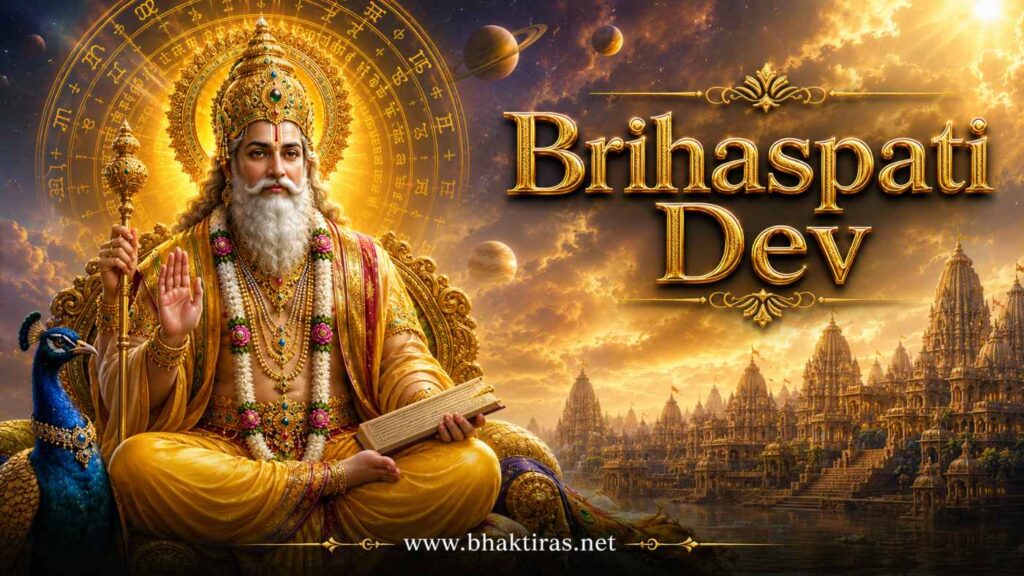
Who Is Brihaspati Dev
Brihaspati holds two great offices in Hindu thought at once. Among the Navagraha, the nine influences that shape human destiny, he is the planet Jupiter – the largest, gentlest and most auspicious of them all. Beyond the sky, he is the Devaguru, the teacher and family priest of the gods, the one who counsels Indra and the devas and keeps the rituals of heaven in order.
His name comes from bṛhas-pati, often read as ‘lord of prayer’ or ‘lord of sacred speech’. In the earliest hymns of the Rigveda he appears as the divine voice that makes offerings effective, the power behind mantra itself. Over time this early figure of sacred sound merged with the story of a wise sage and settled into the role Hindus know today: the calm, golden preceptor who values learning above wealth and dharma above cleverness.
Brihaspati is the son of the sage Angiras, which is why he carries the epithet Angirasa. As a graha he is warm and giving, a bringer of children, education, and quiet good fortune. As a guru he is the model of what a teacher should be – patient, upright, and more concerned with a student’s character than with applause.
To pray to Brihaspati is to ask for the two things Hindus have always prized together: the knowledge that lifts a life, and the blessings that make it prosper without pride.
Brihaspati – Guru of the Gods
In the ordering of the heavens the devas needed a guide of their own, and that place belongs to Brihaspati. He is the Suracharya, teacher of the shining ones, the priest who performs their yajnas and the wise head they turn to when strategy fails. Where Indra rules by strength, Brihaspati steadies the gods by counsel.
This role is best understood by its mirror image. The asuras, the rivals of the devas, have their own preceptor – Shukra (the planet Venus). Shukra is brilliant and fiercely loyal to his students, and he alone possesses the Mrita Sanjivani vidya that can revive the dead, which is why the asuras often recover from defeat. Brihaspati and Shukra are set against each other again and again in the Puranas, two learned guides serving opposite sides. The contrast is deliberate: it shows that knowledge alone is neutral, and that what matters is the dharma in whose service it is used. Brihaspati stands for wisdom joined to righteousness.
Because he is the teacher of the very gods, Brihaspati became the archetype of the guru in Hindu life. The reverence a student owes a teacher, the trust a family places in its priest, the belief that no learning is complete without a guide – all of this traces back to his example. When Hindus speak of the immense value of a true guru, of Guru Purnima and the debt owed to those who teach, Brihaspati is the presiding figure standing behind the word.
Iconography & Symbols
Brihaspati is imagined in warm golden tones, seated in serene composure. Each detail of his form carries a meaning that a devotee can read at a glance.
Yellow-Gold Body
His complexion is the yellow of turmeric and ripe grain, the colour of Jupiter itself. It marks him as the most benefic and life-giving of the grahas, and is why yellow flowers, cloth and food are offered to him.
Four Arms
He is usually shown with four arms, a sign of divine capacity – the ability to teach, protect, bless and hold sacred duty all at once, beyond ordinary human limits.
Elephant Mount
His vahana is the elephant, a creature of patience, memory and steady dignity. In another well-known depiction he rides a golden chariot drawn by eight horses across the sky.
Danda (Staff)
The staff he holds is the danda, emblem of guidance and gentle authority. It is the rod of the teacher who corrects and directs, not the weapon of a warrior.
Japamala
A rosary rests in one hand, marking him as a master of mantra and japa. It reminds worshippers that his wisdom is rooted in disciplined prayer and repetition of the sacred word.
Kamandalu
The water pot he carries is the kamandalu of an ascetic and priest. It stands for purity, self-restraint, and a life given to ritual and study rather than indulgence.
Jupiter in Jyotisha – the Great Benefic
In Jyotisha, Vedic astrology, Brihaspati is called the Great Benefic – the single most auspicious planet a chart can carry. Where other grahas may bring hard lessons, Guru’s touch tends to expand, protect and uplift whatever house he sits in.
He is the lord of two signs, Sagittarius (Dhanu) and Pisces (Meena), and is exalted in Cancer. In a horoscope he governs some of life’s dearest matters: children and progeny, higher education and wisdom, dharma and ethics, wealth honestly earned, and good fortune in general. For a woman’s chart he is traditionally read as the significator of the husband, which is why unmarried girls are often advised to honour him on Thursdays.
A strong, well-placed Brihaspati is said to give clear judgement, a generous nature, respect from others, and the guidance of good teachers at the right moments. When he is weak or afflicted, remedies focus on his benefic themes – Thursday fasting, yellow offerings, feeding others, charity of gram-dal and turmeric, and for those advised by a competent astrologer, the wearing of a yellow sapphire (Pukhraj). His gemstone and rituals are never about controlling fate, but about aligning one’s life with wisdom and right conduct so that his natural grace can flow.
How Brihaspati Dev Is Worshipped
Devotion to Brihaspati centres on Thursday, his sacred day, when his benefic energy is believed to be closest. The observances are simple, gentle and steeped in the colour yellow.
- Keep the Guruvar vrat – a Thursday fast taken for wisdom, marriage, childbirth or general good fortune, often continued for a set number of weeks.
- Wear yellow clothing and offer yellow flowers, turmeric, gram (chana) dal, jaggery and yellow sweets at the shrine or before his image.
- Perform banana tree puja – watering and worshipping a banana plant with turmeric, a chana-dal offering and a lamp, a much-loved Thursday practice.
- Recite the Guru mantra and the Brihaspati stotra, and read or listen to the Brihaspativar vrat katha at the close of the fast.
- Give in charity on Thursdays – gram-dal, bananas, yellow cloth or a meal to a teacher, priest or student, since generosity pleases the guru of the gods.
- Wear a yellow sapphire (Pukhraj) only on the advice of a qualified astrologer, set in gold and worn on the index finger.
The spirit of all these acts is the same one honoured on Guru Purnima – gratitude to the teacher and a wish to grow in knowledge and dharma. Brihaspati asks for no extravagance, only sincerity, cleanliness and a heart turned toward learning.
The Tara Episode
One of the most retold stories about Brihaspati concerns his wife Tara and the birth of the planet Mercury.
The Moon god Chandra, dazzling and proud, was captivated by Tara, the graceful consort of Brihaspati. He carried her away, and Tara for a time went willingly. Brihaspati sought her return, and when Chandra refused, the quarrel widened until the gods themselves took sides and heaven stood on the edge of war. Brahma intervened, and Tara was restored to Brihaspati.
Soon after, Tara gave birth to a radiant son. Both Brihaspati and Chandra claimed the child. When Tara was finally pressed to speak the truth, she named Chandra as the father. That son was Budha – the planet Mercury, who thus carries in his very origin the wit of the Moon and grew into a graha of intelligence and speech.
The episode is remembered less for scandal than for its resolution: even the guru of the gods faced loss and returned to his duty with dignity, and even a wrong could give rise, in Budha, to something bright and enduring. It also weaves the grahas together into a single family drama, binding Jupiter, the Moon and Mercury into the living map of the sky.
Temples & Sacred Sites
Because Brihaspati is a graha, he is worshipped most often within the Navagraha shrines that stand in almost every South Indian temple – a cluster of nine idols where devotees circle Guru’s image on Thursdays. A few sites, however, are dedicated to him in particular:
- Alangudi (Apathsahayeswarar Temple), Tamil Nadu – the celebrated Guru sthalam among the nine Navagraha temples, where Brihaspati is the presiding planetary deity and Thursdays draw large crowds.
- Navagraha temples across South India – such as the nine-planet circuit near Kumbakonam, where a dedicated Guru shrine is visited for education, marriage and prosperity.
- Guru shrines in North Indian temples – many Shiva and Devi temples across the plains keep a small Brihaspati murti in their Navagraha panel, honoured with yellow flowers and dal on Thursdays.
- Home worship – for most families devotion happens at the home altar or beside a banana tree, where the guru is honoured without needing a grand temple.
A Story from the Scriptures
The Guru Who Would Not Bow to Pride
The Puranas tell of a time when Indra, flushed with power, failed to rise and honour Brihaspati when the guru entered his court. Slighted, Brihaspati quietly withdrew and made himself unavailable to the gods. Without their preceptor the devas grew weak, and the asuras, sensing the gap, pressed their advantage. Only when Indra recognised his arrogance and sought his teacher’s forgiveness did balance return. The tale is a lasting reminder that even the king of the gods cannot prosper once he neglects his guru.
Kacha and the Secret of Revival
In another famous episode, the devas sent Brihaspati’s son Kacha to study under the rival guru Shukra, hoping to learn the Sanjivani vidya that revived the dead. The story of Kacha’s dangerous apprenticeship – being killed and restored, and the loyalty and heartbreak it caused – turns on this rivalry between the two great preceptors. It underscores how the whole struggle between devas and asuras was, at heart, a contest between their teachers, with Brihaspati’s steady dharma set against Shukra’s fierce cunning.
Prayers & Mantras
Brihaspati is invoked with short, resonant mantras chanted especially on Thursdays, often on a mala of yellow beads. His seed sound (bīja) is Brim, and repeating his mantras is a traditional remedy for a weak Guru in the chart and a prayer for wisdom, children and fortune.
The most widely used is the beej mantra: ॐ बृं बृहस्पतये नमः (Om Brim Brihaspataye Namah) – ‘Om, salutations to Brihaspati.’ Chanted 108 times on a Thursday with a yellow flower or turmeric offering, it is believed to steady the mind and draw the guru’s grace.
The classical Vedic invocation, Om Gurave Namah, and the planetary stotra beginning Devanam cha rishinam cha gurum kanchana sannibham (‘the teacher of the gods and sages, radiant like gold’) are also recited to honour him. Whatever the words, the intention is the same – to bow before the great teacher and ask for clear understanding and a life lived in dharma.
Frequently Asked Questions about Brihaspati Dev
Who is Brihaspati Dev?
Brihaspati is the guru of the gods and the planet Jupiter among the Navagraha. He is the wise preceptor who guides Indra and the devas, and in astrology he is the most benefic influence, governing wisdom, children, education, dharma and good fortune. His sacred day is Thursday and his colour is yellow.
Why is Thursday special to Brihaspati?
Thursday, called Guruvar or Brihaspativar, is Brihaspati's own day, when his benefic energy is believed to be strongest. Devotees keep a Thursday fast, wear yellow, offer chana dal, turmeric and bananas, and worship the banana tree to seek his blessings for marriage, children, learning and prosperity.
What does Brihaspati govern in a horoscope?
As Jupiter, Brihaspati rules children and progeny, higher education, wisdom, dharma, honestly earned wealth and general good fortune. In a woman's chart he is read as the significator of the husband. A strong Guru gives sound judgement, respect and the guidance of good teachers at the right time.
What is the difference between Brihaspati and Shukra?
Both are learned preceptors, but of opposite camps. Brihaspati is the guru of the devas (the planet Jupiter), while Shukra is the guru of the asuras (Venus), holding the vidya that revives the dead. Their rivalry shows that knowledge itself is neutral – what matters is the dharma it serves.
Which gemstone is associated with Brihaspati?
The gemstone of Brihaspati is the yellow sapphire, known in Hindi as Pukhraj. It is believed to strengthen a weak Jupiter and support education, marriage and prosperity. It should only be worn on the advice of a qualified astrologer, usually set in gold on the index finger.
How can I please Brihaspati Dev?
Honour him on Thursdays by wearing yellow, keeping a Guruvar fast, and offering turmeric, gram dal, jaggery and bananas. Worship a banana tree, recite Om Brim Brihaspataye Namah, and give charity of yellow food or cloth to teachers, priests or students. Sincerity and cleanliness matter more than expense.
What is the Guru mantra of Brihaspati?
His beej mantra is Om Brim Brihaspataye Namah (ॐ बृं बृहस्पतये नमः), meaning 'Om, salutations to Brihaspati.' Chanted 108 times on a Thursday, often on a mala of yellow beads, it is a traditional prayer for wisdom, children and fortune and a remedy for a weak Jupiter in the chart.
Who was Tara in Brihaspati's story?
Tara is the consort of Brihaspati. In a well-known Puranic episode she was carried away by Chandra, the Moon god, sparking a conflict among the gods until Brahma restored her. She later gave birth to Budha (the planet Mercury), whom she named as Chandra's son, weaving the grahas into one family story.
May Brihaspati Dev, the golden guru of the gods, bless you with clear wisdom, honest fortune and the guidance of good teachers on every Thursday and beyond.