
Agni Dev
अग्नि
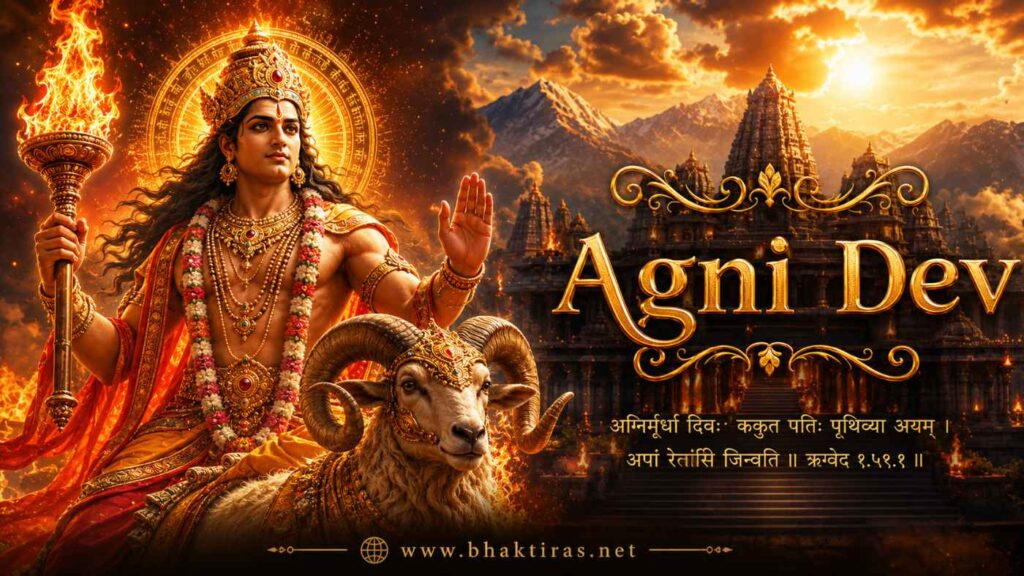
Agni is the Vedic god of fire and the divine priest of the gods. As the sacred flame kindled in every yajna, he carries offerings up to the heavens, which makes him the mouth of the gods. He rides a ram, is paired with Svaha, guards the South-East, and witnesses every Hindu marriage.
Who Is Agni Dev
Agni is fire itself made divine – the living flame that a family kindles at dawn, the blaze that receives butter and grain in a yajna, and the light that consumes the body on the funeral pyre. His name simply means fire in Sanskrit, and among the Vedic Devas few are as close to daily human life as he is. Wherever a lamp is lit before a shrine or a ritual fire crackles, Agni is understood to be present.
In the Rigveda, Agni is honoured more than almost any other god. The collection opens with a hymn to him, and across its verses he is invoked second only to Indra. This tells you how central fire was to the people who composed those hymns: it cooked their food, warmed their nights, cleared their fields, and above all connected them to the unseen powers they wished to reach.
What sets Agni apart is his double nature. He belongs to the earth, since every hearth and altar holds him, yet he belongs to the sky as well, because his smoke and light rise upward. This makes him a natural go-between, a deity who lives at the meeting point of the human and the heavenly. The priests called him the purohita, the one placed in front, the divine chaplain who conducts the ceremony on behalf of the gods.
Because he is present in cooking, in the body’s warmth, in the sun, and in lightning, Agni is often described as having many births and many forms. He is one and many at once – a single principle of fire showing itself in countless places.
The Mouth of the Gods – Agni in Yajna
The heart of Vedic worship is the yajna, a fire offering in which ghee, grains, wood, and herbs are placed into the flames while mantras are chanted. Agni is not a spectator at this rite; he is its central actor. When an offering is poured into the fire, the belief is that Agni consumes it and carries its essence upward to the intended deity. For this reason he is called the mouth of the gods – the gods eat through his flames.
This is why almost every oblation ends with the word Svaha. Svaha is at once the ritual exclamation spoken as the offering is released and the name of Agni’s consort, the goddess who ensures the gift reaches its destination. To say idam Indraya Svaha – this for Indra, Svaha – is to hand the offering to Agni and trust him to deliver it. Without Svaha the offering is said not to arrive, so the two are inseparable in the logic of sacrifice.
Agni’s role as messenger gives every havan and homa its meaning. The worshipper cannot climb to heaven, but the smoke can. By feeding the fire correctly and calling the right names, a household reaches Indra, Varuna, the ancestors, or any deity it wishes to honour. In this sense fire is not merely a symbol of devotion but the actual channel through which devotion travels.
Iconography & Symbols
Agni is pictured as a red or golden being, radiant and restless, with flames for hair and a body that seems to burn even as it stands. Later art and the Puranas give him a set of recognisable marks, each carrying a meaning.
Two Faces
Agni is often shown with two faces, read as his benevolent and his fierce aspects – the gentle household fire and the all-devouring blaze. The pair also suggests his reach across the earthly and the heavenly realms.
Seven Tongues
Seven flickering tongues of flame are his best-known feature. They are named in ritual texts and stand for the many kinds of offering he can taste and the many directions his light travels.
Flames & Radiance
His whole form glows red-gold, wreathed in fire. Smoke serves as his banner rising to the sky, marking the path by which offerings ascend to the gods.
The Ram (Mesha)
Agni rides a ram, an animal linked to sacrifice and to stubborn, driving heat. The mount carries him swiftly between altar and heaven as he does his priestly work.
Spear, Axe & Torch
In his hands he may hold a spear or axe and a flaming torch, weapons that show fire’s power to clear, to purify, and to destroy what must be consumed.
Seven Arms
He is sometimes given seven arms, echoing his seven tongues and expressing the abundance of his gifts – warmth, light, cooking, protection, and the carrying of prayers.
Agni as the Witness of Vows
Of all Agni’s duties, the one most Hindus meet in their own lives is his role as the witness of the marriage vow. A traditional wedding is not sealed by signatures alone but before the sacred fire, and the fire is Agni himself. This is the principle of Agni Sakshi – Agni as witness.
The most solemn moment is the Saptapadi, the seven steps the couple takes together around the fire. With each step they make a promise about the life they will share – nourishment, strength, prosperity, family, and lasting friendship. Because Agni sees and receives these steps, the marriage is considered witnessed by a deity who cannot be deceived. A vow taken before fire is a vow that cannot quietly be forgotten.
This idea reaches beyond weddings. Fire has long been treated as an honest witness to oaths and truths across Hindu tradition, since it neither hides nor flatters. To swear before Agni is to place one’s word under the gaze of a god who consumes falsehood as readily as fuel, and this is why the lit fire remains the moral centre of so many rites of passage.
The Many Fires
Agni is one god, but Vedic practice recognises that fire serves in many settings, and each is honoured as a form of him. The tradition organises these into a small set that a householder and priest would know well.
- Garhapatya – the household fire, kept burning continuously in the home. It is the domestic hearth from which the other ritual fires are drawn, symbol of the family’s ongoing life.
- Ahavaniya – the offering fire, set to the east, into which oblations for the gods are poured during a formal yajna. This is Agni in his role as carrier of gifts to heaven.
- Dakshinagni – the southern fire, associated with rites for the ancestors and with protection from harm. Together these make up the classic three sacred fires.
- Jatharagni – the fire of the belly, the inner heat of digestion. Ayurveda treats this bodily fire as Agni working within us, cooking food and sustaining life.
- The cremation fire – at the end of life Agni receives the body itself, releasing the departed and returning the elements. Here fire is both destroyer and purifier, closing the circle it began at the hearth.
Guardian of the South-East
Hindu cosmology places a guardian deity at each point of the compass, and these guardians are called the Dikpalas. Agni holds the South-East, the direction known after him as Agneya – the quarter of fire.
This placement shapes practical life. In Vastu Shastra, the traditional science of building, the South-East corner is set aside for the kitchen, because that is Agni’s own direction and cooking is his work. Placing the hearth in the fire-quarter is thought to keep a home’s energy in balance and to honour the deity who feeds the household.
As a Dikpala, Agni also stands as a protector, warding his corner of the world and lending his heat and light to the order of the cosmos. Among the directional guardians he is the one people invoke whenever they light a flame with intention, whether for cooking, for worship, or for warmth.
How Agni Is Invoked & Worshipped
Agni is rarely worshipped in a temple of his own; instead he is present in nearly every ritual another deity receives. To honour Agni is, in practice, to light and tend fire correctly. A few forms of this worship are especially common.
- Havan / Homa – the fire offering performed at festivals, housewarmings, weddings, and personal vows. Wood, ghee, and herbs are fed to the flames with mantras, and each offering ends in Svaha so Agni can carry it onward.
- Agnihotra – a simple, disciplined daily fire rite performed at sunrise and sunset. Small offerings of milk or ghee are made to Agni, keeping an unbroken thread of devotion through the day.
- The kindled lamp (deepa) – even the small flame of a ghee lamp before a shrine is an act of Agni worship, inviting his light and presence into everyday prayer.
- Rites of passage – from the first sacred fire lit at a wedding to the final fire at cremation, Agni presides over the great turning points of a Hindu life.
A Story from the Vedas & Puranas
Agni Hides in the Waters
Weary of his endless duty of carrying offerings, Agni once fled and hid, taking refuge in the waters and the plants so the gods could not find him. Without fire, the sacrifices stopped and the worlds grew cold and dark. The gods searched everywhere and at last coaxed him out, promising him a lasting share of every offering and freedom from decay. This tale explains why fire seems to sleep inside wood and water until it is drawn out, and why Agni is honoured first in every rite – the gods learned they cannot do without him.
The Burning of the Khandava Forest
In the Mahabharata, Agni falls gravely ill after consuming too many rich offerings and can only be cured by devouring the Khandava forest, thick with living beings protected by Indra’s rains. He begs Krishna and Arjuna for help. The two heroes hold back Indra’s storm and guard the blaze until Agni consumes the whole forest and is restored to full strength. In gratitude he grants Arjuna divine weapons and the famous Gandiva bow, tying the fire god directly into the epic’s great war.
Prayers & Mantras
The very first verse of the Rigveda is addressed to Agni, and it remains the most famous prayer to him: Agnim ile purohitam – “I praise Agni, the chosen priest, the divine minister of the sacrifice, who bestows the greatest wealth.” To open the oldest of the Vedas with these words is to place fire at the doorway of all worship. Alongside it, devotees use a short seed mantra to invoke him at any lamp or altar.
Frequently Asked Questions about Agni Dev
Who is Agni Dev in Hinduism?
Agni is the Vedic god of fire and the divine priest of the gods. He is the sacred flame present in every ritual, and his task is to carry offerings from humans to the deities in heaven. Riding a ram and paired with the goddess Svaha, he is one of the most invoked gods in the Rigveda.
Why is Agni called the mouth of the gods?
Because offerings placed in the sacrificial fire are believed to be consumed by Agni and carried upward to the intended deity. The gods receive their share through his flames, so the fire acts as their mouth. This is why nearly every oblation is released with the word Svaha, the name of Agni's consort who delivers the gift.
What is the vahana of Agni?
Agni's vahana, or mount, is the ram (mesha). The ram is an animal long linked with sacrifice and with driving heat, and it carries Agni swiftly between the altar and the heavens as he performs his role as the messenger and priest of the gods.
What are the three fires of Agni?
The three sacred fires of Vedic ritual are the Garhapatya, the continuous household fire; the Ahavaniya, the eastern offering fire into which oblations for the gods are poured; and the Dakshinagni, the southern fire used in rites for the ancestors. All three are forms of Agni serving different purposes in worship.
What does Agni Sakshi mean in a Hindu wedding?
Agni Sakshi means the fire is a witness. A Hindu marriage is sealed before the sacred fire, and the couple takes the Saptapadi, seven steps around it, each with a vow. Because Agni sees and receives these promises, the marriage is considered witnessed by a deity, making the vows binding and sacred.
Which direction does Agni guard?
Agni guards the South-East, the direction named Agneya after him, as one of the Dikpalas or directional guardians. In Vastu Shastra this is why the kitchen is traditionally placed in the South-East corner of a home, since cooking with fire belongs to Agni's own quarter.
What are the other names of Agni?
Agni is known by several epithets. Vahni means the carrier, Jataveda the knower of all beings, Pavaka the purifier, Hutashana the eater of offerings, and Anala the fire. Each name highlights a different aspect of his role as fire, priest, and messenger of the gods.
How is Agni worshipped today?
Agni is worshipped mainly through fire rites rather than in temples of his own. Devotees honour him by performing havan and homa, by keeping the daily Agnihotra at sunrise and sunset, and by lighting lamps before shrines. He is also present at every wedding and cremation, presiding over life's great turning points.
From the lamp before your shrine to the fire that witnesses a marriage, Agni is the warmth that carries every heartfelt prayer to the divine – may his light steady your worship.