
Phool Dei 2027 – Uttarakhand's Festival of Flowers
फूलदेई
When is Phool Dei in 2027?
Phool Dei falls on 14 March 2027, the first day of the Hindu month of Chaitra (Chaitra Sankranti). It is a children’s folk festival of Uttarakhand welcoming spring, when children scatter fresh flowers, rice and jaggery on the thresholds of homes and bless each household for a prosperous year.
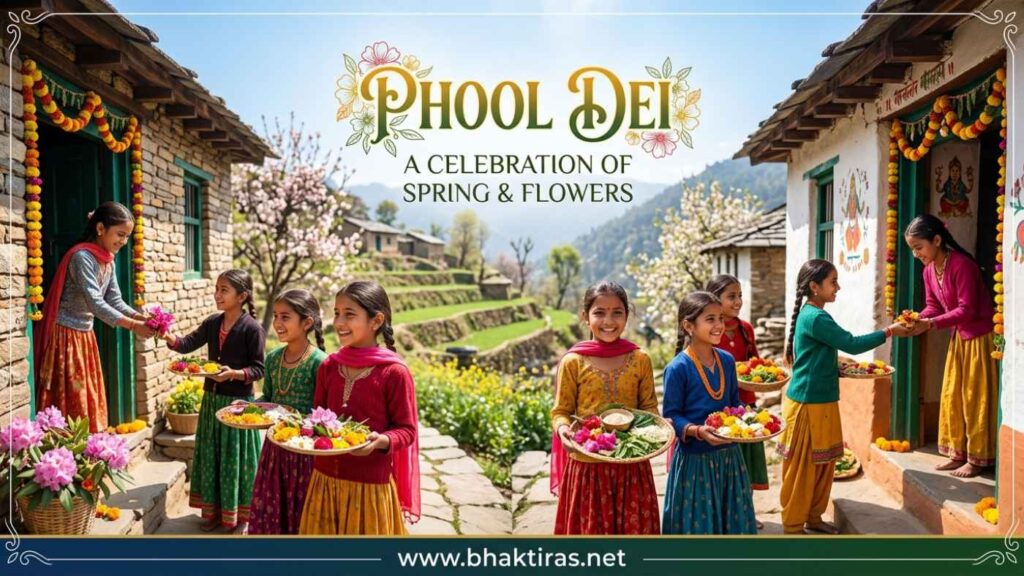
Phool Dei is the gentle spring festival of Uttarakhand, kept by children on the first day of the month of Chaitra as the hills begin to flower after winter. Bowls of fresh blossoms, rice and jaggery in hand, children go from door to door scattering petals on each threshold and singing a blessing for the household, and are sent home with jaggery, grain and a sweet rice dish. It is one of the warmest folk customs of the Garhwal and Kumaon hills.
Phool Dei 2026-2028: Dates
Phool Dei is celebrated on Chaitra Sankranti, the first day of the Hindu solar month of Chaitra, which falls around 14 March each year. The next Phool Dei is on 14 March 2027.
| Year | Date | Day | Notes |
|---|---|---|---|
| 2026 | 14 March | Saturday | Chaitra Sankranti |
| 2027 | 14 March | Sunday | Next occurrence |
| 2028 | 14 March | Tuesday | Chaitra Sankranti |
In many Garhwal villages the celebration continues through the early days of Chaitra, with children visiting homes over more than one morning.
Why Phool Dei Is Celebrated
Phool Dei welcomes spring and the new agricultural year, and asks the flowering season to bring plenty to every home.
A greeting to spring
Chaitra Sankranti marks the turn of the season in the hills, when fruit trees and wildflowers such as buransh (rhododendron) and peach blossom open across the slopes. Scattering these first flowers on doorsteps is a way of carrying the season’s renewal into every household.
A blessing for the home
As they lay the flowers, children sing for the family’s wellbeing, good harvest and prosperity. The household in turn blesses the children and gives them jaggery, rice and coins, so the festival binds the whole village in an exchange of goodwill.
A children's festival
Unusually, Phool Dei belongs to the children of the village, who lead every part of it. It passes the region’s folk songs, seasonal knowledge and sense of community down to the youngest generation.
How Phool Dei Is Celebrated
The festival is simple and joyful, built around flowers, a song and a shared sweet.
- Gathering flowers. On the morning of Chaitra Sankranti children collect fresh seasonal flowers – phyonli, buransh, peach and plum blossom – along with rice and jaggery in a small plate or basket.
- Visiting each home. Groups of children go door to door across the village, laying flowers and rice on the threshold (dehli) of every house.
- Singing the Phool Dei song. At each doorstep they sing the traditional blessing – “Phool dei, chhamma dei, deni dwar, bhar bhakar…” – wishing the family a home full of grain and happiness.
- Receiving the blessing. The household blesses the children and gives them jaggery, rice, coins and sometimes ghee in return.
- Sharing the dei. The gathered rice and jaggery are used to make dei, a sweet rice-flour pudding, which is shared among the children and families.
Foods of Phool Dei
The festival’s foods are simple hill preparations made from what each household gives.
Dei
A sweet pudding of rice flour, jaggery and milk or curd, which gives the festival the second half of its name. It is cooked from the grain and jaggery the children collect and shared among all.
Jaggery & rice
Gur (jaggery) and rice are the customary gifts placed in the children’s baskets at each home, along with coins.
Seasonal sweets
Households also prepare local treats such as arsa, singal and sweet rotis to mark the first day of Chaitra.
Phool Dei Across Uttarakhand
The custom is shared across the hill districts, with small local differences.
Garhwal
In the Garhwal region the festival is often spread over the first eight days of Chaitra, with children visiting homes on more than one morning and the flower-scattering continuing until Chaitra’s early phase closes.
Kumaon
In Kumaon Phool Dei is usually kept on the single day of Chaitra Sankranti, with the same doorstep flower-offering and the Phool Dei song.
Today
Schools and cultural groups across Dehradun, Pauri, Almora and the Uttarakhand diaspora now revive Phool Dei each year to keep the folk tradition and its songs alive among city children too.
Phool Dei Do's and Don'ts
A few simple customs keep the spirit of the day.
Do
- Use fresh, naturally gathered seasonal flowers for the doorstep offering.
- Let children lead the singing and the visiting, as the festival is theirs.
- Bless the visiting children and give jaggery, rice or coins in return.
- Share the dei pudding with everyone who took part.
- Take the chance to teach the young the Phool Dei song and its meaning.
Avoid
- Do not pluck flowers wastefully or damage trees while gathering blossoms.
- Do not turn children away empty-handed from the doorstep.
- Do not treat it as a competition; the day is about shared goodwill, not collection.
- Avoid plastic or artificial flowers, which go against the festival’s link to the living spring.
- Do not let the folk songs be forgotten – they are the heart of the custom.
Frequently Asked Questions
When is Phool Dei in 2027?
Phool Dei is on 14 March 2027, celebrated on Chaitra Sankranti, the first day of the Hindu month of Chaitra.
When is Phool Dei in 2026 and 2028?
Phool Dei falls on 14 March in 2026 and on 14 March in 2028. Because it follows the solar Chaitra Sankranti, the date stays close to 14 March every year.
What is Phool Dei?
Phool Dei is a spring folk festival of Uttarakhand in which children scatter fresh flowers, rice and jaggery on the thresholds of homes and sing a blessing for the family, welcoming the flowering season and the new agricultural year.
Why is Phool Dei celebrated?
It welcomes spring in the Himalayan foothills and asks the season for a good harvest and prosperity for every home. It is also a children’s festival that passes the region’s folk songs and community spirit to the youngest generation.
What is the Phool Dei song?
At each doorstep children sing a traditional Garhwali-Kumaoni blessing that begins “Phool dei, chhamma dei, deni dwar, bhar bhakar” – a wish that the household’s doors and grain stores stay full and happy through the year.
What food is made on Phool Dei?
The festival dish is dei, a sweet pudding of rice flour and jaggery, made from the grain and jaggery the children gather. Households also give jaggery, rice and coins and prepare local hill sweets.
Which region celebrates Phool Dei?
Phool Dei is celebrated across the Garhwal and Kumaon regions of Uttarakhand. In Garhwal it often runs over the first days of Chaitra, while in Kumaon it is usually kept on Chaitra Sankranti itself.
Is Phool Dei only for children?
Children lead Phool Dei – they gather the flowers, visit the homes and sing the blessings – but the whole village takes part, blessing the children, giving grain and jaggery, and sharing the dei together.
May your doorway stay full of flowers and grain – Phool Dei, Chhamma Dei