
Shri Ramchandra Kripalu Bhajman
श्री रामचन्द्र कृपालु भजु मन
What is Shri Ramchandra Kripalu Bhajman?
Shri Ramchandra Kripalu Bhajman Shri Ramchandra Kripalu Bhajman is a devotional Ram Stuti composed by Goswami Tulsidas that calls the mind to worship the compassionate Lord Rama, whose lotus eyes, dark-cloud form and warrior grace dispel the deep fear of worldly existence.
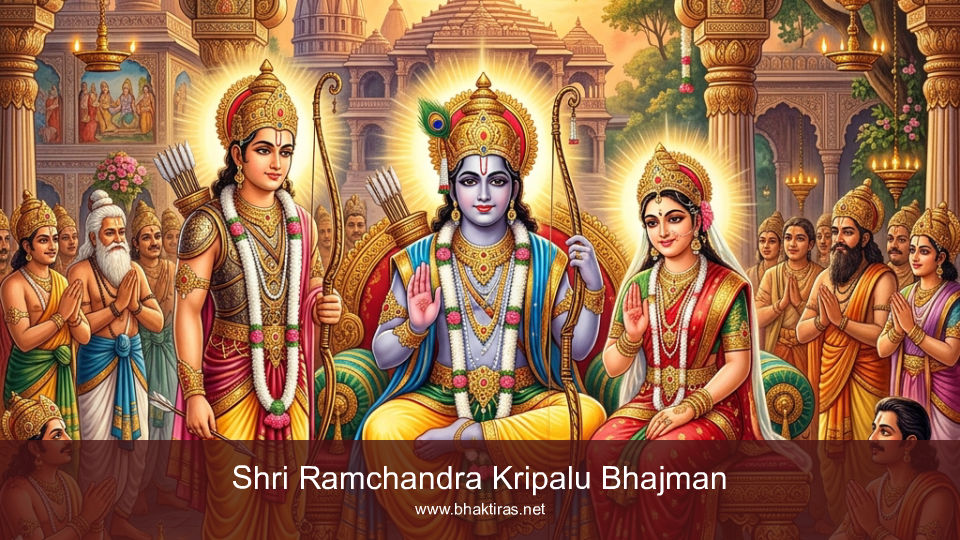
Shri Ramchandra Kripalu Bhajman is one of the most-recited praises of Lord Rama, drawn from Goswami Tulsidas’s Vinaya Patrika. Written in a blend of Sanskrit and Awadhi, it is a stuti rather than a lamp-aarti: instead of describing a ritual with a flame, each line paints a portrait of Rama and urges the mind to hold that image and let go of fear. Devotees sing it during morning and evening prayer, and it becomes especially common in homes and temples through Ram Navami. Below you will find the verses in Devanagari with a clean Roman transliteration, a short original explanation for each line, and notes on how and why it is sung.
Shri Ramchandra Kripalu Bhajman Lyrics
Roman transliteration for easy chanting. Tap “Meaning” under any verse for the English translation.
Shri Ramchandra kripalu bhaj man, haran bhav-bhay darunam
Nav-kanj lochan kanj-mukh, kar kanj pad kanjarunam
Meaning
O mind, take refuge in the gracious Rama, the one who removes the dreadful fear of birth and death. His eyes are like a fresh lotus, his face like a lotus, his hands and his reddish feet all soft and radiant like lotus blooms.
Kandarp aganit amit chhavi, nav-neel neerad sundaram
Pat-peet manahu tadit ruchi, shuchi naumi janak-sutavaram
Meaning
His beauty outshines countless gods of love, dark and lovely like a fresh rain-heavy cloud, with a yellow garment glowing across it like lightning. To that pure lord, the chosen husband of Janaka's daughter Sita, I bow.
Bhaj deenbandhu dinesh, danav-daitya-vansh-nikandanam
Raghunand anand-kand, koshal-chand dashrath-nandanam
Meaning
Worship the friend of the helpless, radiant as the sun, who uproots the lineages of demons and tyrants. He is the delight of the Raghu line, the very root of joy, the moon of Kosala, and the beloved son of Dasharatha.
Sir mukut kundal tilak charu, udaar ang vibhushanam
Aajanu bhuj shar chaap dhar, sangraam-jit khar-dushanam
Meaning
A crown rests on his head, earrings and a graceful tilak adorn him, and ornaments grace his noble limbs. His arms reach to his knees; he holds arrow and bow, and in battle he vanquished the demons Khara and Dushana.
Iti vadati tulsidas shankar, shesh-muni-man-ranjanam
Mam hriday-kamal nivas kuru, kaam-aadi khal-dal-ganjanam
Meaning
So says Tulsidas: you who gladden the hearts of Shiva, Shesha and the sages, please make your home in the lotus of my heart, you who crush the wicked army of lust, anger and their kind.
Meaning & Significance
The stuti moves from Rama’s outward form to an inward plea. The opening doha names its whole purpose in a single breath: worship Rama and the “dreadful fear” of the cycle of birth and death loosens its grip. Tulsidas returns four times to the lotus — eyes, face, hands, feet — not as decoration but as a way of holding the image steady in the mind while singing.
The middle verses build the portrait a devotee is meant to picture: a dark, rain-cloud complexion crossed by a lightning-yellow garment, a form that outshines the god of love many times over, arms long enough to reach the knees, bow and arrow in hand. These are not random details. They gather Rama’s roles at once — the tender son of Dasharatha and the moon of Kosala on one side, the destroyer of Khara and Dushana on the other — so that grace and strength are seen together.
The closing verse turns personal. Having praised the lord who delights Shiva, Shesha and the sages, Tulsidas asks for only one thing: that Rama live in the lotus of his heart and scatter the “wicked army” of lust, anger and the inner enemies. That final request is why many treat this as a daily prayer rather than a festival song — the point is not to describe Rama once, but to keep inviting him in.
How Do You Perform the Aarti?
- Sit facing an image or picture of Lord Rama, ideally at dawn or after the evening lamp is lit. —
- Begin with the opening doha, singing it slowly so the meaning of each lotus-image can settle in the mind. —
- Move through the four chaupais in order; since this is a stuti, there is no chorus to repeat, so keep an even, unhurried pace. —
- Hold the mental picture the verses describe — the dark form, yellow garment, bow in hand — rather than reciting on autopilot. —
- Close with the final verse's request that Rama dwell in your heart, then sit quietly for a moment before ending with a jaikara. —
What Are the Benefits of Singing This Aarti?
Regular recitation of this stuti is valued for reasons that are as much about steadiness of mind as about ritual:
- Calms fear and unease: The very first line frames Rama as the remover of the deep fear of worldly existence, which is why many turn to it in anxious moments.
- Fits daily practice: Short enough to complete in a couple of minutes, it suits both a busy morning and a quiet evening sitting.
- Sharpens devotional focus: Its lotus imagery gives the mind a clear picture to rest on, making the recitation contemplative rather than mechanical.
- Central to Ram Navami: Its association with Rama's birth celebration makes it a natural choice for household and temple gatherings on that day.
- Carries Tulsidas's language: Singing it keeps a devotee close to the same Sanskrit-Awadhi voice found across the Ramcharitmanas and Vinaya Patrika.
Who Wrote This Aarti?
The stuti comes from Goswami Tulsidas (traditionally 1511–1623), the poet-saint best known for the Ramcharitmanas, his retelling of Rama’s story in Awadhi. This praise belongs to his Vinaya Patrika, a collection of personal petitions and hymns addressed to Rama and other deities.
What makes the piece characteristic of Tulsidas is its ending: after four verses of pure praise, he signs his own name and turns the hymn into a request that Rama settle in his heart and drive out the inner enemies. That mix of grand description and humble, first-person longing is a hallmark of his devotional writing, and it is part of why this short stuti has stayed in daily use for centuries.
Frequently Asked Questions
What is Shri Ramchandra Kripalu Bhajman?
Shri Ramchandra Kripalu Bhajman is a devotional Ram Stuti composed by Goswami Tulsidas that calls the mind to worship the compassionate Lord Rama, whose lotus eyes, dark-cloud form and warrior grace dispel the deep fear of worldly existence.
Who wrote Shri Ramchandra Kripalu Bhajman?
It was composed by Goswami Tulsidas, the 16th-century poet-saint who also wrote the Ramcharitmanas. This stuti appears in his Vinaya Patrika.
Is Shri Ramchandra Kripalu Bhajman an aarti or a stuti?
It is a stuti, a hymn of praise. Unlike a lamp-aarti, it does not describe a flame ritual or use a repeating chorus; each verse praises Rama and, in the final verse, asks him to dwell in the devotee's heart.
When is it usually sung?
It is commonly recited during morning and evening prayers and is especially popular during Ram Navami, the celebration of Lord Rama's birth.
What language is it written in?
It is written in a blend of Sanskrit and Awadhi, the same devotional register Tulsidas used across much of his poetry.
How many verses does it have?
It has five short parts: an opening doha followed by four chaupais, ending with the verse in which Tulsidas signs his name and makes his request.
॥ बोलो सियावर रामचन्द्र की जय ॥