ॐ
Hoysaleswara Temple, Halebidu
Shiva • Halebidu, Hassan, Karnataka
॥ ॐ नमः शिवाय ॥
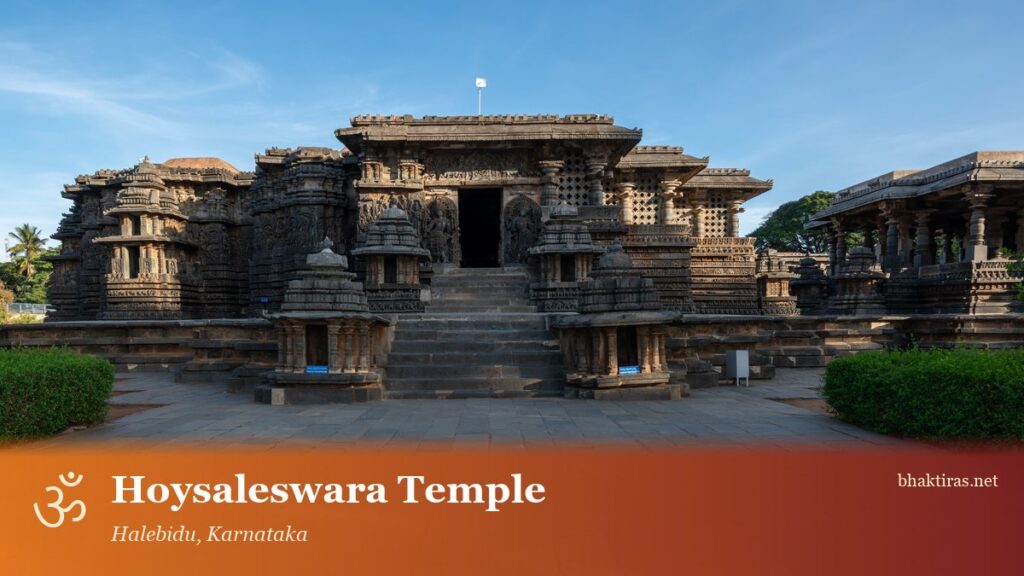
The Hoysaleswara Temple at Halebidu is a twin Shiva shrine begun around 1121 in the old Hoysala capital of Dwarasamudra. Carved from soapstone, its walls carry some of the most densely worked sculpture in India, and in 2023 it joined the UNESCO World Heritage list.
A twin temple on a star-shaped platform
The building is really two temples joined side by side — Hoysaleswara, named for King Vishnuvardhana, and Santaleswara, named for his queen Shantala Devi. Each has its own sanctum and its own Nandi pavilion facing the linga, set on a shared platform whose plan follows the stepped star (stellate) outline favoured by Hoysala builders.
That doubled layout lets a visitor walk a single connected circuit past two sanctums, two assembly halls and two seated Nandis, the larger of which is among the biggest monolithic Nandi figures in Karnataka.
Walls of continuous narrative
The outer walls are wrapped in horizontal bands of relief that run almost without a break around the whole structure. The lowest courses show marching elephants, then lions, then horsemen, then friezes of foliage and mythical creatures, with upper registers given over to scenes from the Ramayana, the Mahabharata and the Bhagavata.
Because the soapstone is soft when freshly quarried and hardens with exposure, the carvers could cut deep undercuts, jewellery, and fine detail that would be difficult in granite — which is why the surfaces feel almost metalwork-fine up close.
- Lowest band: processions of elephants, each one carved differently
- Mid bands: lions, horsemen and scrollwork
- Upper panels: gods, dancers and epic episodes
Left unfinished
Despite decades of work the temple was never fully completed; parts of the planned superstructure and some panels remain in outline. The sack of Dwarasamudra by the Delhi Sultanate in the early 14th century ended the Hoysala capital, and the towers that once rose over the sanctums are gone.
What survives is still extraordinary, and the unfinished sections are themselves instructive — they show how a Hoysala wall was blocked out and then carved inward, stage by stage.
Visiting Halebidu today
The temple is maintained by the Archaeological Survey of India and sits within a green lawn beside a tank, with a small museum nearby holding loose sculpture. It pairs naturally with Belur, about 16 km away, whose Chennakeshava temple was built by the same dynasty.
Early morning light raking across the west wall is the best time for photographing the friezes, and a slow clockwise circuit of the platform reveals the detail that a quick visit misses.
Frequently Asked Questions
Who built the Hoysaleswara Temple?
The Hoysaleswara Temple was built by the Hoysala dynasty, with construction beginning around 1121 during the reign of King Vishnuvardhana. The two shrines are named after the king and his queen Shantala Devi. Work continued for several decades but was never finished.
Why is the temple called a twin temple?
It is two complete temples joined together on one platform, each with its own sanctum, hall and Nandi pavilion. One shrine is Hoysaleswara and the other Santaleswara. Visitors can walk a single connected circuit past both sanctums.
What is the temple made of?
It is built of soapstone (chloritic schist), a soft stone that hardens after quarrying. This allowed sculptors to cut very deep, fine detail, which is why the friezes look almost like metalwork. The same material was used at the related Belur and Somnathpur temples.
Is Halebidu a UNESCO World Heritage Site?
Yes. In 2023 the Sacred Ensembles of the Hoysalas, which include Halebidu along with Belur and Somnathpur, were inscribed on the UNESCO World Heritage list. The Hoysaleswara Temple is the centrepiece of the Halebidu component.
Is the temple still used for worship?
The Hoysaleswara Temple is primarily a protected monument under the Archaeological Survey of India rather than an active daily-worship centre. Visitors are welcome during open hours to view the sculpture. The Shiva lingas remain in their sanctums.
How far is Halebidu from Belur?
Halebidu is about 16 km from Belur, and the two are usually visited together as a single trip. Both were Hoysala foundations, with Belur known for the Chennakeshava temple. Hassan is the nearest large town and rail point.
॥ हर हर महादेव ॥ • Bhaktiras.net Temple Guide
| Primary Deity | Shiva |
| Built | From c. 1121 CE |
| Dynasty | Hoysala |
| Patron | King Vishnuvardhana |
| Material | Soapstone |
| Plan | Twin stellate shrines |
| UNESCO | Inscribed 2023 |
| Location | Halebidu, Hassan, Karnataka |
Related Temples
Explore more sacred temples connected by deity and region.