ॐ
Jageshwar Dham, Almora
Shiva as Jageshwar (Nagesh) • Jageshwar, Almora, Uttarakhand
॥ ॐ नमः शिवाय ॥
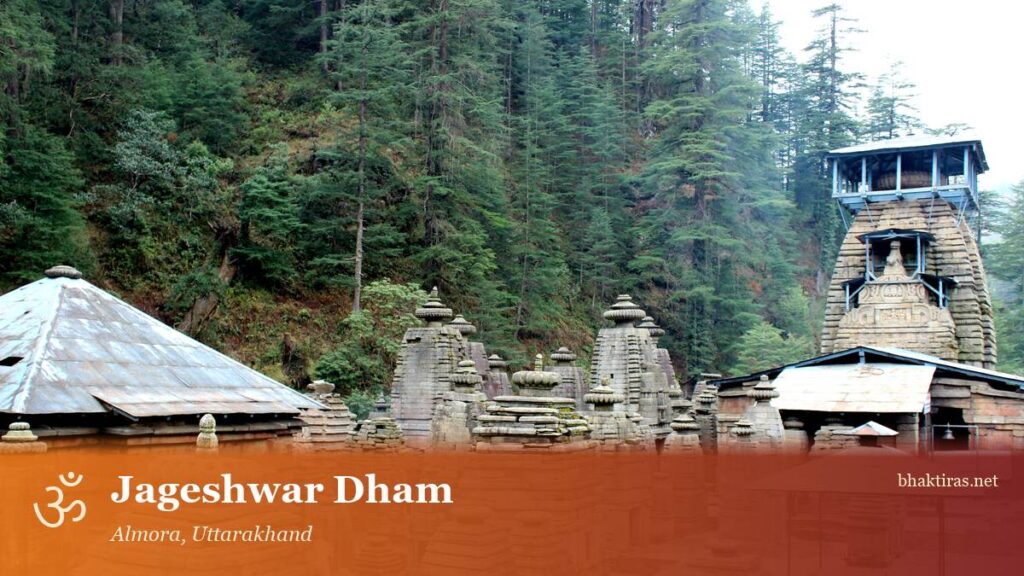
In a deodar-cedar forest on the Jata Ganga, the stone temples of Jageshwar Dham gather in their scores, a cluster of around 124 shrines built across the early medieval centuries. Shiva is worshipped here as Jageshwar, also called Nagesh, and some traditions hold the site to be a Jyotirlinga. The cool, fragrant cedar grove gives the dham a stillness that has drawn pilgrims for over a thousand years.
A cluster among the cedars
Jageshwar is not a single temple but a dense group of roughly 124 stone shrines set within a forest of tall deodar cedars. The Jata Ganga stream runs through the valley, and the close ranks of carved towers make a striking sight among the trees.
The shrines were raised between about the 7th and 12th centuries under the Katyuri and later the Chand kings. Building across so long a span has left the group varied in scale and detail while sharing a common stone idiom.
Shiva as Jageshwar, the Nagesh
Here Shiva is worshipped as Jageshwar, also known as Nagesh, the lord of serpents. The dham’s standing as a Shaiva centre is old and deep, and the principal shrines draw the main flow of devotion.
Some traditions count Jageshwar among the Jyotirlingas, the self-manifest lights of Shiva, which adds to the site’s pull for pilgrims. The claim is held by lineage and custom rather than settled across all lists.
Dandeshwar and the museum
A short distance away lies the Dandeshwar group, another cluster of shrines linked to the same sacred landscape. Together the two groups make Jageshwar one of the richest concentrations of early temples in the Himalaya.
An archaeological museum near the site keeps sculptures and images recovered from the shrines, helping visitors read the carving and chronology. It is a useful first or last stop on a walk through the dham.
Visiting Jageshwar
Jageshwar lies in Almora district, reached by a road that winds up through the Kumaon hills into the cedar valley. The altitude keeps the air cool, and the forest setting is as much a draw as the shrines.
Mahashivratri and the Shravan month bring the largest gatherings, when the dham fills with worshippers. At quieter times the cedar grove and the ranked temples reward a slow, unhurried visit.
- Roughly 124 stone shrines
- Built c. 7th–12th centuries (Katyuri and Chand)
- Setting: deodar-cedar forest on the Jata Ganga
- Nearby: Dandeshwar group and archaeological museum
- District: Almora, Kumaon
Frequently Asked Questions
How many temples are at Jageshwar Dham?
Jageshwar Dham is a cluster of around 124 stone shrines, not a single temple. They stand close together in a deodar-cedar forest on the Jata Ganga stream.
When were the Jageshwar temples built?
The Jageshwar temples were built roughly between the 7th and 12th centuries, under the Katyuri and later the Chand kings. The long building span has left the group varied in scale and ornament.
Which deity is worshipped at Jageshwar?
Shiva is worshipped at Jageshwar as Jageshwar, also called Nagesh, the lord of serpents. Some traditions hold the site to be one of the Jyotirlingas.
Is Jageshwar a Jyotirlinga?
Some traditions count Jageshwar among the Jyotirlingas of Shiva, and it is revered as such locally. The identification rests on lineage and custom and is not uniform across all Jyotirlinga lists.
What is the Dandeshwar group?
The Dandeshwar group is a nearby cluster of shrines linked to the same sacred landscape as Jageshwar. Together with an archaeological museum, it makes the area one of the richest early temple sites in the Himalaya.
Where is Jageshwar Dham and when is it busiest?
Jageshwar Dham is in Almora district of Uttarakhand, in the Kumaon hills. It is busiest at Mahashivratri and through the Shravan month, when pilgrims gather in large numbers.
॥ हर हर महादेव ॥ • Bhaktiras.net Temple Guide
| Primary Deity | Shiva as Jageshwar (Nagesh) |
| Temples | About 124 shrines |
| Builders | Katyuri and Chand kings |
| Period | c. 7th–12th centuries |
| Stream | Jata Ganga |
| Setting | Deodar-cedar forest |
| Nearby | Dandeshwar group, museum |
| District | Almora |
Related Temples
Explore more sacred temples connected by deity and region.