ॐ
Triveni Sangam, Prayagraj
Ganga • Prayagraj, Uttar Pradesh
॥ ॐ गंगायै नमः ॥
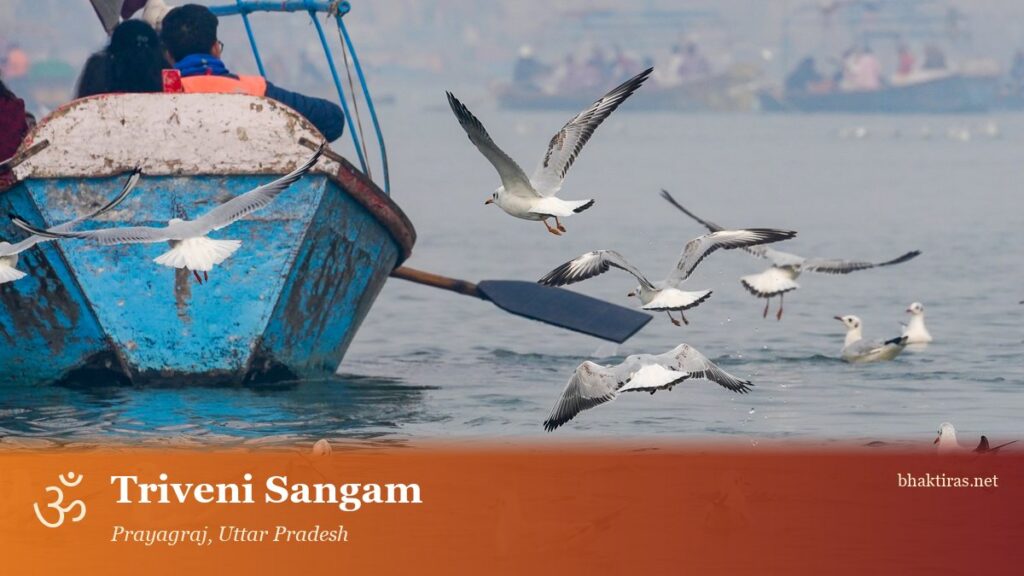
Triveni Sangam is the meeting of three rivers at Prayagraj — the Ganga, the Yamuna and the unseen Saraswati — and one of the most sacred bathing points in India. Here the brown waters of the Ganga visibly join the greener Yamuna, while the Saraswati is believed to flow underground to complete the confluence. Pilgrims take boats out to the exact meeting point to bathe, and it is the central site of the Kumbh and Magh Melas.
Where three rivers meet
The word triveni means a braid of three, and at Prayagraj it names the confluence of the Ganga, the Yamuna and the Saraswati. Two of the rivers are visible: the silt-laden Ganga runs a pale brown, the Yamuna a deeper green, and the line where they merge can be seen clearly from a boat. The Saraswati is the antardhana, or hidden, river, believed to join from below.
This is a tirtha — a sacred water crossing — rather than a built temple. The act of worship here is the snan, the ritual bath at the point of confluence, taken to be especially purifying. Boatmen ferry pilgrims from the ghats out to the sangam, where small platforms and tethered boats mark the bathing spot.
The Kumbh and Magh Melas
Prayagraj is one of the four cities that host the Kumbh Mela in rotation, and the Sangam is its ritual heart. On the principal bathing days, vast crowds of pilgrims and ascetic orders take the sacred dip in a sequence set by tradition. The gathering is among the largest peaceful assemblies of people anywhere.
Between the great Kumbhs, the Sangam hosts the annual Magh Mela through the winter month of Magh, when devotees called kalpavasis camp on the riverbank for weeks of prayer, bathing and simple living. A tent city rises each year on the floodplain and is dismantled when the waters return.
Akshayavat and the fort
Beside the Sangam stands the historic fort, within whose precincts lies the Akshayavat, the “immortal banyan” of legend that is said never to die. Pilgrims have long associated the tree with imperishability and the continuity of the sacred site through the ages.
Close to it is the underground Patalpuri temple, a low pillared chamber lined with images, traditionally visited together with the Akshayavat. Access to these spots within the fort has varied over time, so it is worth checking current arrangements before planning a visit.
- Akshayavat — the “immortal banyan” said never to wither
- Patalpuri — the underground temple beside the fort
- The Sangam ghats — boarding points for boats to the confluence
Visiting the Sangam
Most visitors reach the confluence by boat from the riverside ghats, agreeing a fare with the boatmen before setting out. The crossing offers the clearest view of the two-coloured meeting of the waters, and many pilgrims perform their bath from the boat itself or from the small platforms at the sangam.
The experience changes sharply with the season. During the Magh Mela and the Kumbh the area becomes a planned tent city with marked routes and bathing ghats; at other times it is far quieter. Early morning is the calmest and most atmospheric time to go out on the water.
Frequently Asked Questions
What is the Triveni Sangam at Prayagraj?
It is the sacred confluence of three rivers — the Ganga, the Yamuna and the unseen Saraswati — at Prayagraj in Uttar Pradesh. It is a tirtha, a holy water site, rather than a temple building, and the chief act of worship is bathing at the meeting point. It is the ritual centre of the Kumbh and Magh Melas.
Which rivers meet at the Sangam?
The Ganga and the Yamuna meet visibly at the Sangam, with the brown Ganga joining the greener Yamuna. The third river, the Saraswati, is believed to flow underground and is unseen. Together the three are called the Triveni, meaning a braid of three.
Why is the Sangam important for the Kumbh Mela?
Prayagraj is one of four cities that host the Kumbh Mela, and the Sangam is the exact point where pilgrims and ascetic orders take the sacred bath. The principal bathing days follow a traditional order, drawing some of the largest human gatherings on earth. Between Kumbhs, the annual Magh Mela is also centred here.
How do pilgrims bathe at the Sangam?
Pilgrims usually take a boat from the riverside ghats out to the confluence and bathe at the meeting point of the waters. Small platforms and tethered boats mark the spot, and many perform the dip directly from the boat. Fares are agreed with the boatmen before the crossing.
What is the Akshayavat?
The Akshayavat is the “immortal banyan” tree within the fort beside the Sangam, said in legend never to die. It is linked with the idea of imperishability and the lasting sanctity of the site. The nearby underground Patalpuri temple is traditionally visited with it.
When is the best time to visit Triveni Sangam?
Early morning is the calmest and most atmospheric time for a boat trip to the confluence. During the Magh Mela in winter and the periodic Kumbh Mela, the area becomes a vast organised tent city with marked bathing ghats. Outside these times it is far quieter.
॥ हर हर गंगे ॥ • Bhaktiras.net Temple Guide
| Sacred to | Ganga, Yamuna, Saraswati |
| Location | Prayagraj |
| State | Uttar Pradesh |
| Type | Tirtha (river confluence) |
| Rivers | Ganga, Yamuna, unseen Saraswati |
| Key events | Kumbh Mela, annual Magh Mela |
| Nearby | Akshayavat, Patalpuri temple |
| Worship | Sacred bath (snan) at the confluence |
Related Temples
Explore more sacred temples connected by deity and region.