ॐ
Har Ki Pauri, Haridwar
Ganga • Haridwar, Uttarakhand
॥ ॐ गंगायै नमः ॥
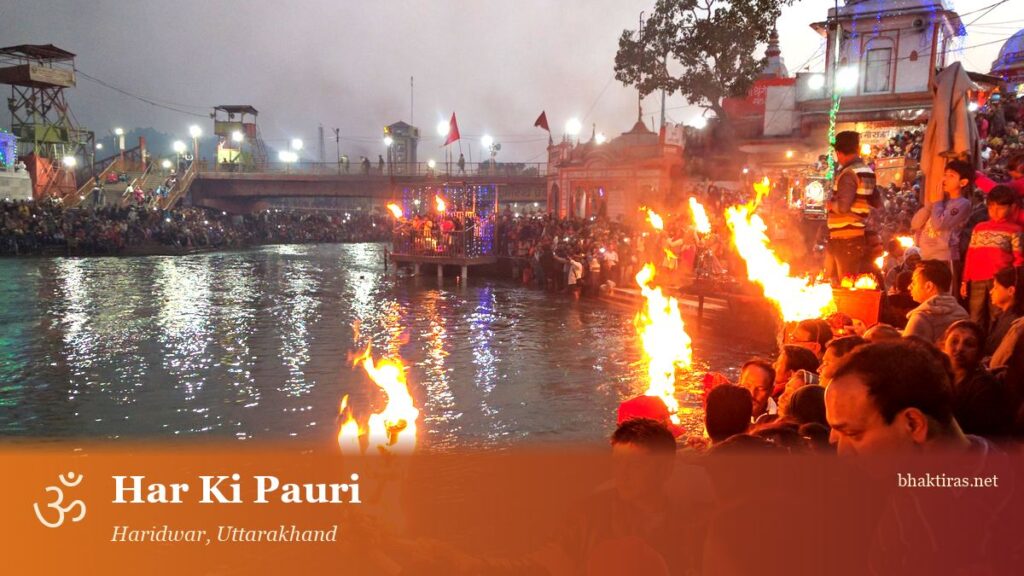
Har Ki Pauri is the chief ghat of Haridwar on the banks of the Ganga, and its name — “the steps of Hari” — recalls a footprint of Vishnu said to be imprinted here. Each evening the Ganga Aarti at Brahma Kund sends hundreds of floating lamps across the water before a great crowd of devotees. As one of the four Kumbh Mela sites and a place where drops of amrit are said to have fallen, it is among the most sacred points on the river.
The steps of Hari
The name Har Ki Pauri means the steps, or pauri, of Hari — that is, of Vishnu — and tradition holds that a footprint of the god is imprinted on a stone here. The ghat is the focal point of Haridwar’s riverfront, where the Ganga is channelled past stone steps lined with shrines.
Pilgrims come to bathe in the swift, cold current, holding the chains and rails fixed along the ghat against the pull of the water. The bath at Har Ki Pauri is regarded as deeply purifying, and the ghat is busy from before dawn until late evening.
The evening Ganga Aarti
At dusk the ghat fills for the Ganga Aarti at Brahma Kund. Priests swing large flaming lamps in time with bells and chanting, and devotees set small leaf boats of flowers and lit diyas adrift on the river. The lamps drifting downstream against the dark water are the sight most associated with Haridwar.
The aarti draws thousands each evening, and seating along the steps fills early on busy days. It is a public ceremony open to all, and visitors are asked simply to be respectful, keep the steps clear and take care near the fast-moving water.
Brahma Kund and the amrit
The most sacred part of the ghat is Brahma Kund, the pool where the aarti is performed. By tradition this is one of the spots where drops of amrit, the nectar of immortality, fell during the churning of the cosmic ocean, which is why Haridwar is counted among the four Kumbh Mela cities.
For this reason the Kumbh and the Ardh Kumbh bring enormous gatherings to Har Ki Pauri, with bathing on the principal days following an order set by tradition. The ghat is the ritual heart of Haridwar at these times.
- Brahma Kund — the central pool where the aarti is held
- One of four Kumbh Mela cities
- Said to be a spot where amrit fell during the ocean-churning
Haridwar, where the Ganga reaches the plains
Haridwar is one of the Sapta Puri, the seven holy cities, and is known as the Ganga Dwara — the gateway of the Ganga — because it is here that the river leaves the Himalayan foothills and flows out onto the plains. This makes it a natural starting point for the wider Char Dham pilgrimage routes into the hills.
Beyond Har Ki Pauri, the town offers the Mansa Devi and Chandi Devi hilltop shrines, reached on foot or by cable car, and a riverfront of temples and ashrams. Many pilgrims pair an evening at the aarti with a morning visit to these surrounding sites.
Frequently Asked Questions
What is Har Ki Pauri?
Har Ki Pauri is the principal ghat of Haridwar on the Ganga in Uttarakhand. Its name means “the steps of Hari” and refers to a footprint of Vishnu said to be imprinted here. It is famous for its nightly Ganga Aarti and is one of the four Kumbh Mela sites.
What is the Ganga Aarti at Har Ki Pauri?
The Ganga Aarti is an evening ceremony held at Brahma Kund, in which priests wave large flaming lamps to the sound of bells and chanting. Devotees float small leaf boats of flowers and lit diyas on the river. Thousands gather each evening, and it is the sight most associated with Haridwar.
Why is Brahma Kund sacred?
Brahma Kund is the pool at the centre of Har Ki Pauri where the aarti is performed. Tradition holds that drops of amrit, the nectar of immortality, fell here during the churning of the ocean. This is why Haridwar is one of the four cities that host the Kumbh Mela.
Why is Haridwar called the Ganga Dwara?
Haridwar is called the Ganga Dwara, or “gateway of the Ganga,” because it is the point where the river leaves the Himalayan foothills and enters the plains. It is also one of the Sapta Puri, the seven holy cities. This position makes it a traditional starting point for pilgrimage routes into the hills.
Can anyone attend the Ganga Aarti?
Yes, the Ganga Aarti at Har Ki Pauri is a public ceremony open to all visitors. Seating along the steps fills early on busy evenings, so arriving ahead of time helps. Visitors are asked to be respectful, keep the steps clear and take care near the fast-flowing water.
What other sites are near Har Ki Pauri?
Close to the ghat are the Mansa Devi and Chandi Devi hilltop shrines, reached on foot or by cable car, along with a riverfront of temples and ashrams. Many pilgrims pair the evening aarti with a morning visit to these shrines. Haridwar is also a gateway to the Char Dham routes.
॥ हर हर गंगे ॥ • Bhaktiras.net Temple Guide
| Sacred to | Ganga / Vishnu (Hari) |
| Location | Haridwar |
| State | Uttarakhand |
| Type | Ghat (sacred riverfront) |
| Name means | Steps of Hari (Vishnu) |
| Central pool | Brahma Kund |
| Daily ritual | Evening Ganga Aarti |
| Status | Sapta Puri; one of four Kumbh sites |
Related Temples
Explore more sacred temples connected by deity and region.