
ॐ
Badrinath Temple
Vishnu (Badrinarayan) · Chota Char Dham · Uttarakhand
॥ ॐ नमो भगवते वासुदेवाय ॥
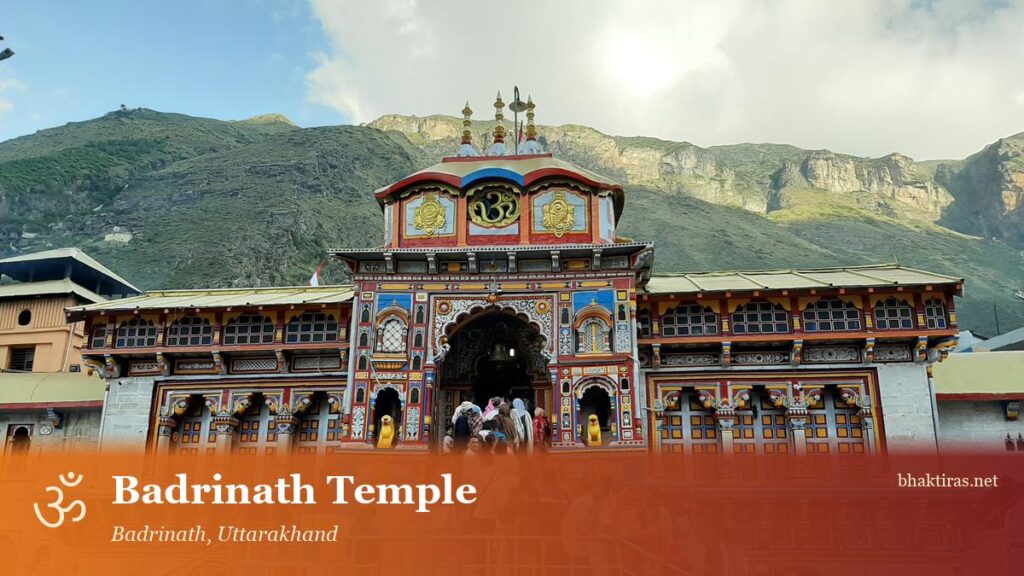
High in the Chamoli Himalaya, between the Nar and Narayan peaks on the bank of the Alaknanda, the Badrinath Temple is among the holiest shrines of Vishnu and a jewel of the Char Dham. The lord sits here as Badrinarayan, a black saligram image in deep meditation, his brightly painted gateway glowing against the snows. Open only through the warm months, it draws pilgrims from every corner of India.
The meditating lord of the snows
Badrinath enshrines Vishnu in a rare meditative form, carved in black saligram stone and seated in penance. The name comes from the badri, the wild berry: tradition tells that when Vishnu sat in long austerity here, the goddess Lakshmi took the form of a berry tree to shade him from the Himalayan sun, and so he became Badri-nath, the lord of the berry forest.
Adi Shankaracharya and the saligram image
The shrine is bound to Adi Shankaracharya, who in the 8th century is said to have recovered the saligram image of Badrinarayan from the Alaknanda and enshrined it, founding the seat as one of his four cardinal dhams. By a custom that endures, the head priest — the Rawal — is drawn from the Nambudiri Brahmins of Kerala, a living thread between the far south and this northern height.
Tapt Kund and the Himalayan season
Just below the temple steams the Tapt Kund, a hot sulphur spring where pilgrims bathe before darshan, a startling warmth amid the cold. The shrine opens around Akshaya Tritiya in spring and closes soon after Diwali, when heavy snow seals the valley and the worship of the lord moves down to Joshimath for the winter.
How to reach Badrinath
- By road: Badrinath is reached by mountain road from Rishikesh via Devprayag, Rudraprayag and Joshimath, about 300 km from Rishikesh.
- By train: Rishikesh and Haridwar are the nearest railheads.
- By air: Dehradun (Jolly Grant) is the nearest airport; helicopter services also run in season.
Frequently Asked Questions
Who is the deity at Badrinath?
Badrinath enshrines Vishnu as Badrinarayan, worshipped in a rare meditative form as a black saligram image seated in penance, between the Nar and Narayan peaks.
Why is it called Badrinath?
The name comes from the badri (wild berry). Tradition holds that when Vishnu sat in long austerity, Lakshmi took the form of a berry tree to shade him, so he became Badri-nath, lord of the berry forest.
What is the connection with Adi Shankaracharya?
Adi Shankaracharya is said to have recovered the saligram image from the Alaknanda in the 8th century and enshrined it, founding Badrinath as one of his four cardinal dhams.
When is Badrinath open?
The temple opens around Akshaya Tritiya in spring and closes soon after Diwali; in winter heavy snow seals the valley and worship moves to Joshimath.
What is the Tapt Kund?
The Tapt Kund is a hot sulphur spring just below the temple where pilgrims bathe before darshan, a natural warm pool amid the Himalayan cold.
How do I reach Badrinath?
It is reached by mountain road from Rishikesh via Joshimath (about 300 km). Rishikesh and Haridwar are the nearest railheads, and Dehradun is the nearest airport.
॥ जय बद्री विशाल ॥ • Bhaktiras.net Temple Guide
| Deity | Vishnu as Badrinarayan (meditating saligram image) |
| Significance | Char Dham and Chota Char Dham shrine |
| Enshrined by | Adi Shankaracharya, 8th c |
| River | Alaknanda |
| Special | Tapt Kund hot spring; Rawal priest from Kerala |
| Season | Akshaya Tritiya to after Diwali |
Related Temples
Explore more sacred temples connected by deity and region.
 VishnuBharat Mandir, Rishikesh📍 Uttarakhand
 VishnuAdinatha Temple, Alwarthirunagari📍 Tamil NaduॐVishnuAkshayavat, Prayagraj📍 Uttar PradeshॐVishnuAnantha Padmanabha Swamy Temple, Adyar📍 Tamil Nadu
 VishnuAnanthasayana Vishnu Temple, Bhubaneswar📍 Odisha
 VishnuBirla Mandir (Laxmi Narayan Temple), Jaipur📍 Rajasthan