ॐ
Gavi Gangadhareshwara Temple
Shiva · Rock-Cut Cave · Bengaluru, Karnataka
॥ ॐ नमः शिवाय ॥
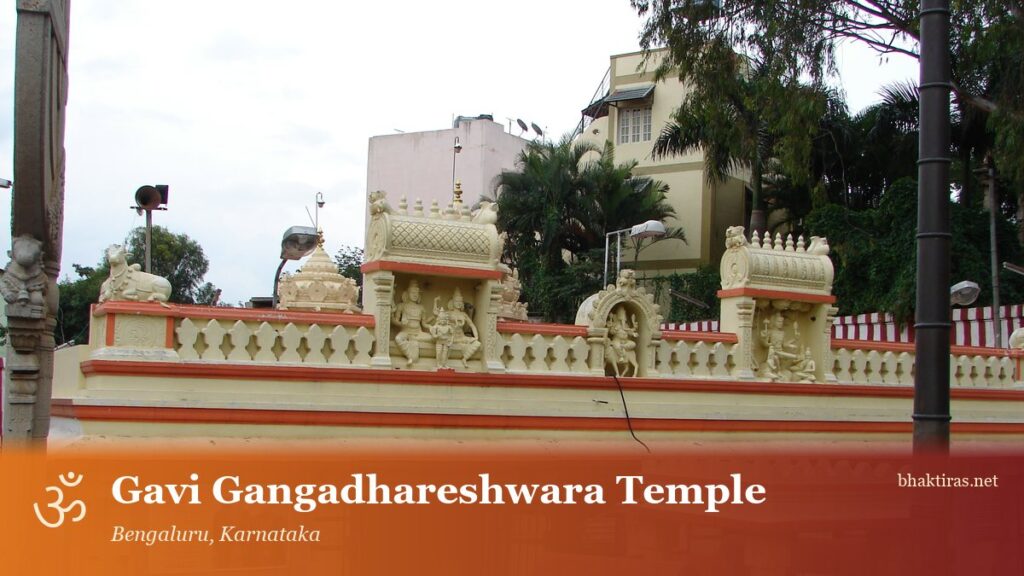
The Gavi Gangadhareshwara Temple in Bengaluru is an old rock-cut cave shrine of Shiva, famed for a yearly solar wonder: on Makar Sankranti each January, the setting sun’s rays pass between the horns of a stone Nandi and through an arch to fall directly on the Shivalinga in the dark sanctum. Carved from a single outcrop, it is one of the oldest and most curious temples in the city.
The sun between the horns
Each year around Makar Sankranti, for a few minutes at dusk, the sun aligns so that its beam enters the cave, passes between the horns of the great monolithic Nandi in the forecourt and through a window, and lights the Shivalinga within. Crowds gather to witness the brief solar darshan, a feat of placement by builders who understood the path of the sun.
A temple cut from the rock
“Gavi” means cave, and the sanctum is hewn into a natural granite outcrop, its inner chambers low and dim. In the forecourt stand strange monolithic discs representing the sun and moon, and tall stone pillars carved as a trishul and a damaru — emblems of Shiva that have puzzled and delighted visitors for centuries.
From the Ganga age to Kempe Gowda
The cave shrine is traced to the early medieval centuries, and it was developed by Kempe Gowda, the 16th-century founder of Bengaluru, who is closely tied to the temple’s history. Set in the Gavipuram area, it remains an active shrine and a window onto the city’s deep past beneath its modern surface.
How to reach the temple
- By road/metro: the temple is in Gavipuram, south Bengaluru, near the Gavipuram and National College metro stations.
- By train: Bengaluru City station is a few kilometres away.
- By air: Kempegowda International Airport is about 40 km to the north.
Frequently Asked Questions
What is the solar phenomenon at Gavi Gangadhareshwara?
On Makar Sankranti each January, the setting sun’s rays pass between the horns of the stone Nandi and through an arch to fall directly on the Shivalinga in the cave — a brief solar darshan witnessed by crowds.
Why is it called a cave temple?
“Gavi” means cave; the sanctum is cut into a natural granite outcrop, with low, dim inner chambers, making it a true rock-cut shrine.
What are the stone discs and pillars in the forecourt?
The forecourt holds monolithic discs representing the sun and moon, and tall pillars carved as a trishul and a damaru — emblems of Shiva, distinctive to this temple.
Who developed the temple?
The cave shrine dates to the early medieval period and was developed by Kempe Gowda, the 16th-century founder of Bengaluru.
How do I reach Gavi Gangadhareshwara?
It is in Gavipuram, south Bengaluru, near the Gavipuram and National College metro stations, a few kilometres from Bengaluru City railway station.
When should I visit for the sun phenomenon?
The solar alignment occurs around Makar Sankranti (mid-January); arrive before sunset, as the effect lasts only a few minutes.
॥ हर हर महादेव ॥ • Bhaktiras.net Temple Guide
| Deity | Shiva (Gangadhareshwara) |
| Special | Makar Sankranti sun lights the lingam through a Nandi’s horns |
| Architecture | Rock-cut cave (Gavi) |
| Developed by | Kempe Gowda, 16th c |
| Forecourt | Monolithic sun, moon, trishul and damaru |
| Main Festival | Makar Sankranti |
Related Temples
Explore more sacred temples connected by deity and region.