ॐ
Kesava Temple, Somnathpur
Vishnu • Somnathpur, Mysuru, Karnataka
॥ ॐ नमो भगवते वासुदेवाय ॥
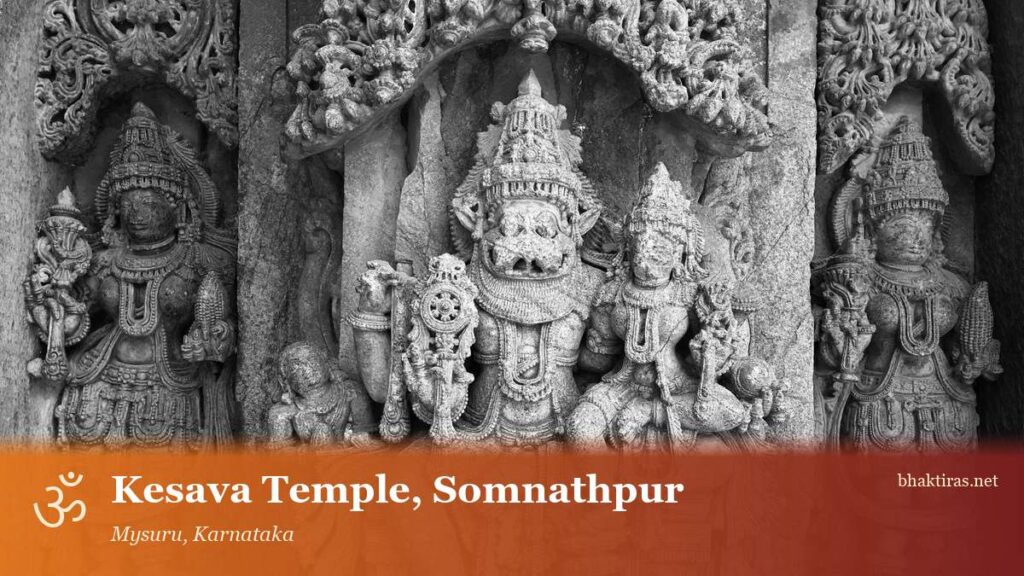
The Kesava Temple at Somnathpur, finished in 1268, is the last of the great Hoysala temples and one of the most complete. Built on a three-shrine plan for three forms of Vishnu, it was inscribed by UNESCO in 2023 as part of the Sacred Ensembles of the Hoysalas.
A complete Hoysala temple
Where Belur and Halebidu were left unfinished, Somnathpur was carried through to completion, which makes it the best place to see a Hoysala design exactly as intended. An inscription on site records that it was consecrated in 1268 under King Narasimha III and endowed by his general Somanatha, after whom the village is named.
The temple sits inside a walled courtyard ringed by a cloister of small cells, so the visitor approaches the carved sanctuary across an open quadrangle rather than from a crowded street.
The trikuta plan
The building follows a trikuta, or three-shrine, layout: three sanctums open off a shared pillared hall, each once holding a different form of Vishnu — Keshava, Janardana and Venugopala. The central Keshava image is lost, but the Janardana and Venugopala figures survive in their niches.
Each sanctum is crowned by its own stepped, star-shaped tower, so the roofline reads as three linked spires rising from a single platform.
Surface carving
As at the sister temples, the outer walls run with continuous bands of relief — elephants, horsemen, mythical beasts and epic scenes — but here the work is unusually crisp because the temple was finished and then protected early. Lathe-turned pillars inside the hall and deeply cut ceiling medallions show the same precision.
Niche figures of Vishnu in his various aspects, framed by foliate arches, line the upper wall and reward a slow, clockwise walk around the building.
A protected monument
Worship no longer takes place at Somnathpur; the temple is a non-living monument cared for by the Archaeological Survey of India, with the sanctum images displaced or empty. That status is partly why so much detail has survived intact.
It lies about 35 km east of Mysuru and is an easy half-day trip from the city, often combined with Talakad and the river site nearby.
Frequently Asked Questions
When was the Kesava Temple at Somnathpur built?
The Kesava Temple was consecrated in 1268 under the Hoysala king Narasimha III. It was commissioned by his general Somanatha, who also founded the village of Somnathpur. It is the latest of the major Hoysala temples.
What does trikuta mean here?
Trikuta means a three-shrine plan: three sanctums open off one shared hall, each originally housing a different form of Vishnu — Keshava, Janardana and Venugopala. Each sanctum has its own star-shaped tower. This layout makes Somnathpur a triple temple under a single roofline.
Is worship still performed at Somnathpur?
No. Somnathpur is a protected, non-living monument under the Archaeological Survey of India, and regular worship is not performed there. The central Keshava image is lost, though two of the three Vishnu figures survive. Visitors come to view the architecture and sculpture.
Why is Somnathpur considered so well preserved?
Because it was completed and then protected relatively early, much of its fine carving survives crisp and intact. Unlike Belur and Halebidu, which were left unfinished, Somnathpur shows a Hoysala design fully realised. This makes it valuable for understanding the style.
Is the Kesava Temple a UNESCO World Heritage Site?
Yes. In 2023 Somnathpur was inscribed as part of the Sacred Ensembles of the Hoysalas, together with Belur and Halebidu. The Kesava Temple is the Somnathpur component of that listing.
How do I reach Somnathpur from Mysuru?
Somnathpur lies about 35 km east of Mysuru and is reachable by road in roughly an hour. It is commonly visited as a half-day trip, sometimes combined with nearby Talakad. Mysuru is the closest city for rail and air connections.
॥ जय श्रीमन्नारायण ॥ • Bhaktiras.net Temple Guide
| Primary Deity | Vishnu |
| Completed | 1268 CE |
| Dynasty | Hoysala |
| Patron | General Somanatha |
| Plan | Trikuta (three shrines) |
| Material | Soapstone |
| UNESCO | Inscribed 2023 |
| Location | Somnathpur, Mysuru, Karnataka |
Related Temples
Explore more sacred temples connected by deity and region.