ॐ
Teli Ka Mandir, Gwalior Fort
Lord Vishnu • Gwalior Fort, Madhya Pradesh
॥ ॐ नमो नारायणाय ॥
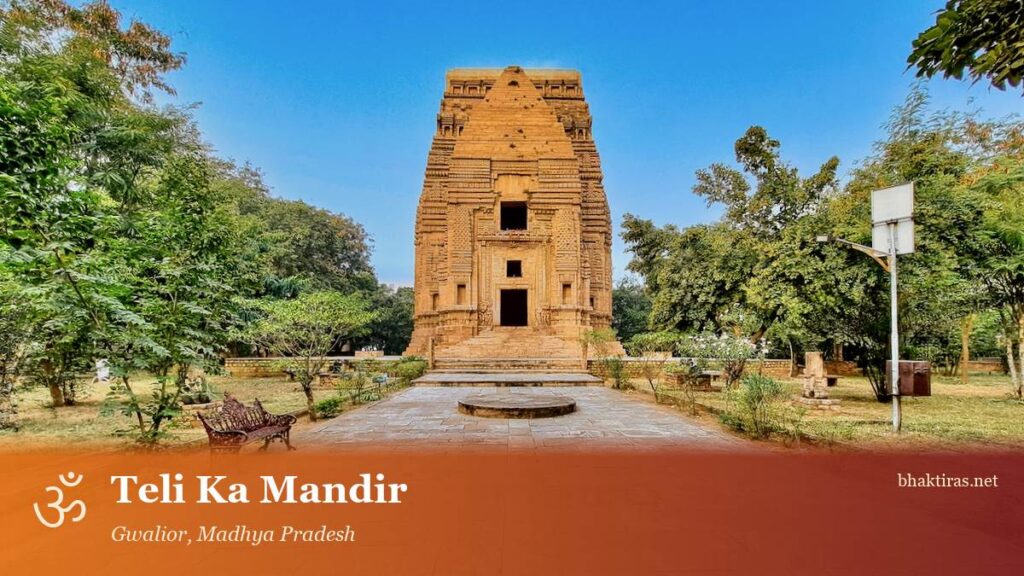
Rising about thirty metres inside Gwalior Fort, Teli Ka Mandir is the tallest structure on the hill and one of its oldest. Built between the eighth and ninth centuries under the Gurjara-Pratiharas, it fuses a South Indian barrel-vaulted roof with a North Indian temple body, a pairing rarely seen elsewhere. A great Garuda over the doorway marks its dedication to Vishnu.
An Unusual Architectural Hybrid
What sets Teli Ka Mandir apart is its mixed design. The body follows the North Indian Nagara idiom, yet the roof is a long barrel vault in the Dravidian gajaprishtha or ‘elephant-back’ shape more typical of the south, producing a silhouette unlike other temples in the fort.
The rectangular sanctum and tall, tapering form give the shrine an austere monumentality. Carved doorframes and surviving sculpture show the skill of Pratihara-era craftsmen working at the height of their tradition.
Dating and Dedication
Most scholars place the temple in the eighth to ninth centuries CE, during Gurjara-Pratihara rule, which would make it among the earliest major monuments inside Gwalior Fort. Its precise patron is not recorded.
A large image of Garuda, the eagle-mount of Vishnu, crowns the entrance and points to a Vaishnava dedication, though some have linked the shrine to Shiva. The Garuda emblem is the strongest surviving clue to its original worship.
The Nineteenth-Century Restoration
By the colonial period the temple had suffered considerable decay. Between 1881 and 1883 it was restored under Major Keith, an effort that stabilised the towering structure and preserved its distinctive roofline for later generations.
The popular name ‘Teli Ka Mandir’, often read as the ‘oilman’s temple’, has several folk explanations and no settled origin. The label has stuck regardless of its uncertain meaning.
Visiting Within Gwalior Fort
The temple sits within the walls of Gwalior Fort, the great hilltop citadel that also holds the Sas-Bahu temples, the Man Mandir palace and rock-cut Jain figures. It is easily combined with a wider tour of the fort.
Reached by road up to the fort plateau, the site is open to visitors during fort hours. Its height and bare stone make it a striking stop, best appreciated alongside the other monuments crowded onto the ridge.
- Tallest structure in Gwalior Fort (~30 m)
- Combine with Sas-Bahu temples and Man Mandir palace
- Access via the fort road on the Gwalior hill
Frequently Asked Questions
Which deity is Teli Ka Mandir dedicated to?
Teli Ka Mandir is dedicated to Lord Vishnu, indicated by the large Garuda image crowning its doorway. Garuda is the eagle-mount of Vishnu, marking the shrine as Vaishnava. Some traditions have also linked it to Shiva, but the Garuda emblem points to Vishnu.
How old is Teli Ka Mandir?
Teli Ka Mandir was built in the eighth to ninth centuries CE under the Gurjara-Pratihara dynasty. This makes it one of the oldest major structures inside Gwalior Fort. Its exact patron and date are not recorded.
What makes the architecture of Teli Ka Mandir unusual?
The temple combines a North Indian Nagara body with a South Indian barrel-vaulted roof in the Dravidian gajaprishtha shape. This blend of northern and southern styles is rarely seen elsewhere. The result is a tall, distinctive silhouette unlike the fort’s other temples.
How tall is Teli Ka Mandir?
Teli Ka Mandir rises to about thirty metres, making it the tallest structure inside Gwalior Fort. Its height and bare stone form dominate that part of the citadel. The towering barrel-vaulted roof is its most recognisable feature.
Who restored Teli Ka Mandir?
The temple was restored between 1881 and 1883 under Major Keith during the colonial period. The work stabilised the decayed structure and preserved its unusual roofline. Before this restoration the monument had fallen into serious disrepair.
Where is Teli Ka Mandir located?
Teli Ka Mandir stands within Gwalior Fort in Gwalior, Madhya Pradesh. The fort is a hilltop citadel reached by road, also holding the Sas-Bahu temples and Man Mandir palace. The temple is easily visited as part of a wider fort tour.
॥ जय श्रीमन्नारायण ॥ • Bhaktiras.net Temple Guide
| Primary Deity | Vishnu (Garuda over doorway) |
| Built | 8th–9th century CE, Gurjara-Pratiharas |
| Height | about 30 m (tallest in fort) |
| Architecture | Nagara body, Dravidian barrel-vault roof |
| Sanctum | Rectangular |
| Restored | 1881–83 under Major Keith |
| Location | Gwalior Fort |
| State | Madhya Pradesh |
Related Temples
Explore more sacred temples connected by deity and region.