
ॐ
Shahji Temple, Vrindavan
Krishna (Chhote Radha Raman) · Vrindavan · Uttar Pradesh
॥ ॐ नमो भगवते वासुदेवाय ॥
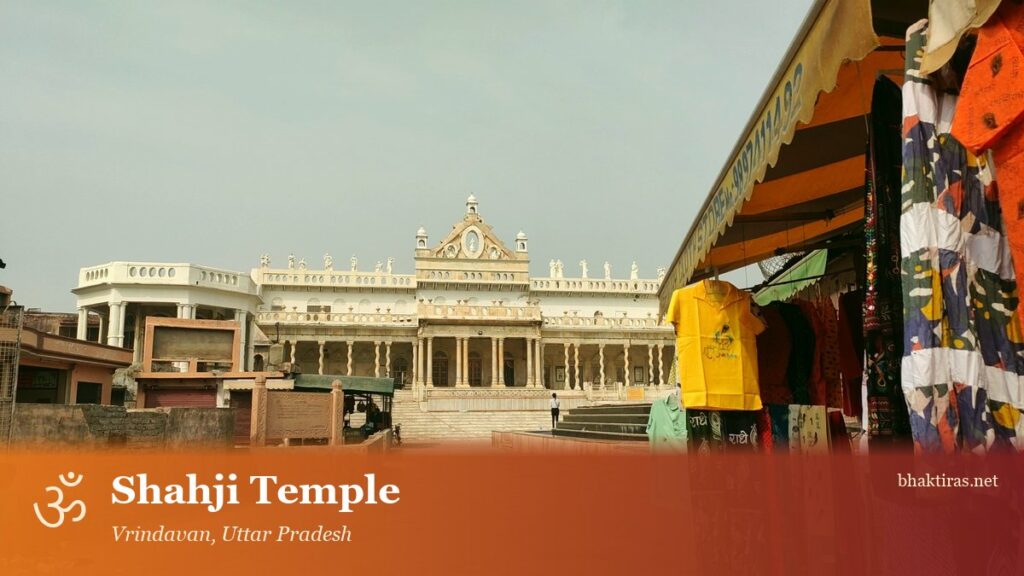
Among the many shrines of Vrindavan, the Shahji Temple is admired for the sheer refinement of its marble craft. Built in 1876 by Shah Kundan Lal of Lucknow, it is famed for twelve spiral ‘Tedhe Khambe’ — helical columns — and the Basanti Kamra, a hall glowing with imported coloured glass. The presiding deity is Chhote Radha Raman, worshipped with the loving devotion that flavours all of Krishna’s town.
A Marble Jewel of Vrindavan
The Shahji Temple was raised in 1876 by Shah Kundan Lal, a wealthy devotee from Lucknow, and reflects the elegant tastes of that city in its white marble and decorative finesse. It stands apart from the older devotional shrines of Vrindavan for its ornamental ambition.
The temple is dedicated to Krishna in the form of Chhote Radha Raman, with Radha and Krishna worshipped together in the intimate, affectionate spirit central to Vrindavan’s tradition of bhakti.
The Tedhe Khambe and the Basanti Kamra
The temple’s signature feature is its set of twelve spiral columns — the Tedhe Khambe, or ‘curved pillars’ — each carved in a twisting helical form from marble, around four metres tall, that lends the hall a flowing, almost musical rhythm.
Equally celebrated is the Basanti Kamra, a chamber whose walls are set with coloured glass imported from abroad, casting tinted light across the marble. The room takes its name from the spring festival of Basant, when it is at the centre of celebration.
Worship of Chhote Radha Raman
Daily worship at the Shahji Temple follows the warm devotional rhythms of Vrindavan, with darshan, aarti and seasonal observances offered to Chhote Radha Raman. The deity is dressed and served as a beloved presence, in keeping with the town’s tender approach to Krishna.
The temple is a favourite stop on the Vrindavan pilgrimage circuit, valued both for its devotion and for the beauty of its setting — a place where art and faith are closely joined.
How to reach Shahji Temple, Vrindavan
- By road: Vrindavan lies about 15 km from Mathura and is well linked by road; from within the town, autos, e-rickshaws and cycle-rickshaws reach the temple lanes.
- By train: Mathura Junction is the main railway station, well connected to Delhi, Agra and beyond, with onward road transfer to Vrindavan.
- By air: The nearest airports are at Agra and Delhi; Delhi’s Indira Gandhi International Airport, about 150 km away, offers the widest connections, followed by road travel.
Frequently Asked Questions
Who built the Shahji Temple in Vrindavan?
It was built in 1876 by Shah Kundan Lal, a wealthy devotee from Lucknow, and is known for its refined marble craftsmanship.
What are the Tedhe Khambe?
They are the temple’s twelve spiral or helical marble columns, its most famous feature, whose twisting form gives the hall a distinctive flowing appearance.
What is the Basanti Kamra?
It is a hall set with imported coloured glass that casts tinted light across the marble. Its name comes from the spring festival of Basant, celebrated here.
Which deity is worshipped at the Shahji Temple?
The presiding deity is Krishna in the form of Chhote Radha Raman, worshipped together with Radha in the devotional spirit of Vrindavan.
Where is the temple located?
It stands in Vrindavan, Uttar Pradesh, the town associated with Krishna’s childhood, about 15 km from Mathura.
How do I reach Vrindavan?
Mathura Junction, about 15 km away, is the nearest major railway station. Delhi and Agra are the closest airports, with good road links to Vrindavan.
॥ राधे राधे ॥ • Bhaktiras.net Temple Guide
| Primary Deity | Krishna (Chhote Radha Raman) |
| Location | Vrindavan, Uttar Pradesh |
| Built | 1876 by Shah Kundan Lal of Lucknow |
| Known For | Twelve spiral ‘Tedhe Khambe’ marble columns |
| Highlight | Basanti Kamra of imported coloured glass |
| Style | Ornate Lucknow-influenced marble |
Related Temples
Explore more sacred temples connected by deity and region.
 KrishnaBanke Bihari Temple, Vrindavan📍 Uttar PradeshॐKrishnaDwarkadhish Temple, Mathura📍 Uttar PradeshॐKrishnaGita Mandir (Birla Temple), Mathura📍 Uttar PradeshॐKrishnaGokul Nathji Temple, Gokul📍 Uttar Pradesh
 KrishnaISKCON Krishna-Balaram Mandir, Vrindavan📍 Uttar Pradesh
 KrishnaKrishna Janmabhoomi Temple, Mathura📍 Uttar Pradesh