
ॐ
Rani Sati Temple, Jhunjhunu
Rani Sati • Jhunjhunu, Rajasthan
॥ ॐ दादी सती नमः ॥
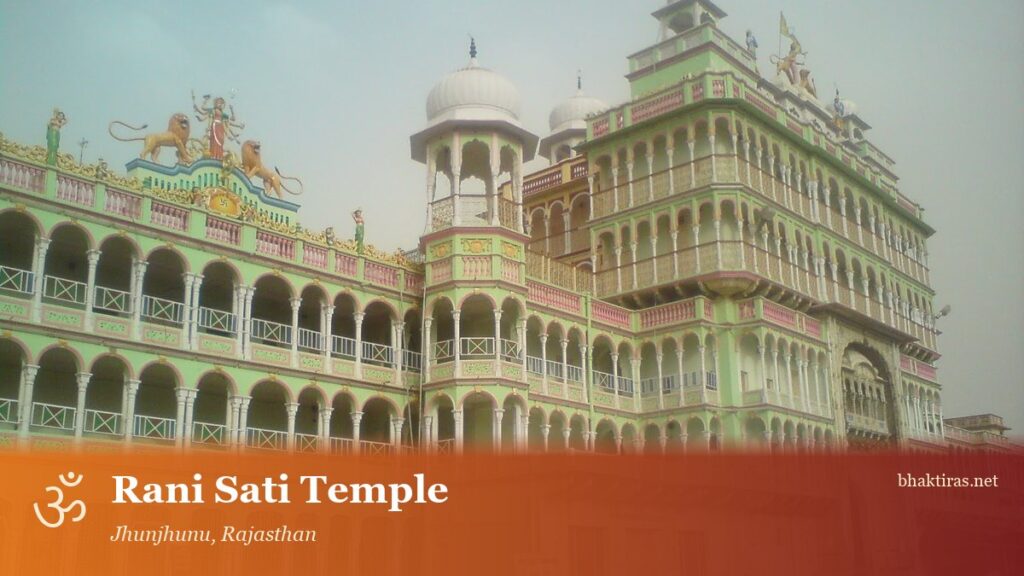
The Rani Sati Temple at Jhunjhunu is one of the largest temples of the Shekhawati region, dedicated to a figure worshipped as Dadiji or Narayani Devi and revered as a symbol of shakti by the Marwari and Agarwal community. Worship here centres on a trishul and the sacred Shri symbol rather than a human-form idol. The temple today honours Narayani Devi as a goddess of strength; it does not endorse the historical practice of sati.
A great temple of Shekhawati
The Rani Sati Temple is among the biggest temples in the Shekhawati region of Rajasthan, set in the town of Jhunjhunu. It is built on a large scale, with courtyards, halls and decorated walls, and serves as a major centre of devotion for the Marwari and Agarwal community spread across India.
For this community the temple is a focus of identity as much as worship, and families with roots in the region return here across the generations. Its size and the steady flow of devotees make it one of the best-known temples of the area.
Worship of Dadiji
The deity is worshipped as Dadiji and as Narayani Devi, and is revered as an embodiment of shakti, the divine feminine power. Devotees approach her as a goddess of strength and protection, and she holds a place of deep affection within the community that venerates her.
What is striking about the worship here is its form: there is no human-shaped idol of the goddess. Instead the focus of devotion is a trishul, the trident, together with the auspicious Shri symbol, before which offerings and prayers are made.
The annual fair and observances
A large fair is held at the temple on Bhadrapad Amavasya, the new-moon day of the month of Bhadrapad, drawing devotees from across the country. The occasion fills the temple with worship, devotional singing and the gathering of the wider community.
On ordinary days too the temple keeps a regular round of aarti and worship. The Bhadrapad observance, however, is the high point of its calendar, when the connection between the temple and its far-flung community is most visible.
- Main fair on Bhadrapad Amavasya (new moon)
- Worship centred on a trishul and the Shri symbol
- A focal point for the Marwari and Agarwal community
How the temple is understood today
It is important to be clear about what the temple venerates. Today it honours Narayani Devi as a goddess of strength and shakti, and the worship is directed to her in that form. The temple does not endorse or promote the practice of sati, which is prohibited by law in India.
Visitors are welcomed to the temple as a place of devotion and community gathering. Approached in that spirit — as a shrine to a goddess of strength revered by a large community — it offers a window into the religious life of Shekhawati.
Frequently Asked Questions
What is the Rani Sati Temple at Jhunjhunu?
It is one of the largest temples of the Shekhawati region of Rajasthan, in the town of Jhunjhunu, dedicated to a figure worshipped as Dadiji or Narayani Devi. She is revered as a symbol of shakti, the divine feminine power, by the Marwari and Agarwal community. Worship centres on a trishul and the Shri symbol rather than a human-form idol.
Who is worshipped at the Rani Sati Temple?
The deity is worshipped as Dadiji and as Narayani Devi, and is revered as a goddess of strength and shakti. She is especially venerated by the Marwari and Agarwal community across India. There is no human-shaped idol; the focus of worship is a trishul and the auspicious Shri symbol.
Does the temple endorse the practice of sati?
No. The temple today honours Narayani Devi as a goddess of strength and shakti, and the worship is directed to her in that form. It does not endorse or promote the practice of sati, which is prohibited by law in India. Visitors come to it as a place of devotion and community gathering.
Why is there no idol of the deity?
At the Rani Sati Temple the goddess is not represented by a human-form idol. Instead, devotion is focused on a trishul, the trident, together with the sacred Shri symbol. Offerings and prayers are made before these emblems of shakti.
When is the main fair at the Rani Sati Temple?
The temple’s main fair is held on Bhadrapad Amavasya, the new-moon day of the month of Bhadrapad. It draws devotees from across the country for worship and devotional singing. It is the high point of the temple’s yearly calendar.
Who reveres the Rani Sati Temple most?
The temple is especially revered by the Marwari and Agarwal community, for whom it is a focus of devotion and identity. Families with roots in the Shekhawati region return across the generations. The deity, Narayani Devi, is honoured by them as a goddess of strength.
॥ जय दादी जी ॥ • Bhaktiras.net Temple Guide
| Primary Deity | Narayani Devi (Dadiji) |
| Location | Jhunjhunu |
| State | Rajasthan |
| Region | Shekhawati |
| Revered by | Marwari and Agarwal community |
| Object of worship | Trishul and Shri symbol |
| Main fair | Bhadrapad Amavasya |
| Note | Honours a goddess of strength; does not endorse sati |
Related Temples
Explore more sacred temples connected by deity and region.
 ShivaBaroli (Badoli) Temples, Chittorgarh📍 RajasthanॐShivaBhuteshwar Mahadev, Chambal📍 RajasthanॐShivaBhuteshwar Mahadev, Jodhpur📍 Rajasthan
 VishnuBirla Mandir (Laxmi Narayan Temple), Jaipur📍 Rajasthan
 Brahma KumarisBrahma Kumaris Headquarters, Mount Abu📍 Rajasthan