ॐ
Danteshwari Temple, Dantewada
Danteshwari Devi • Dantewada, Chhattisgarh
॥ ॐ दुं दुर्गायै नमः ॥
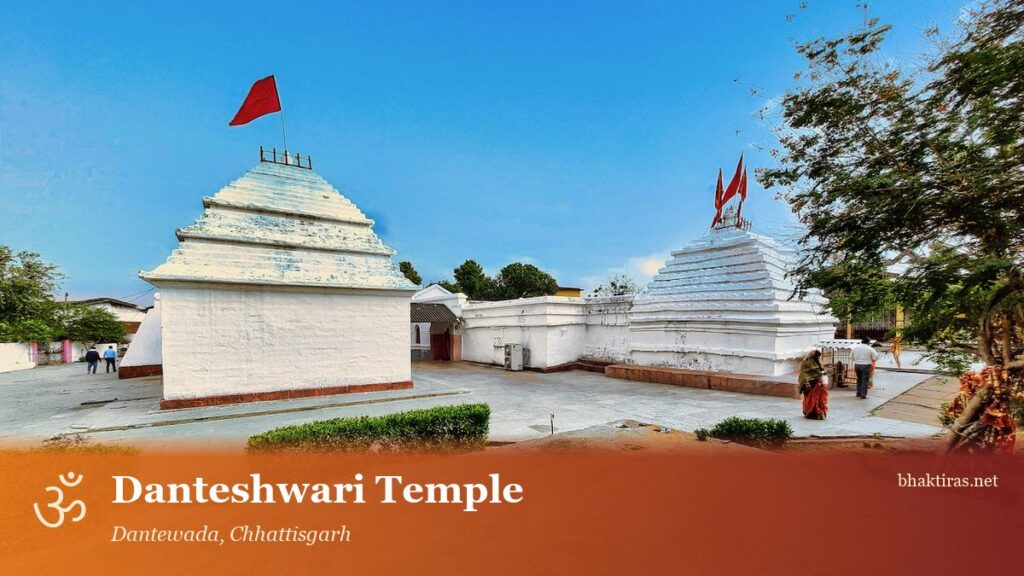
On a tongue of land where the Dankini and Shankini rivers meet, the Danteshwari temple holds the goddess who gave Dantewada its name. She is the kuladevi of the Bastar royal house, and tradition counts her seat among the Shakti Peethas. For the people of Bastar she is less a distant deity than a presiding mother whose calendar shapes the year.
The goddess who named the town
Local tradition links Dantewada to the Sanskrit word danta, the tooth, recalling the legend that a part of Sati fell here when her body was scattered across the land. By that account the place is a Shakti Peetha, and the goddess seated in the sanctum carries the older Peetha story along with her role as the family deity of the Bastar kings.
The presiding image is cut from black stone and shown with six arms, a fierce yet maternal form that devotees address simply as Mai, the mother. Pilgrims approach her with the same directness, bringing the small troubles and large vows of ordinary life rather than any single grand petition.
Where two rivers meet
The temple occupies the confluence of the Dankini and Shankini, and the meeting of waters has long been read as auspicious. Worshippers bathe before darshan, and the river edge frames the approach to the shrine, giving the whole site a quiet, water-bound character.
This setting ties the goddess to the land itself. In a region of forest and river, a deity placed at the sangam is understood to watch over the country around her, and the geography is part of why the seat has held its importance for so long.
Building and lineage
The fabric of the temple is generally placed in the Kakatiya–Chalukyan period, around the fourteenth century, when the ruling line carried the worship of Danteshwari with them as their tutelary goddess. Successive rulers maintained and added to the shrine, binding the dynasty’s fortunes to the deity.
That bond between throne and goddess is the thread running through Bastar’s history. The Danteshwari of Dantewada and the goddess honoured at the old capital of Jagdalpur are treated as the same divine presence, carried between the seats of power.
Bastar Dussehra
The goddess stands at the centre of the long Bastar Dussehra, a festival unlike the ten-day Dussehra observed elsewhere. Here the cycle runs for about seventy-five days and weaves together tribal rituals, the royal house and the worship of Danteshwari into a single extended observance.
Because the festival belongs as much to Bastar’s communities as to the temple, it draws the region together each year. Beyond Dussehra, Navaratri remains the other peak of the calendar, when crowds gather for darshan of the mother of Dantewada.
- Counted among the Shakti Peethas (tradition of the falling tooth)
- Kuladevi of the Bastar royal house
- Black-stone six-armed image of the goddess
Frequently Asked Questions
Where is the Danteshwari temple located?
The Danteshwari temple is at Dantewada in southern Chhattisgarh, in the Bastar region. It sits at the confluence of the Dankini and Shankini rivers, which forms part of the approach to the shrine.
Why is the town called Dantewada?
The name is traditionally linked to danta, the Sanskrit word for tooth. Local legend holds that a part of Sati fell here, marking the spot as a Shakti Peetha, and the goddess took the name Danteshwari from it.
Who is Danteshwari Devi?
Danteshwari is a form of the Mother Goddess and the kuladevi, or family deity, of the Bastar royal house. She is enshrined as a black-stone, six-armed image and revered across the region as a protective mother.
Is Danteshwari temple a Shakti Peetha?
Yes, tradition counts the shrine among the Shakti Peethas, connected to the falling of Sati’s tooth. Pilgrims visit it both as a Peetha and as the seat of the Bastar kuladevi.
What is Bastar Dussehra?
Bastar Dussehra is a distinctive festival lasting roughly seventy-five days, far longer than the usual ten-day Dussehra. It centres on Danteshwari and blends tribal ritual with the customs of the royal house.
When is the best time to visit?
Navaratri and the long Bastar Dussehra season are the most active times, when the temple and town fill with worshippers. The winter months are generally more comfortable for travel in the Bastar region.
॥ जय माता दी ॥ • Bhaktiras.net Temple Guide
| Primary Deity | Danteshwari Devi |
| Tradition | Shakti Peetha (tooth) |
| Role | Kuladevi of Bastar royals |
| Location | Dantewada, Bastar |
| Setting | Dankini–Shankini confluence |
| Image | Black stone, six-armed |
| Built | Around 14th century |
| Main Festival | Bastar Dussehra (~75 days) |
Related Temples
Explore more sacred temples connected by deity and region.