
ॐ
Masroor Rock-Cut Temples, Kangra
Shiva • Masroor, Kangra, Himachal Pradesh
॥ ॐ नमः शिवाय ॥
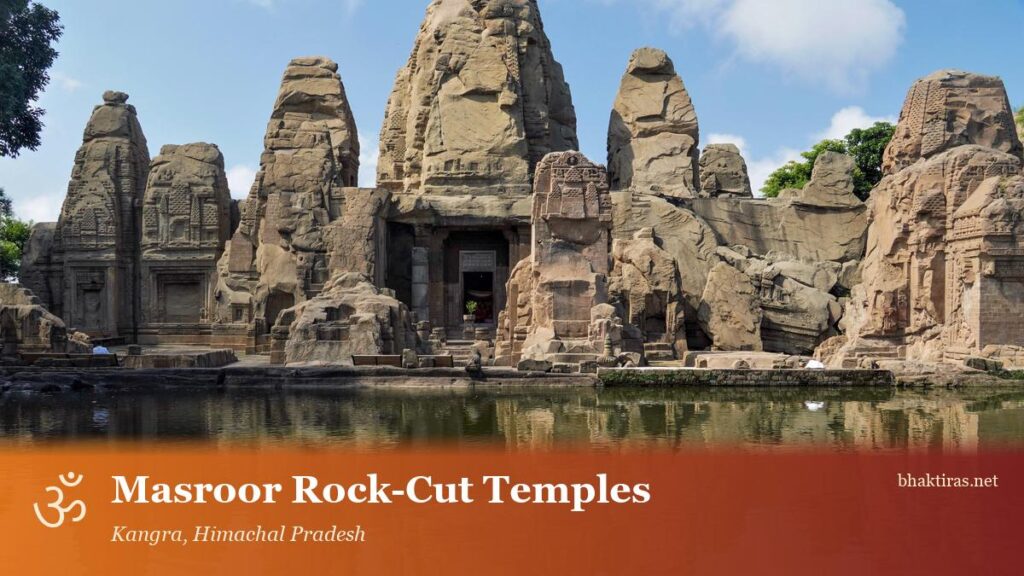
The Masroor temples are an eighth-century complex carved top-down from a single sandstone ridge, so often compared with Ellora that they are called the Himalayan Ellora. Around fifteen shikhara shrines were hewn from the living rock in one ambitious project that was left partly unfinished and later damaged by the 1905 Kangra earthquake. A rock-cut tank lies before them, and the sanctum holds images of Rama, Lakshmana and Sita.
A temple carved from living rock
Masroor is monolithic architecture: instead of being built up from cut blocks, the shrines were carved downward and inward from a single sandstone outcrop in the eighth century. The sculptors worked from the top of the rock to release a cluster of temples already part of the ridge, a method shared with the great rock-cut sites of the Deccan.
This origin is what earns Masroor its nickname, the Himalayan Ellora. Around fifteen shikhara shrines rise from the stone, their towers and niches shaped directly out of the bedrock rather than assembled, making the whole hill a single continuous work of devotion.
An ambitious, unfinished project
The complex was never completed. Sections remain roughed out, and the original scheme of shrines was only partly realised before work stopped, leaving the site a vivid record of how such monolithic temples were quarried into being.
Later, the Kangra earthquake of 1905 damaged the structures, adding fractures to the unfinished forms. A rock-cut reflecting tank lies in front of the temples, and on still days the carved towers mirror in its water, with the Dhauladhar range rising behind.
- Eighth-century monolithic temples carved from one sandstone ridge
- Around fifteen shikhara shrines, the project left partly unfinished
- Damaged by the 1905 Kangra earthquake; ASI-protected
Deities and shared traditions
The main sanctum holds images of Rama, Lakshmana and Sita, giving the site a strong Vaishnava presence. Yet the carvings across the complex bring Shaiva and Vaishnava elements together, so Masroor reflects more than one devotional stream within a single rock-cut whole.
This blending is part of what makes the temples historically rich. Rather than belonging to one sect alone, Masroor preserves a moment when Shaiva and Vaishnava imagery shared the same sacred hill, carved side by side from the same stone.
Setting and visiting
Masroor lies in Kangra district, with open views toward the snow-capped Dhauladhar range that frame the carved towers. The combination of monolithic temples, reflecting tank and mountain backdrop makes the site as striking for its landscape as for its sculpture.
The complex is protected by the Archaeological Survey of India and reached by road from the Kangra valley. Visitors should allow time to walk among the shrines, take in the unfinished sections, and view the temples from across the water tank for the classic reflection.
Frequently Asked Questions
What are the Masroor rock-cut temples?
The Masroor temples are an eighth-century complex of monolithic shrines carved top-down from a single sandstone ridge in Kangra. Around fifteen shikhara shrines were hewn directly from the living rock.
Why are they called the Himalayan Ellora?
Masroor is called the Himalayan Ellora because, like the rock-cut temples of Ellora, the shrines were carved from living rock rather than built from blocks. The comparison reflects the scale and ambition of the monolithic project.
Were the Masroor temples ever finished?
No, the complex was left partly unfinished, with sections still roughed out. It was later damaged by the 1905 Kangra earthquake, which added fractures to the unfinished forms.
Which deities are enshrined at Masroor?
The main sanctum holds images of Rama, Lakshmana and Sita, giving a strong Vaishnava presence. The wider complex combines Shaiva and Vaishnava elements carved together from the same rock.
Where are the Masroor temples located?
The Masroor temples are in Masroor, Kangra district, Himachal Pradesh, with views toward the Dhauladhar range. They are reached by road from the Kangra valley.
Is there an entry fee or protection status?
The Masroor temples are protected by the Archaeological Survey of India. A rock-cut reflecting tank lies in front of the shrines, offering the site’s well-known mirrored view.
॥ हर हर महादेव ॥ • Bhaktiras.net Temple Guide
| Deity | Rama, Lakshmana, Sita (Shaiva-Vaishnava) |
| Period | 8th century CE |
| Type | Monolithic rock-cut temples |
| Shrines | Around fifteen shikhara shrines |
| Nickname | Himalayan Ellora |
| Damage | 1905 Kangra earthquake |
| Feature | Rock-cut reflecting tank |
| District | Kangra |
| Protection | ASI-protected |
Related Temples
Explore more sacred temples connected by deity and region.
 ShivaBaijnath Temple, Himachal Pradesh📍 Himachal Pradesh
 ShivaBathu Ki Ladi Temples, Pong Dam📍 Himachal Pradesh
 ShivaBijli Mahadev Temple, Kullu📍 Himachal Pradesh
 ShivaChaurasi Temple, Bharmour (84 Shrines)📍 Himachal Pradesh
 ShivaManimahesh Lake & Kailash Yatra📍 Himachal PradeshॐShivaMarkandeya Temple, Bilaspur (HP)📍 Himachal Pradesh