
ॐ
Chaurasi Temple, Bharmour
84 Shrines of Brahmapura · Bharmour, Himachal Pradesh
॥ ॐ नमः शिवाय ॥
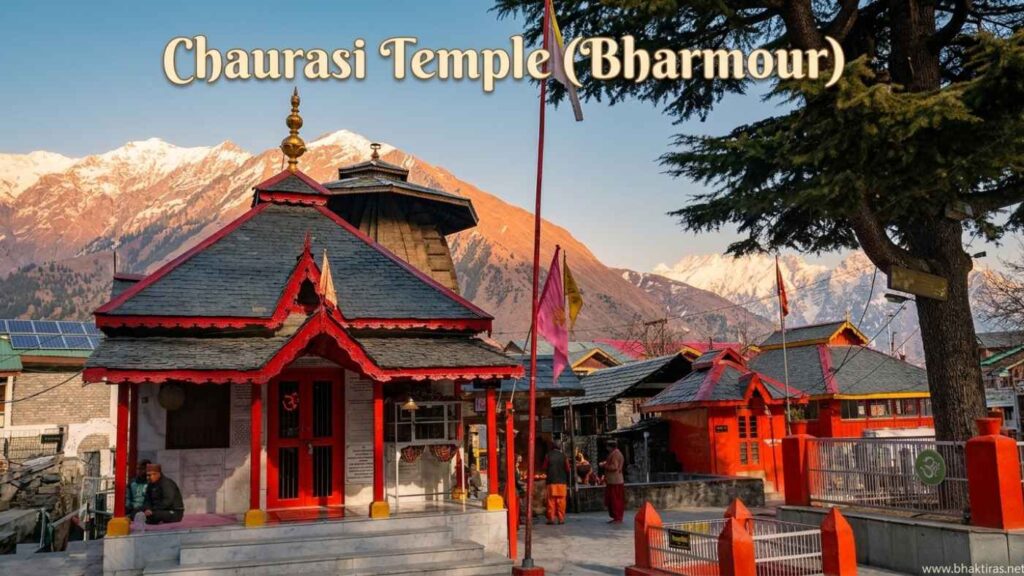
The Chaurasi Temple at Bharmour in Himachal Pradesh is not one shrine but a courtyard holding eighty-four (chaurasi) temples, raised between the 7th and 10th centuries when Bharmour — then called Brahmapura — was the capital of the Chamba kingdom. Its oldest shrines, dedicated to Lakshana Devi and to Shiva as Manimahesh, hold some of the earliest surviving metal and stone images in the western Himalaya.
Why are there 84 temples in one courtyard?
“Chaurasi” is simply the Pahari word for eighty-four, the number of shrines gathered on the open plateau at the centre of Bharmour. Tradition holds that 84 siddhas — accomplished yogis — once halted at Bharmour on their way to Manimahesh Kailash, sat in meditation, and on rising left 84 small temples to mark the spot. The complex grew over centuries around that older core, and the shrines today range from tall stone towers to modest cells.
The ancient Lakshana Devi shrine
The most precious building is the Lakshana Devi temple, raised in the 7th century by Raja Meru Varman. Built in the Himalayan wooden style, it holds a brass image of the goddess cast by the master craftsman Gugga — among the earliest dated metal images in the region. Two more bronzes from Meru Varman’s reign, at the Ganesh and Nara Singh shrines, survive in the same complex, making Bharmour an open-air record of early Chamba art.
The Manimahesh temple and the Gaddi people
At the centre stands the Manimahesh temple, a stone shikhara shrine to Shiva in the north-Indian Nagara style. For the Gaddi shepherd community, whose homeland is Bharmour, Shiva as Manimahesh is the chief deity, and this temple is the spiritual heart of their world. The Gaddis carry the worship of the snow-peak of Manimahesh Kailash, seen from the high pastures, down into the temple at Bharmour.
Architecture across three centuries
The Chaurasi complex sets two traditions side by side: the carved wooden shrines of the 7th-century Varman kings, with their deeply worked doorframes, and the later stone shikhara temples of the Nagara style. Together they form a compact record of how Himalayan temple-building changed between the 7th and 10th centuries, gathered on a single paved courtyard above 2,100 metres.
The Manimahesh Yatra
Bharmour is the staging point for the Manimahesh Yatra, the annual pilgrimage to the sacred glacial lake of Manimahesh below its Kailash peak. Held around Janmashtami and Radhashtami in August–September, the trek draws thousands who begin with worship at the Chaurasi temples before climbing to the lake. For many pilgrims, the courtyard is where the journey formally begins.
How to reach Bharmour
- By road: Bharmour is about 65 km from Chamba town by mountain road, roughly two-and-a-half to three hours; Chamba links to Pathankot and Dalhousie.
- By rail: Pathankot (about 180 km) is the nearest broad-gauge railhead.
- By air: Kangra (Gaggal) airport near Dharamshala is the closest, with the rest of the journey by road.
Frequently Asked Questions
Why is it called the Chaurasi Temple?
“Chaurasi” means eighty-four in the local language, and the complex at Bharmour holds 84 shrines in one courtyard. Tradition says 84 siddhas (yogis) meditated here on their way to Manimahesh Kailash and left 84 temples behind.
How old is the Chaurasi Temple complex?
Its core shrines date from the 7th to the 10th centuries, when Bharmour — then Brahmapura — was the capital of the Chamba kingdom. The Lakshana Devi temple was built in the 7th century by Raja Meru Varman.
What is the most important shrine at Bharmour?
The central Manimahesh temple, dedicated to Shiva, is the spiritual heart of the complex and of the Gaddi community. The 7th-century Lakshana Devi shrine, with its early brass image, is the most historically precious.
What is the connection to the Manimahesh Yatra?
Bharmour is the starting point of the Manimahesh Yatra to the sacred lake below Manimahesh Kailash, held in August–September. Pilgrims worship at the Chaurasi temples before beginning the high-altitude trek.
Who are the Gaddis associated with Bharmour?
The Gaddis are a shepherd community whose homeland is the Bharmour region. They worship Shiva as Manimahesh, and the Chaurasi temple at Bharmour is central to their religious life.
How do I reach Bharmour?
Bharmour is about 65 km from Chamba town by mountain road, around three hours. The nearest railhead is Pathankot (about 180 km) and the nearest airport is Kangra (Gaggal) near Dharamshala.
॥ हर हर महादेव ॥ • Bhaktiras.net Temple Guide
| Temple Name | Chaurasi Temple (84 Shrines) |
| Primary Deity | Shiva (Manimahesh) & Lakshana Devi |
| Location | Bharmour (Brahmapura), Chamba |
| State | Himachal Pradesh, India |
| Significance | 84 temples in one courtyard |
| Architecture | Nagara shikhara + Himalayan wood |
| Period | 7th–10th century |
| Built by | Varman kings of Chamba |
| Key Festival | Manimahesh Yatra (Aug–Sep) |
| River Nearby | Budhil (Ravi tributary) |
| Altitude | ~2,195 m |
| Entry | Free |
Related Temples
Explore more sacred temples connected by deity and region.
 ShivaBaijnath Temple, Himachal Pradesh📍 Himachal Pradesh
 ShivaBathu Ki Ladi Temples, Pong Dam📍 Himachal Pradesh
 ShivaBijli Mahadev Temple, Kullu📍 Himachal Pradesh
 ShivaManimahesh Lake & Kailash Yatra📍 Himachal PradeshॐShivaMarkandeya Temple, Bilaspur (HP)📍 Himachal Pradesh
 ShivaMasroor Rock-Cut Temples, Kangra📍 Himachal Pradesh