
ॐ
Jwalamukhi Temple
Jwala Ji · Shakti Peetha of Eternal Flames · Kangra, Himachal Pradesh
॥ ॐ ज्वालामुख्यै नमः ॥
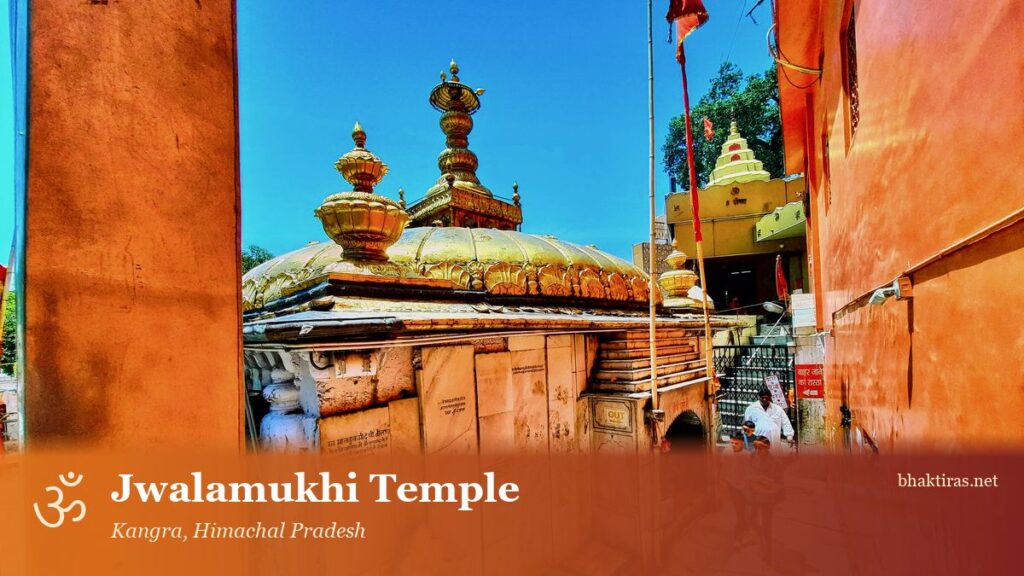
Jwalamukhi, in the Kangra district of Himachal Pradesh, is one of the most striking of the Shakti Peethas: here the Goddess is worshipped not as an image but as natural, ever-burning flames that rise from the rock. Tradition holds that the tongue of Sati fell at this spot, and the eternal blue flames are revered as her living presence.
The temple of eternal flames
Within the sanctum, several natural flames burn continuously from fissures in the rock, each named for a form of the Goddess. There is no idol — the flames themselves are the deity — and they are tended with offerings of water, milk and rabri beneath a gold-plated dome.
A Shakti Peetha of the tongue
Jwalamukhi is counted among the Shakti Peethas as the place where the tongue of Sati fell, with Bhairava worshipped here as Unmatta. The connection of speech and flame gives the shrine its name, “the goddess of the flaming mouth”.
The legend of Akbar
A famous tradition tells of the emperor Akbar trying to extinguish the flames with water and a covering disc, and failing; humbled, he is said to have offered a golden canopy that turned, on the Goddess’s will, into a lesser metal — a sign that her power could not be bought.
History and patrons
The shrine is ancient and has drawn royal devotion for centuries; the gilded dome and gifts are linked to Maharaja Ranjit Singh of the Sikh empire, among others. It remains one of the most revered Devi temples of the Kangra valley.
Festivals
The Navratras of spring (Chaitra) and autumn (Shardiya) are the grandest occasions, when a large fair fills the town and the flames are worshipped around the clock.
Darshan timings
The temple is generally open from early morning to night, around the schedule of aartis, with timings shortened a little in winter. The flames are honoured with continuous offerings through the day.
How to reach Jwalamukhi
- By train: Kangra and Pathankot are the nearest railheads.
- By air: Gaggal (Kangra) airport is about 45 km.
- By road: well connected from Dharamshala, Kangra and Hoshiarpur.
Tips for your visit
- Pair the visit with the Brajeshwari and Chamunda Devi temples of Kangra.
- Navratri is the most crowded — weekdays outside it are calmer.
- Carry a light layer for the hill weather.
- Photography is restricted inside the sanctum.
Frequently Asked Questions
What is worshipped at Jwalamukhi?
Natural eternal flames rising from the rock, each named for a form of the Goddess; there is no idol — the flames are the deity.
Why is Jwalamukhi a Shakti Peetha?
It is counted among the Shakti Peethas as the place where the tongue of Sati fell; Bhairava here is Unmatta.
What is the legend of Akbar at Jwalamukhi?
Akbar is said to have tried to douse the flames and failed, then offered a golden canopy that turned into a baser metal, showing the Goddess’s power could not be bought.
What are the temple timings?
Generally early morning to night around the aarti schedule, slightly shorter in winter; busiest during the Navratras.
How do I reach Jwalamukhi?
Kangra and Pathankot are the nearest railheads; Gaggal (Kangra) airport is about 45 km; it is well connected by road from Dharamshala and Kangra.
Which other temples are nearby?
The Brajeshwari Devi and Chamunda Devi temples of the Kangra valley are commonly visited along with Jwalamukhi.
॥ जय माता दी ॥ • Bhaktiras.net Temple Guide
| Temple Name | Jwalamukhi Temple |
| Primary Deity | Jwalamukhi Devi (Jwala Ji) |
| Location | Jwalamukhi |
| District | Kangra |
| State | Himachal Pradesh |
| Significance | Shakti Peetha (tongue) |
| Architecture Style | Shikhara (gold dome) |
| Approximate Period | Ancient |
| Key Festival | Navratri (Chaitra & Ashwin) |
| River / Body Nearby | Kangra valley hills |
| Special Features | Nine natural eternal flames |
| Darshan | 5:00 AM – 9:00 PM |
| Nearest Railhead | Kangra / Pathankot |
| Coordinates | 31.8758° N, 76.3206° E |
| Entry | Free |
Related Temples
Explore more sacred temples connected by deity and region.
 ShivaBaijnath Temple, Himachal Pradesh📍 Himachal Pradesh
 ShivaBathu Ki Ladi Temples, Pong Dam📍 Himachal Pradesh
 BhimakaliBhimakali Temple, Sarahan📍 Himachal Pradesh
 ShivaBijli Mahadev Temple, Kullu📍 Himachal Pradesh
 DurgaBrajeshwari Devi Temple, Kangra📍 Himachal Pradesh